
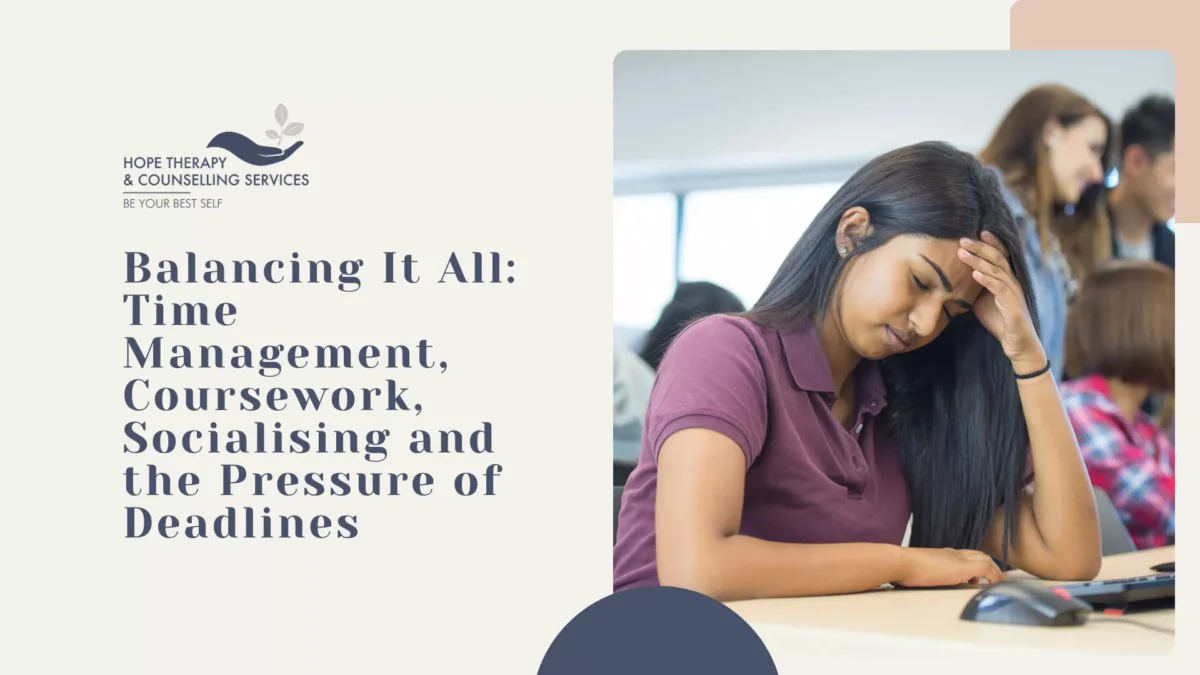
For many students, the challenge isn’t just academic ability. It’s everything that sits around it.
Time management. Coursework load. Social expectations. Assessments. Deadlines that seem to cluster together at the worst possible moment.
On paper, these are practical issues. But in reality, they are deeply emotional experiences.
Because when things start to feel unmanageable, it’s rarely just about time. It’s about pressure, expectation, comparison, and the quiet fear of falling behind.

When Everything Feels Like a Priority
One of the most common difficulties students face is that everything can feel equally urgent.
A deadline is approaching.
Messages are coming in.
There’s a social event you don’t want to miss.
Another assignment has just been set.
There’s no clear place to start, so the mind tries to hold everything at once.
This often leads to a cycle:
- Feeling overwhelmed
- Avoiding starting
- Increased anxiety
- Last-minute pressure
- Self-criticism afterwards
From the outside, it can look like procrastination.
From the inside, it often feels like paralysis.
Time Management Isn’t Just About Organisation
There’s a common assumption that better time management simply means being more disciplined or more structured.
But for many people, the difficulty isn’t knowing what to do — it’s managing how they feel while doing it.
Sitting down to start coursework can bring up:
- Anxiety about not doing it well enough
- Fear of not understanding the material
- Pressure to meet expectations
- Mental exhaustion
So the issue becomes emotional regulation, not just scheduling.
This is why rigid timetables often don’t work long-term. If the emotional side isn’t acknowledged, the plan can quickly fall apart — which then reinforces the belief of “I just can’t manage my time.”
The Weight of Coursework and Deadlines
Coursework doesn’t exist in isolation. It builds.
Multiple modules.
Overlapping deadlines.
Different expectations from different lecturers.
And often, very little space in between.
This accumulation can create a constant sense of being “behind,” even when you’re actually keeping up.
Deadlines, in particular, can trigger a strong stress response. Not just because of the work itself, but because of what they represent:
- Performance
- Evaluation
- Fear of failure
- Future consequences
When this pressure builds, it can affect sleep, concentration, motivation, and mood.
Socialising: Support or Pressure?
Social life is often seen as the “break” from academic stress. And it can be.
Connection, laughter, and shared experiences are important. They help regulate stress and create a sense of belonging.
But socialising can also become another source of pressure.
The feeling that you should go out.
The fear of missing out.
Trying to maintain friendships while feeling overwhelmed.
This can create an internal conflict:
“Do I rest? Do I work? Do I go out?”
There isn’t always a clear answer. And whichever choice you make can come with guilt.
Why It Can Start to Feel Like Too Much
When you combine academic pressure, time demands, and social expectations, it creates a constant level of cognitive and emotional load.
There’s very little true “off” time.
Even when you’re resting, you might be thinking about what needs to be done.
Even when you’re socialising, part of your mind may still be on deadlines.
Over time, this can lead to:
- Burnout
- Anxiety
- Low mood
- Reduced motivation
- Feeling disconnected or overwhelmed
And often, people respond by being harder on themselves.
“I should be coping better.”
“Everyone else seems fine.”
But those thoughts usually increase pressure rather than relieve it.
A Different Way of Approaching It
Rather than trying to control everything perfectly, it can be more helpful to shift how you relate to the workload itself.
1. Breaking Things Down (Genuinely)
Not just “start assignment” — but:
- Open the document
- Write one paragraph
- Spend 20 minutes reading
Reducing the entry point lowers the emotional barrier to starting.
2. Working With Your Energy, Not Against It
You don’t need to be productive all day.
Some periods will be more focused than others. Identifying when you have more mental energy — even if it’s just small windows — can be more effective than forcing long sessions.
3. Making Space for Imperfection
Perfectionism often slows things down.
Allowing work to be “good enough” initially creates momentum. You can refine later — but starting matters more.
4. Reframing Rest
Rest isn’t avoidance. It’s part of functioning.
Without it, concentration and motivation naturally drop. Taking breaks intentionally can actually support productivity rather than reduce it.
5. Being Realistic About Capacity
There are limits to what anyone can hold at once.
Recognising those limits — without judgement — can reduce the pressure to do everything at full capacity all the time.
When It’s More Than Just Stress
Sometimes, what starts as workload pressure can develop into something more persistent.
Ongoing anxiety.
Difficulty concentrating.
Sleep disruption.
A constant sense of dread around work.
When this happens, it’s not just about “managing time better.” It’s about having space to explore what’s going on underneath that pressure.
How Counselling Can Help
Counselling offers a space to step out of the constant cycle of doing and into understanding.
Not just:
“What do I need to get done?”
But:
“What’s making this feel so difficult right now?”
It can help you:
- Understand your relationship with pressure and expectations
- Explore patterns like avoidance or perfectionism
- Develop more sustainable ways of managing workload
- Reduce anxiety around assessments and deadlines
And importantly, it provides a space where you don’t have to hold everything on your own.
A Final Thought
Balancing coursework, time, social life, and deadlines isn’t just a practical challenge — it’s an emotional one.
If you’re finding it difficult, it doesn’t mean you’re failing.
It often means you’re carrying a lot.
And support — whether through small changes, conversations, or counselling — can make that feel more manageable: https://www.hopefulminds.co.uk/free-consultation-with-hope-therapy/