
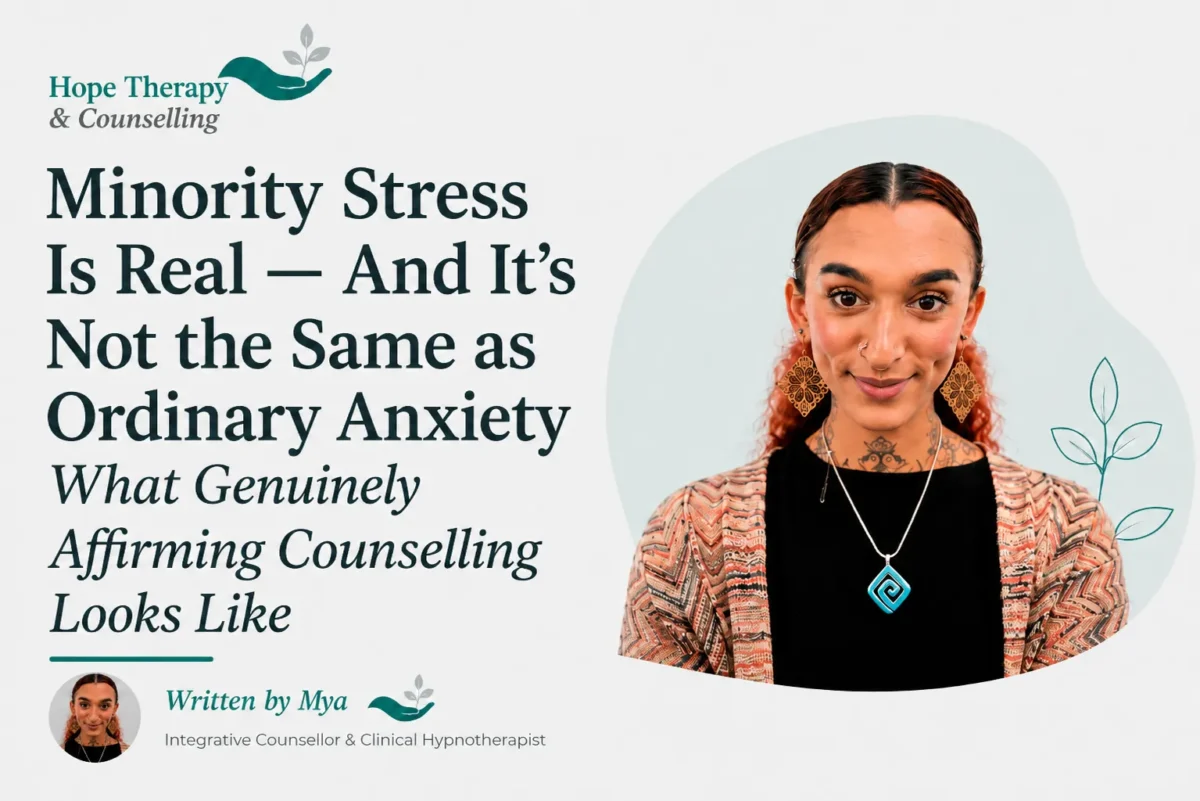
By Mya, MBACP
Integrative Counsellor & Clinical Hypnotherapist
Have you ever walked away from a conversation feeling exhausted without really knowing why?
Or found yourself replaying a seemingly small interaction for hours afterwards, wondering whether you were overreacting?
Many LGBTQIA+ people describe carrying a kind of background tension that is difficult to explain to others. It is not always linked to a major life event. Sometimes it comes from navigating a world where acceptance, understanding, or safety can feel uncertain.
The feeling can show up as anxiety, self-doubt, emotional exhaustion, difficulty relaxing, or a sense of always being slightly on guard.
There is a name for this experience: minority stress.
For many people, discovering that minority stress exists can be incredibly validating. It helps explain why emotional struggles can feel so persistent, even when there is no obvious crisis taking place.
This article is intended for general information and educational purposes only and should not be considered medical, psychiatric, psychological, or therapeutic advice. Every person’s circumstances are unique, and reading this article does not create a therapeutic relationship with Hope Therapy & Counselling Services. If you are concerned about your mental health or emotional wellbeing, we encourage you to seek support from a suitably qualified healthcare or mental health professional. Hope Therapy & Counselling Services offers a free 15-minute consultation which can be booked at https://www.hopefulminds.co.uk/free-consultation-with-hope-therapy/.
What Is Minority Stress?
Minority stress is a term used to describe the additional emotional and psychological burden that can come from belonging to a marginalised group.
For LGBTQIA+ people, this may include experiences such as discrimination, rejection, misunderstanding, exclusion, prejudice, or simply living with uncertainty about how others will respond to who you are.
Importantly, minority stress is not caused by being LGBTQIA+.
Research consistently shows that higher rates of anxiety, depression, and emotional distress within LGBTQIA+ communities are linked to social experiences and environmental pressures rather than identity itself.
The problem is not who someone is.
The problem is what they may have had to navigate because of who they are.
Understanding this distinction matters because many LGBTQIA+ people spend years believing they are somehow failing to cope. Minority stress offers a different perspective. It recognises that constantly adapting, monitoring, assessing risk, or preparing for rejection takes energy.
Over time, that energy expenditure can affect wellbeing.
Why Minority Stress Feels Different From Ordinary Anxiety
Most people experience anxiety at certain points in life.
A job interview. Financial worries. Relationship difficulties. Health concerns.
These experiences are usually linked to a specific situation.
Minority stress often works differently.
Rather than being connected to one event, it develops through the accumulation of many experiences over time.
A colleague making assumptions about your relationship.
A healthcare form that does not reflect your identity.
A family member avoiding certain conversations.
The hesitation before deciding whether it feels safe to mention your partner.
The mental calculation that happens before entering a new social environment.
Each moment may appear small in isolation.
Together, they can become emotionally exhausting.
Many people find it difficult to explain this exhaustion because there is rarely one defining incident responsible for it. Instead, it is the cumulative impact of navigating environments that are not always fully affirming.
When Small Moments Carry Unexpected Weight
One of the most challenging aspects of minority stress is that it is often invisible.
From the outside, many experiences appear insignificant.
For the person living them, they can carry much greater emotional weight.
Imagine a trans person attending a work lunch. A colleague introduces them to someone from another department using their old pronouns.
There is no obvious hostility.
The colleague simply forgets.
For a moment, the table falls quiet.
Everyone seems to wait to see what will happen next.
The person smiles politely and carries on with the conversation because they do not want to create discomfort or become the centre of attention.
Later, however, they find themselves staring at their lunch.
They replay the interaction in their mind.
They wonder whether anyone at the table truly sees them for who they are.
They question whether correcting the mistake would have changed anything.
They feel invisible.
What appears to be a small moment from the outside can stay with someone for hours or days afterwards.
Experiences like these are often referred to as microaggressions. While individual incidents may seem minor, the cumulative effect of repeatedly navigating them can be emotionally draining.
Carrying More Than Anyone Realises?
Sometimes the hardest part of minority stress is that nobody else can see it.
You may appear to be coping well while privately feeling exhausted, anxious, hypervigilant, or disconnected from yourself.
At Hope Therapy, our LGBTQIA+ affirming therapists understand the impact minority stress can have on confidence, relationships, wellbeing, and mental health.
You do not need to justify your experiences before seeking support.
Book a free 15-minute consultation:
https://calendly.com/hopetherapy/consultation
The Different Forms Minority Stress Can Take
Internalised Stigma
The messages LGBTQIA+ people receive from families, institutions, media, culture, and society can sometimes influence how they view themselves.
This is often described as internalised stigma.
It does not necessarily mean consciously believing negative stereotypes. More often, it can appear as self-doubt, discomfort with visibility, difficulty accepting kindness, or a feeling that certain parts of yourself need to be hidden in order to feel accepted.
These beliefs often develop gradually and without conscious awareness.
Many people discover in therapy that beliefs they assumed were simply part of their personality are actually connected to experiences of judgement, rejection, or exclusion.
Recognising this is not about blaming yourself.
It is about understanding how our environments shape the way we relate to ourselves.
Concealment And Self-Monitoring
Many LGBTQIA+ people regularly make decisions about how much of themselves to share.
Sometimes this is about comfort.
Sometimes it is about safety.
Sometimes it is both.
Even when those decisions are sensible and protective, making them repeatedly can become emotionally tiring.
The effort involved in constantly assessing risk, reading situations, and deciding what feels safe to disclose can create its own form of stress.
Why “Just Managing It Better” Is Not The Answer
One of the reasons minority stress can be misunderstood is because conversations about mental health often focus on coping skills.
Coping strategies are valuable.
Mindfulness, self-care, emotional regulation, supportive relationships, healthy boundaries, and therapy can all play important roles in wellbeing.
However, minority stress is not simply a thinking problem.
The vigilance many LGBTQIA+ people experience is often grounded in real experiences.
The concerns are not necessarily irrational.
The exhaustion is not imagined.
This is why effective support does not begin by questioning whether someone’s experience is valid.
Instead, it begins by acknowledging that what they are carrying makes sense in the context of what they have lived through.
From there, therapy can help people develop resilience, self-understanding, self-compassion, and healthier ways of responding to ongoing challenges.
What Affirming Therapy Can Feel Like
Good affirming therapy is not simply about avoiding mistakes or using the correct terminology.
It is about creating a space where you do not need to explain or justify your existence before the therapeutic work can begin.
For many clients, particularly those who have spent years feeling misunderstood, there can be something deeply relieving about sitting with a therapist who genuinely understands LGBTQIA+ experiences.
Sometimes that understanding comes through specialist training.
Sometimes it comes through lived experience.
Often it is a combination of both.
Clients frequently describe feeling seen, heard, and understood in ways they have not experienced elsewhere.
Rather than spending energy educating the therapist, they can focus on exploring themselves.
What Healing Can Look Like
Minority stress may not disappear entirely, particularly while social inequalities continue to exist.
That does not mean people are powerless.
Healing often involves developing greater self-acceptance and recognising which beliefs genuinely belong to you and which have been shaped by other people’s assumptions.
It can involve building relationships where you feel safe to be fully yourself.
It can involve finding affirming communities, strengthening boundaries, and learning to trust your own experiences.
Perhaps most importantly, healing can involve recognising that your struggles make sense.
There is often enormous relief in understanding that what you are feeling is not weakness, oversensitivity, or personal failure.
It is a human response to experiences many LGBTQIA+ people know well.lexity. It creates space for all the different factors that may be influencing a person’s emotional life without reducing them to a single aspect of who they are.
Frequently Asked Questions
What is minority stress?
Minority stress is not a mental health condition or diagnosis. It is a framework used to describe the additional emotional and psychological burden that can come from belonging to a marginalised group and navigating environments that are not always affirming, understanding, or accepting.
Why do small comments affect me so much?
Often it is not the individual comment itself that creates distress. The emotional impact can come from years of similar experiences accumulating over time. A single interaction may seem minor in isolation but can connect to a much larger history of feeling misunderstood, excluded, judged, or unsafe.
Can minority stress cause anxiety?
Research suggests that minority stress can contribute to anxiety, low mood, emotional exhaustion, hypervigilance, burnout, and difficulties with self-esteem among LGBTQIA+ people. These responses are often linked to ongoing social pressures rather than identity itself.
How can therapy help with minority stress?
Affirming therapy can help people understand the impact minority stress has had on their lives, strengthen self-acceptance, process difficult experiences, and develop healthier ways of responding to ongoing challenges. Therapy cannot remove every external stressor, but it can provide a supportive space to explore their impact and build resilience.
Free 15-minute consultation
A calm, supportive and no-pressure conversation to help you find the right therapist for your needs.
Book now — it’s freeABOUT THE AUTHOR
Ready to Take the First Step?
Reaching out for support can feel difficult, especially when you have been carrying everything quietly for a long time. At Hope Therapy & Counselling Services, we offer calm, compassionate and professional support tailored to your needs — online across the UK and in-person at selected clinics.
Book your free consultationSupport That Understands What You’re Carrying
Many LGBTQIA+ people come to therapy wondering whether what they are experiencing is serious enough to deserve support.
The reality is that emotional struggles do not need to reach crisis point before help becomes worthwhile.
Minority stress is often invisible to those around us. It can leave people feeling exhausted, isolated, confused, or questioning their own reactions to experiences that genuinely affect them.
At Hope Therapy, we take care to match clients with therapists who understand LGBTQIA+ experiences and can provide support that feels informed, compassionate, and affirming.
Mya is a registered BACP therapist who works alongside an LGBTQIA+ charity in London and offers face-to-face counselling in Dalston, Hackney, as well as online sessions across the UK.
Ian is an NCPS Accredited Integrative Counsellor, Hypnotherapist, and LGBTQIA+ Affirming Practitioner who offers face-to-face sessions near Basingstoke and online across the UK.
Ready To Take The First Step?
If this article has resonated with you, support is available.
You do not need to have everything worked out before reaching out.
Many people find that simply speaking to someone who understands can be the beginning of feeling less alone with what they are carrying.
This article is intended for general information and educational purposes only and should not be considered medical, psychiatric, psychological, or therapeutic advice. Every person’s circumstances are unique, and reading this article does not create a therapeutic relationship with Hope Therapy & Counselling Services. If you are concerned about your mental health or emotional wellbeing, we encourage you to seek support from a suitably qualified healthcare or mental health professional. Hope Therapy & Counselling Services offers a free 15-minute consultation which can be booked at https://www.hopefulminds.co.uk/free-consultation-with-hope-therapy/.
Pride is often associated with visibility and celebration, but for many LGBTQIA+ people it is also about feeling safe, understood and accepted. Finding a therapist who genuinely understands your experiences can be an important part of that journey.
📅 Published: May 2026 📄 Written by Simon and Steve