
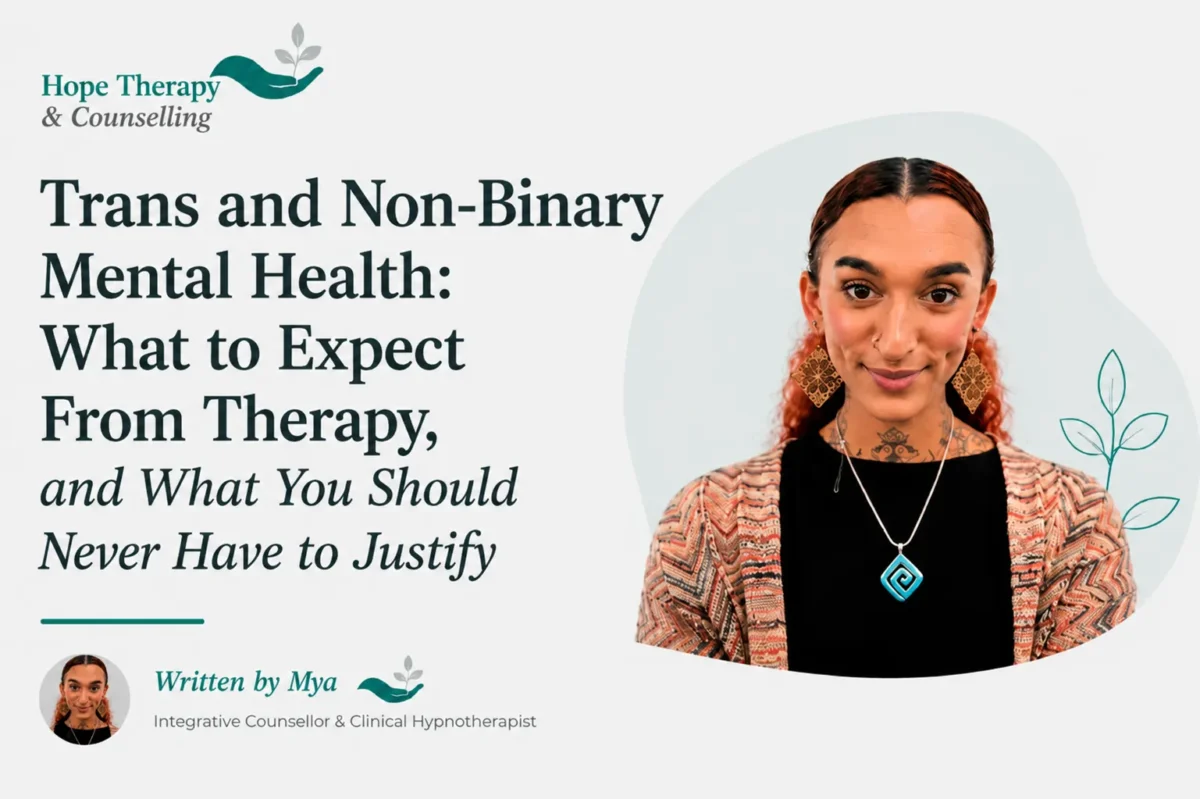
By Mya, MBACP
Integrative Counsellor & Clinical Hypnotherapist
If you are trans or non-binary and you have considered counselling, you may already be carrying a particular set of questions alongside the ones that brought you there in the first place.
Will this therapist understand what trans means — not in theory, but in practice? Will they use the right language without being corrected? Will your gender be treated as something to be explored as a problem, or as a straightforward part of who you are?
These are not unreasonable questions. They are reasonable responses to a history, both personal and collective, of therapeutic spaces that have not always felt genuinely affirming.
This post is about what trans and non-binary counselling can and should look like when it is done well.
This article is for informational purposes only and does not constitute medical or clinical advice. If you are concerned about your mental health or the mental health of someone you know, please speak with a qualified professional. Hope Therapy & Counselling Services offers a free 15-minute consultation — book yours here .
Your Gender Identity Is Not the Problem
One of the most important things a therapist working with trans and non-binary clients needs to understand — and demonstrate, not just claim — is that gender identity is not automatically a presenting problem.
For many trans and non-binary people, therapy is not about understanding, questioning, or exploring their gender identity at all. They may be seeking support for anxiety, relationship difficulties, bereavement, burnout, workplace stress, low self-esteem, or any number of challenges that affect people from all walks of life. Their gender identity forms part of the context of their experience, but it may not be the focus of the work.
At the same time, some people do come to therapy specifically to explore their gender identity, make sense of their experiences, navigate transition-related decisions, or better understand themselves. That is equally valid.
What matters is that the direction comes from the client, not from assumptions made by the therapist.
This distinction is important because many trans and non-binary people have experienced environments where their identity became the focus of every conversation, regardless of why they were seeking support. Good therapy recognises that gender may be central, peripheral, or somewhere in between, depending entirely on the individual’s needs.
This sounds like it should be obvious. For many trans and non-binary people who have accessed counselling, it has not always been the experience. A therapist who automatically positions trans or non-binary identity as something to be understood, processed, or resolved, rather than following the client’s lead, risks missing what the person has actually come to therapy for. The distinction is significant.
What Genuinely Trans-Affirming Therapy Looks Like
Language That Does Not Require Constant Correction
A trans-affirming therapist makes every effort to use your pronouns accurately and consistently from the beginning of the therapeutic relationship. They use the language you use to describe yourself, whether that is trans, non-binary, genderqueer, non-conforming, or any other term that feels right for your experience. They avoid outdated terminology and do not ask questions framed around assumptions that you then have to untangle.
Getting language right matters because it creates safety. At the same time, therapists are human, and mistakes can occasionally happen. What matters is how those mistakes are handled. A therapist who notices an error, corrects themselves, takes accountability, and moves forward respectfully creates a very different experience from someone who becomes defensive, dismissive, or repeatedly relies on the client to manage the situation.
When language is handled well, it fades into the background. You are free to focus on the work you came to do, rather than monitoring whether you are being understood.
What Affirming Therapy Feels Like in Practice
Much is written about what affirming therapy should avoid, but it is equally important to talk about what it feels like when it is done well.
Many trans and non-binary people describe a sense of relief. The energy that would normally go into explaining, educating, correcting, or defending yourself simply is not required. You do not feel observed, analysed, or treated as an interesting case study. Instead, you feel understood.
A therapist who is genuinely knowledgeable about LGBTQIA+ experiences, and in some cases may have worked extensively within LGBTQIA+ communities or alongside people with similar lived experiences, can engage in a way that feels organic and authentic. You feel seen, heard, and met in a way that feels real to your experience.
That does not mean a therapist always gets everything perfect. It means the therapeutic relationship is built on respect, curiosity that serves the client rather than the therapist, and an understanding that your identity does not need to be justified before support can begin.
No Inappropriate Curiosity
Trans and non-binary people have consistently reported encounters with healthcare professionals whose curiosity about their identity crosses the line from relevant into something that feels more personal than clinical — questions about bodies, medical decisions, or the specifics of transition that have no bearing on the presenting issue.
A genuinely affirming therapist does not ask questions about your gender or body that you have not chosen to raise. They follow your lead. If your trans identity is relevant to what you are exploring, you will introduce it.
Good therapy is not about satisfying someone else’s curiosity. It is about creating a space where your experiences can be explored safely and at your pace.
If This Feels Familiar
If you have found yourself in a session managing a therapist’s curiosity about your identity rather than receiving support, that experience is real and valid. It reflects a gap in preparation, not a problem with you.
You deserve something different from this.
What You Should Never Have to Justify
There are aspects of who you are that you should never feel pressured to justify, explain, or defend in therapy. Discussions about identity may sometimes become relevant, particularly if you choose to explore them, but those conversations should be guided by your needs rather than a therapist’s assumptions or personal curiosity.
Whether or how you have transitioned, what medical decisions you have or have not made, how long you have known, or the language you use to describe yourself should not become hurdles you must clear in order to be believed, respected, or supported.
You should not have to justify identifying as non-binary in a way that a binary trans person would not be asked to justify their identity. You should not have to explain why your experience of gender does not match a particular script. You should not have to account for any aspect of your identity or history in order to receive compassionate and respectful support.
A therapist who repeatedly asks you to explain or defend aspects of your identity that are unrelated to your goals for therapy may be moving away from affirming practice. It is reasonable to name this if it happens. It is also reasonable to decide that a therapist is not the right fit for you and to look elsewhere.
Looking for a genuinely affirming space?
Identity-Based Trauma and Why It Needs to Be Named
Research consistently indicates that trans and non-binary people experience significantly higher rates of anxiety, depression, and trauma-related difficulties than the general population. Understanding why matters for how therapeutic work is approached.
Much of this is attributable not to trans identity itself, but to the experience of living as a trans or non-binary person in environments that are not consistently affirming. Family rejection, misgendering, discrimination in healthcare and employment, social exclusion, and the ongoing pressure of navigating systems that may not fully recognise or understand your identity can all have a cumulative impact on mental wellbeing.
Sometimes these experiences are obvious and significant. Sometimes they are subtle.
It may be the repeated experience of having to explain yourself. The exhaustion of anticipating misunderstanding. The quiet calculation that takes place before deciding whether it feels safe to correct someone, disclose part of your identity, or simply let a comment pass.
For example, imagine being introduced at a work lunch using the wrong pronouns. No hostility is intended. Someone simply forgets. The conversation continues. Nobody means harm. Yet for the person affected, there may be a moment of feeling unseen, exposed, or reminded that recognition is not always guaranteed. Experiences like these may seem small in isolation, but over time they can accumulate and affect how safe, visible, and understood someone feels in the world.
Not every trans or non-binary person will experience these situations in the same way. However, for many people, repeated experiences of misunderstanding, invalidation, or discrimination can leave a lasting emotional impact.
What This Means in the Therapy Room
A therapist working affirmingly with trans and non-binary clients understands that caution, difficulty trusting, or guardedness in early sessions may reflect understandable responses to previous experiences of being misunderstood, dismissed, or harmed.
This is not resistance. Nor is it something that needs to be worked around.
It is something to be understood and met with patience.
A therapist who understands minority stress and identity-related experiences recognises that trust may need to be built gradually. The client decides the pace. This is not only good practice for trans and non-binary clients; it is a cornerstone of good therapy generally.
Mental Health Beyond Gender
Trans and non-binary people come to counselling for the full range of human difficulties — not only those connected to gender identity.
People seek therapy for anxiety, depression, bereavement, relationship difficulties, burnout, work-related stress, low confidence, family conflict, life transitions, and countless other reasons.
A genuinely affirming therapist does not automatically reduce every presenting issue to gender identity.
At the same time, they are able to recognise when aspects of a person’s identity may be influencing their experience. The challenge is not choosing one perspective or the other. The skill lies in holding both.
Anxiety may be anxiety, while also being shaped by experiences of minority stress. Grief may be grief, while also carrying additional layers when important relationships or identities have not been fully recognised by others.
Good affirming therapy avoids simplistic explanations. It recognises complexity. It creates space for all the different factors that may be influencing a person’s emotional life without reducing them to a single aspect of who they are.
Free 15-minute consultation
A calm, supportive and no-pressure conversation to help you find the right therapist for your needs.
Book now — it’s freeABOUT THE AUTHOR

Ready to Take the First Step?
Reaching out for support can feel difficult, especially when you have been carrying everything quietly for a long time. At Hope Therapy & Counselling Services, we offer calm, compassionate and professional support tailored to your needs — online across the UK and in-person at selected clinics.
Book your free consultationFinding the Right Therapist
Finding a therapist who is genuinely prepared to work with trans and non-binary clients requires more than checking whether someone describes themselves as affirming.
The questions worth asking are often quite practical.
What training in trans-affirming practice have they completed?
What experience do they have of working with trans and non-binary clients?
How do they approach discussions around gender identity?
How do they ensure their practice remains informed and inclusive?
A therapist does not need to have identical life experiences to provide excellent support. However, they should have the knowledge, awareness, humility, and commitment needed to create a genuinely affirming therapeutic environment.
At Hope Therapy, we match carefully. Mya holds trans-affirmative practice training through Gendered Intelligence and works part-time as a counsellor for an LGBTQIA+ charity in London, bringing together specialist training and extensive experience supporting LGBTQIA+ communities within both charity and private practice settings. She offers face-to-face sessions in Dalston in Hackney and online across the UK.
Ian is a registered LGBTQIA+ Affirming Practitioner offering integrative counselling and hypnotherapy near Basingstoke and online across the UK.
The free initial consultation gives you the opportunity to ask questions, discuss what you are looking for, and decide whether a particular therapist feels like the right fit for you.
Ready to Take the First Step?
Reaching out to a therapist for the first time — or for the first time in a long while — takes courage, particularly if previous experiences of healthcare, counselling, or support services have not felt genuinely affirming.
You should not have to spend your therapy sessions educating your therapist, defending your identity, or wondering whether you will be understood.
Good therapy creates space for you to focus on yourself, your wellbeing, and the things that matter most to you.
At Hope Therapy, we take care to match each person with the therapist best suited to their individual needs, experiences, and goals.
A free 15-minute consultation is a simple, no-pressure way to begin.
There is no obligation and no commitment required.
Just a conversation.
Hope Therapy & Counselling Services offers online counselling across the UK and face-to-face appointments in selected locations across England. If you would like to discuss your needs or find the right therapist for you, you can book a free 15-minute consultation today.
Pride is often associated with visibility and celebration, but for many LGBTQIA+ people it is also about feeling safe, understood and accepted. Finding a therapist who genuinely understands your experiences can be an important part of that journey.
📅 Published: May 2026 📄 Written by Simon and Steve