
BLOG
Bereavement Counselling: What It Is and How It Helps
- By Steve Pointon
- Person-Centred Counsellor, Hope Therapy & Counselling Services
- 23rd August 2026
- 7–10 minutes
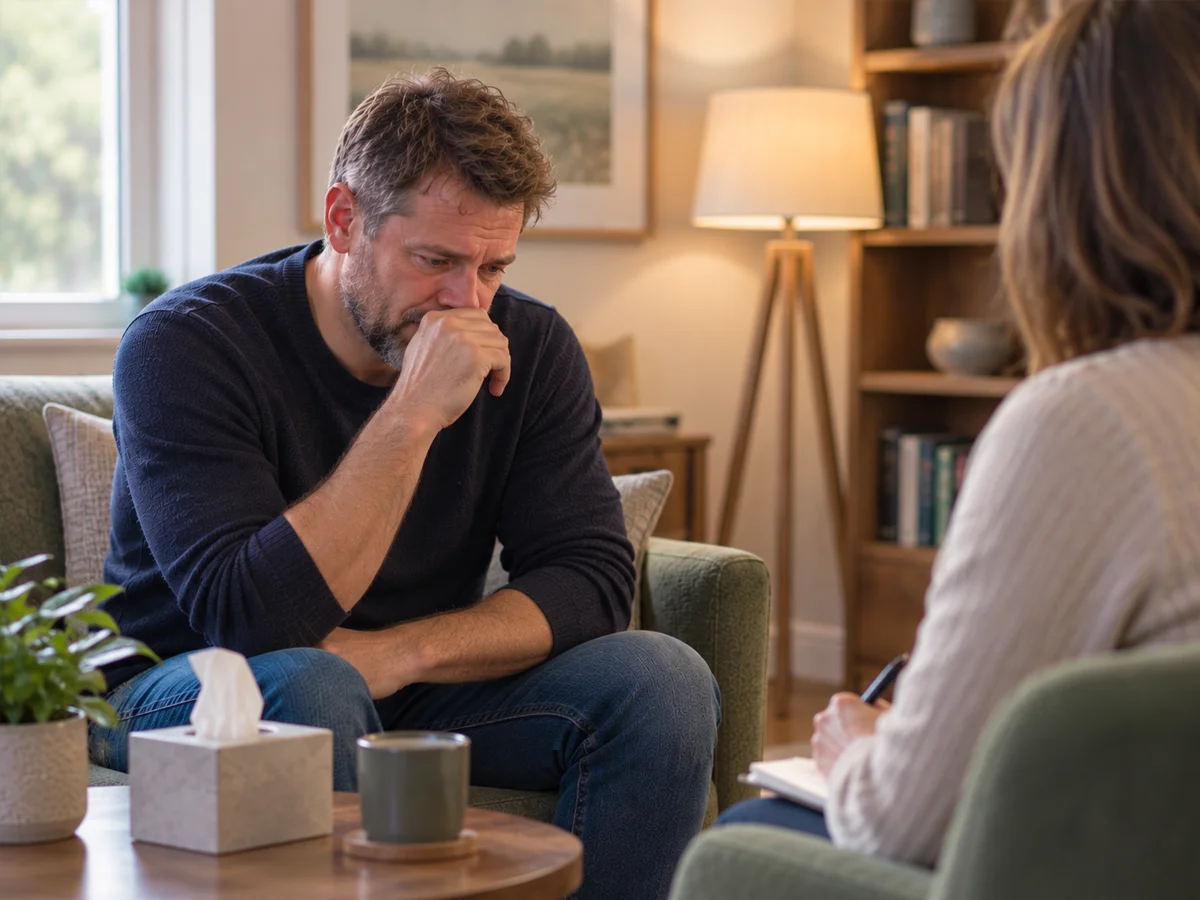
Grief does not follow instructions. It does not arrive on schedule, respect working hours, or resolve itself in a timeframe that suits anyone.
Bereavement counselling exists for exactly this reason, not to accelerate grief or to fix it, but to offer a space in which it can be experienced honestly, at the pace it actually moves, with someone who will not be frightened or exhausted by it.
If you have been wondering whether counselling might help, this post explains what it involves and what you can reasonably expect.
This article is intended for general information and educational purposes only and should not be considered medical, psychiatric, psychological, or therapeutic advice. Every person’s circumstances are unique, and reading this article does not create a therapeutic relationship with Hope Therapy & Counselling Services. If you are concerned about your mental health or emotional wellbeing, we encourage you to seek support from a suitably qualified healthcare or mental health professional. Hope Therapy & Counselling Services offers a free 15-minute consultation – book yours now.
What Is Bereavement Counselling?
Bereavement counselling is a form of talking therapy specifically focused on supporting people through the experience of loss. It offers a structured, confidential space in which to explore grief, the feelings it brings, the ways it is affecting daily life, and the particular aspects of the loss that are hardest to carry.
It is not advice-giving, and it is not about being told how to feel or how long to grieve. A bereavement counsellor will not tell you that you should be feeling better by now, or that you need to find closure, or that your person would want you to move on. The work is led by what is present for you, not by any external expectation of how grief should look or how long it should last.
Who is bereavement counselling for?
Bereavement counselling is for anyone who is struggling with loss, and the loss does not need to meet any particular standard of severity to be worth taking seriously.
The death of a parent, a partner, a child, a sibling, a close friend, a colleague who mattered. The loss of a person you were estranged from, or who died before things were resolved between you. The loss of someone whose relationship with you was complicated, or whose death was sudden, violent, or preceded by a long illness.
There is no threshold of grief that qualifies someone for support. The question is whether the grief is affecting how you are functioning and whether having a dedicated space to work through it would help.
How Does Bereavement Counselling Work?
Bereavement counselling typically begins with an initial session in which the counsellor learns about you, the loss, and what you are hoping to get from the work. There is no pressure to have clear goals at this point, many people come to their first session not knowing exactly what they need, only that they need something.
Sessions are usually weekly or fortnightly, and they last for fifty minutes. The pace is yours. You will not be asked to discuss anything before you are ready, and you will not be pushed toward a particular outcome. The counsellor’s role is to provide consistent, non-judgemental presence, to stay with you in the grief rather than pulling you through it to somewhere more comfortable.
Different counsellors use different approaches. Person-centred counselling, which focuses on the quality of the therapeutic relationship and the client’s own wisdom rather than on techniques, is widely used in bereavement work. CBT-based approaches may also be helpful, particularly when grief has triggered or exacerbated anxiety or depression. An experienced practitioner will adapt the approach to what is needed
What Can Bereavement Counselling Help With?
Bereavement counselling can help with the immediate experience of grief, the shock, the sadness, the disorientation, the physical heaviness that loss brings. It can also help with aspects that are harder to name: the guilt that often accompanies grief, the anger that can sit alongside sadness, and the complicated feelings that arise when a relationship with the person who died was difficult.
It can also help when grief is affecting functioning in tangible ways, disrupting sleep, making work impossible, pulling someone away from the relationships that might otherwise support them.
When the ordinary support of friends and family is not enough, or when those around the bereaved person are also grieving and cannot hold each other’s pain as well as their own, counselling offers a space that is specifically and reliably there.
For some people, grief also raises questions about meaning, identity, and purpose, particularly following the death of someone who was central to their daily life. Bereavement counselling can hold these larger questions as well as the immediate pain.
Does the grief have to be recent?
There is no point at which grief becomes too old for counselling to help. Sometimes grief that was managed at the time resurfaces years later, following another loss, a life transition, or simply because the conditions that allowed suppression have shifted. Long-standing grief that has never been properly processed responds to counselling just as well as recent loss.
Complicated grief, where the loss remains raw and actively affecting life long after most people would expect, is a recognised and distinct presentation. If the death of someone important to you is affecting how you live, regardless of how long ago it occurred, that is a reasonable basis for seeking support.
Wondering if bereavement counselling could help?
A free, no-obligation 15-minute consultation is a good place to start. No preparation needed, no commitment.
When Should You Seek Bereavement Counselling?
There is no correct time to seek bereavement counselling, and no point at which it is too early or too late. Some people find it most helpful in the immediate aftermath of a death, when shock and disorientation are at their most acute. Others come to counselling months or years later, sometimes because grief that was managed at the time has resurfaced, sometimes because a subsequent loss has opened up grief from earlier in their lives.
The question that matters most is not how long ago the death occurred, but whether the grief is affecting you in a way that warrants dedicated support. If you are not sleeping, not functioning at work, withdrawing from people who matter to you, or simply carrying a weight that feels too heavy to carry alone, those are all reasonable reasons to seek help, regardless of the timeline.
There is no requirement to wait until things become unbearable. Coming to counselling when grief is difficult but not yet crisis-level is not premature, it is practical.
What Happens in a Bereavement Counselling Session?
A bereavement counselling session is a conversation, not a test or an assessment. You do not need to prepare, and there is no right or wrong way to begin. Many people find it helpful to simply speak about the person they have lost, who they were, what the relationship was like, what has changed since they died.
The counsellor will listen, reflect, and ask questions, not to lead you somewhere, but to help you explore what is there. Some sessions will feel productive; others may feel more like simply sitting with the weight of what has happened. Both are valid.
The relationship built over time is itself therapeutic, the consistency of having someone who holds your grief with you, session after session, is not incidental to the work. It is the work.
Can Bereavement Counselling Be Done Online?
Online bereavement counselling works well for many people and offers practical advantages, no travel, no waiting room, no need to manage your emotional state in a public space before and after the session. Counselling conducted via video is clinically equivalent to in-person work for most presentations, including bereavement.
Support from Hope Therapy & Counselling Services is available online nationwide and face-to-face across England. Sessions can be booked at a pace that suits you, with no pressure to commit to a fixed number of sessions in advance.
A free 15-minute consultation is available to explore whether this feels like the right fit.
Ready to Take the First Step?
Grief does not have to be unbearable before it qualifies for support. If you are carrying a loss, however recently it occurred or however it compares to what others might regard as significant, a free, no-obligation 15-minute conversation is a good place to start. No preparation needed, no pressure to commit.
- Free 15-minute consultation
- No commitment
- Qualified & registered therapists
- LGBTQIA+ affirming support
- NCPS organisational member
- Online nationwide
- Face-to-face across England
- Established 2014
This article is intended for general information and educational purposes only and should not be considered medical, psychiatric, psychological, or therapeutic advice. Every person’s circumstances are unique, and reading this article does not create a therapeutic relationship with Hope Therapy & Counselling Services. If you are concerned about your mental health or emotional wellbeing, we encourage you to seek support from a suitably qualified healthcare or mental health professional. Hope Therapy & Counselling Services offers a free 15-minute consultation – book yours now.
Frequently Asked Questions
What is bereavement counselling?
Bereavement counselling is a form of talking therapy focused on supporting people through grief and loss. It offers a confidential space to explore the feelings that loss brings at the person’s own pace, without pressure to feel better within any particular timeframe. It is not advice-giving, the work is led by what is present for the person, not by external expectations.
How does bereavement counselling work?
Bereavement counselling typically begins with an initial session to understand you, the loss, and what you are hoping for. Sessions are usually weekly or fortnightly and last fifty minutes. The counsellor provides consistent, non-judgemental presence. Different approaches are used, person-centred counselling is widely used in bereavement work, with CBT-based approaches helpful when grief has triggered anxiety or depression.
When should you seek bereavement counselling?
There is no correct time, counselling can be helpful in the immediate aftermath of loss or years later. The most relevant question is not how long ago the death occurred, but whether the grief is affecting how you are functioning. You do not need to wait until things become unbearable. Coming to counselling while grief is difficult but not yet crisis-level is practical, not premature.
Find the Right Support for You
Our general counselling services page can help you determine what sort of therapy may be suitable for you.
Get Help With Other Conditions
Our general conditions page is a great place to start.
THE AUTHOR
Registered Member of the BACP · BSc (Hons) Person-Centred Counselling · Level 2 & 3 Person-Centred Counselling · Acceptance and Commitment Therapy (ACT)
Before qualifying as a counsellor, Steve built a varied career centred on supporting and advocating for others. Alongside his work in a hospice supporting palliative patients, families, and bereaved individuals, he has worked as a telephone counsellor, Community Development Officer, and Patient Advocate, giving him extensive experience helping people through some of life’s most challenging circumstances.
Steve holds a BSc (Hons) in Person-Centred Counselling from the University of Derby and is a Registered Member of the British Association for Counselling and Psychotherapy (BACP). His practice is grounded in the Person-Centred approach and complemented by training in Acceptance and Commitment Therapy (ACT), providing clients with both a compassionate therapeutic relationship and practical tools for navigating difficult thoughts and emotions.
His specialist interests include bereavement and grief, cancer support, life-limiting illness, anxiety, depression, life transitions, relationship difficulties, and personal growth. His hospice experience has given him a particular depth of understanding when supporting people facing loss, serious illness, and profound life change.
Steve provides a warm, genuine, and accepting environment where clients can explore their experiences at their own pace. He believes that feeling truly heard and understood creates the foundation for meaningful change, helping people build resilience, find clarity, and move forward with greater confidence.
- MBACP Registered
- BSc (Hons) Person-Centred Counselling
- Acceptance & Commitment Therapy (ACT)
- Person-Centred Counsellor
- Bereavement & Grief
- Hospice Experience
- Life-limiting Illness & Palliative Support
- Cancer Support
- Life Transitions
Free 15-minute consultation
A no-pressure conversation to find the right therapist for you. No commitment needed.
IN THIS ARTICLE
ABOUT THE AUTHOR

Steve Pointon
MBACP
Person-Centred counsellor with a hospice background, supporting adults through bereavement, cancer, life-limiting illness, anxiety, depression, and life’s major transitions.
ABOUT HOPE THERAPY
Qualified registered therapists
Online nationwide across UK
Face-to-face across England
LGBTQIA+ & neurodivergent affirming
Mon–Sun, 9am–9pm
NCPS organisational member
Est 2014
Published: 23rd August 2026 | Written by Steve Pointon | Reviewed for clinical accuracy before publishing | Review due: August 2028