BLOG
Can You Get Social Anxiety Counselling Online?
- By Ian Stockbridge
- Founder & Clinical Director, Hope Therapy & Counselling Services
- 28th September 2026
- 9–14 minutes
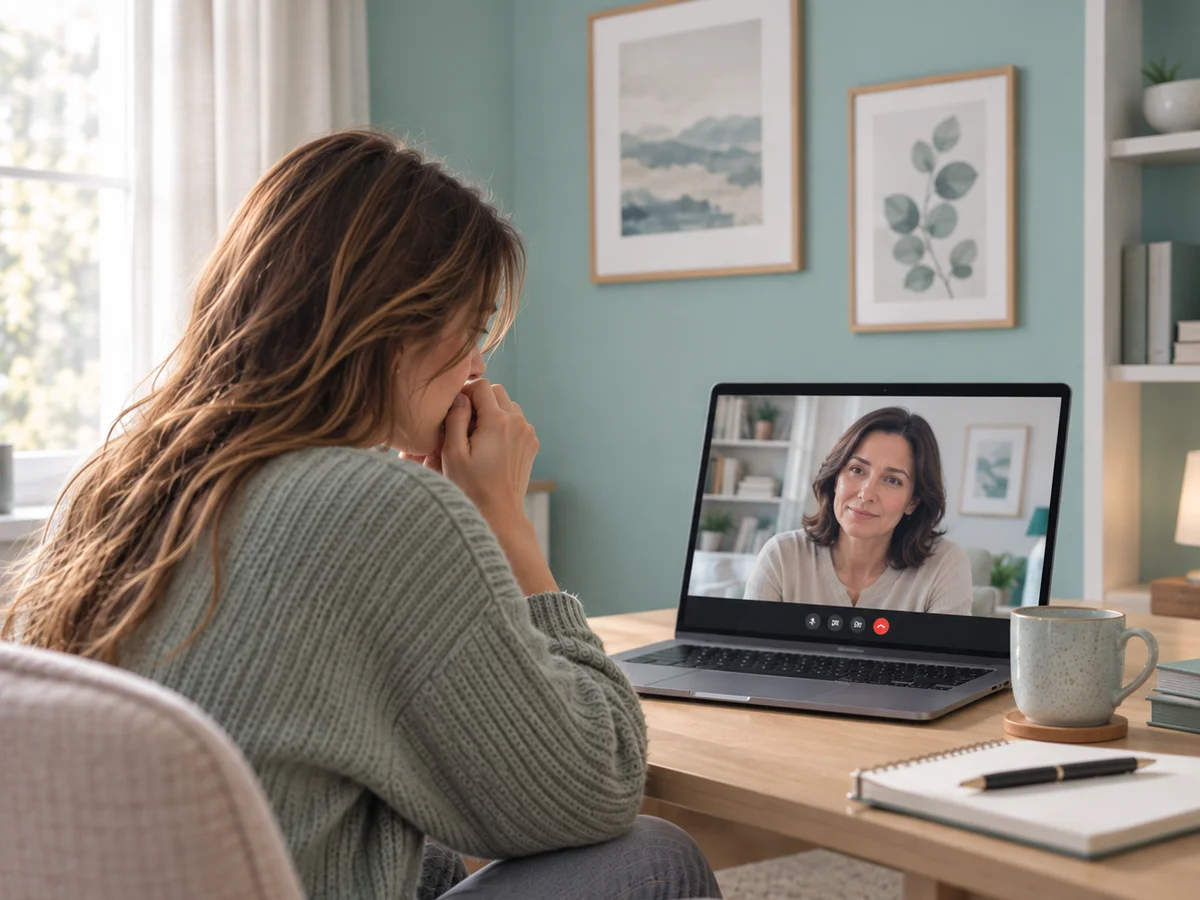
There is a particular cruelty to social anxiety. The help exists, and reaching it means doing the exact thing you find hardest. Phoning a stranger. Sitting in a waiting room where someone might speak to you. Saying your name at a reception desk while other people wait behind you.
Plenty of people never get past that first step, and then decide they cannot have wanted it badly enough. That reading is wrong. This is where online counselling for social anxiety earns its place, not as a thinner version of the real thing, but as the option that removes the specific barrier standing in the way.
This article is intended for general information and educational purposes only and should not be considered medical, psychiatric, psychological, or therapeutic advice. Every person’s circumstances are unique, and reading this article does not create a therapeutic relationship with Hope Therapy & Counselling Services. If you are concerned about your mental health or emotional wellbeing, we encourage you to seek support from a suitably qualified healthcare or mental health professional. Hope Therapy & Counselling Services offers a free 15-minute consultation – book yours now.
Can you get counselling for social anxiety online?
Yes. Online counselling for social anxiety runs much as face-to-face work does — the same session length, the same approaches, the same qualified therapist. What changes is where you sit. For this particular difficulty, that single change does more work than it does for almost anything else.
Most therapists at Hope Therapy offer online sessions as standard, and a good number of people work this way from the first appointment to the last. Others start online and move to a room later, once the idea of a room feels manageable. Both are ordinary. Neither counts as a compromise.
The approaches used do not change with the format. Cognitive behavioural therapy, person-centred work, and acceptance and commitment therapy all translate to video without losing their structure. Online CBT for social anxiety is among the best-evidenced of these, and it follows the same protocol on a screen as it does in a room. A therapist trained in social anxiety will work the same way whether you are across a desk or across a screen, noticing what you avoid, what you predict, and what actually happens when the prediction turns out wrong.
Why the format matters more here than it does elsewhere
For most difficulties, the choice between online and in-person comes down to convenience, cost of travel, and personal preference. Social anxiety is one of the few where the format interacts directly with the problem itself.
Consider what a first appointment usually asks of someone. Find the building. Arrive early enough not to be late, which means sitting somewhere visible. Speak to a receptionist. Wait in a room with strangers, unsure where to look. Then walk into a room with someone you have never met and begin talking about the thing you have never told anyone.
That is a demanding sequence for anybody. For someone whose difficulty is precisely the anticipation of being watched and judged, it is a sequence built almost perfectly to trigger what it is meant to treat. Some people manage it. Many book the appointment and cancel the morning of.
Working online removes four of those five steps. You are in your own room. Nobody watched you arrive. There is no reception desk and no waiting area. The only remaining difficulty is the conversation itself, which is the part that helps.
What actually happens in an online session
The practical shape is unremarkable, which is worth saying, because people often imagine something more clinical or more awkward than it turns out to be.
You receive a secure link before your appointment. You click it at the agreed time. Your therapist appears, says hello, and the session runs for its full length in the usual way. There is no software to learn and nothing to install beyond what your device already has.
Sessions run to the same length as they would in a room, usually fifty minutes, and to the same rhythm. You agree a regular slot, you attend it weekly or fortnightly, and the work builds across appointments in the ordinary way. Cancellation notice, payment, and record-keeping follow the same policies. Confidentiality works the same way too, including the same limits: a therapist may need to break it where there is a serious risk of harm, and yours will explain exactly where those limits sit before you begin.
The first few minutes
Most people describe the opening minutes as the strange part, and then describe them settling faster than expected. Your therapist will usually check the sound and picture, confirm where you are and whether you can speak freely, and agree what happens if the connection drops. That last point matters more than it sounds, knowing there is a plan removes one thing to worry about.
After that it becomes a conversation. The screen stops registering fairly quickly for most people, in much the way a video call with someone you know well stops feeling like a video call.
The camera question
People with social anxiety often ask whether the camera has to stay on, and worry that asking makes them a difficult client. It does not. Some therapists will suggest keeping it on because facial expression carries useful information in both directions. Others will happily work with it off, particularly early on.
This is a reasonable thing to raise in your free consultation, and the answer you get tells you something useful about how that therapist works. A therapist who treats the question as a problem is probably not the right therapist for social anxiety.
Nothing here requires you to decide anything
A free 15-minute consultation happens the same way a session would, online, from wherever you are, with nobody to walk past on the way in.
Does it work as well as sitting in the room?
Research comparing the two formats suggests outcomes are broadly comparable for most people and most presentations. What predicts a good result in social anxiety therapy is not the format. It is the quality of the relationship between you and your therapist.
There is a more specific point for social anxiety, and it cuts both ways. Some people find the screen makes difficult things easier to say, a small buffer that takes the edge off exposure and lets them get to the material sooner. That is a genuine advantage, and for someone who has spent years not saying these things aloud, it can be the difference between starting and not starting.
The same buffer can also become somewhere to hide. If part of the work involves tolerating the discomfort of being seen, a format that quietly reduces that discomfort can slow things down. A therapist who knows the territory will watch for this and name it. In practice it often becomes part of the work rather than an obstacle to it, noticing the urge to turn the camera off is useful information, not a failure.
When online is not the right answer
An honest page has to include this part, because online does not suit everyone and pretending otherwise helps nobody.
If you have nowhere private to talk, online becomes difficult. A session you spend monitoring whether someone can hear you through a wall is not really a session. This is the most common practical obstacle by a distance, and it is worth solving before you start rather than discovering it in week three.
If video calls themselves cause you significant distress, and for some people with social anxiety, seeing their own face on screen is a specific difficulty, then the format is adding a problem rather than removing one.
If you are in crisis, or if what you are carrying feels urgent and unsafe, counselling of any format is not the right first step. Hope Therapy does not provide crisis support. Your GP is a good place to begin, and there is immediate support available if you need it tonight rather than next week.
Some people also find that trauma work lands differently in a room, and prefer to be physically present for it. That preference deserves respect rather than persuasion.
What you need to make it work
The requirements are modest, and the list is shorter than most people expect. There is no specialist equipment, no subscription, and nothing to set up in advance beyond a working device and somewhere to sit.
It is worth separating the two halves of this, because people tend to worry about the wrong one. The technology is almost never the problem. Video calling is reliable now, most people already use it for work or for family, and the small proportion of sessions disrupted by a poor connection is far lower than the worry about it suggests.
The private space is the part that needs planning, and it is the reason a small number of people conclude that online counselling for social anxiety will not work for them at this moment. Thinking it through before the first appointment saves a good deal of frustration later, and your therapist can help you solve it.
The practical part
A device with a working camera, a laptop, tablet, or phone all do the job, though a larger screen is easier on the eyes across fifty minutes. A connection stable enough for video, which most home broadband manages comfortably. Headphones, which help more than almost anything else on this list: they improve the sound, they keep your side of the conversation private, and they make the whole thing feel closer.
Charge your device beforehand. It sounds trivial. Running out of battery twenty minutes into something difficult is a genuinely unpleasant experience.
The private space part
This is the harder half, and it deserves more thought than the equipment does. You need somewhere you can speak freely for fifty minutes without being overheard or interrupted.
For people living alone, that is straightforward. For people sharing a home, a house with children, or a flat with thin walls, it takes planning. A parked car works well and a surprising number of people use one. So does a booked room in a library, a quiet corner of an office out of hours, or simply arranging the session for a time when the house is empty. Your therapist will have heard every version of this and can help you think it through.
Where to start
The step that stops most people is not the counselling. It is the contact that comes before it.
Hope Therapy’s free consultation runs for fifteen minutes and takes place the same way a session would, online, from wherever you are, with no reception desk involved. You do not need to prepare anything or explain yourself well. If speaking feels like too much at first, saying so is a perfectly good opening.
Nothing is decided in that conversation. It exists so you can find out what the person sounds like and whether continuing feels possible. Most people find that first contact harder than everything that follows it.
Ready to Take the First Step?
No pressure, no script — just a chance to be heard, ask questions, and see whether we feel like the right fit.
- Free 15-minute consultation
- No commitment
- Qualified & registered therapists
- LGBTQIA+ affirming support
- NCPS organisational member
- Online nationwide
- Face-to-face across England
- Established 2014
This article is intended for general information and educational purposes only and should not be considered medical, psychiatric, psychological, or therapeutic advice. Every person’s circumstances are unique, and reading this article does not create a therapeutic relationship with Hope Therapy & Counselling Services. If you are concerned about your mental health or emotional wellbeing, we encourage you to seek support from a suitably qualified healthcare or mental health professional. Hope Therapy & Counselling Services offers a free 15-minute consultation – book yours now.
Frequently Asked Questions
Can you get counselling for social anxiety online?
Yes. Sessions run to the same length, use the same approaches, and involve the same qualified therapists as face-to-face work. For social anxiety in particular, working online removes the parts of a first appointment that many people find hardest: the waiting room, the reception desk, and being seen arriving.
Is online counselling as effective as seeing someone in person?
Research comparing the two formats suggests outcomes are broadly comparable for most people and most presentations. What matters more than format is the relationship with your therapist. Some people find the screen makes difficult things easier to say; others find it harder.
What do I need for an online session?
A device with a camera, a reasonably stable connection, and somewhere you will not be interrupted for fifty minutes. Headphones help more than people expect. The private space is usually the harder part to arrange.
Does the camera have to be on?
That is something to agree with your therapist. Some suggest keeping it on because facial expression carries useful information both ways; others are content to work with it off, particularly early on. It is a reasonable question to raise in your free consultation.
When might online counselling not suit someone with social anxiety?
If you have nowhere private to talk, if video calls themselves cause significant distress, or if you are in crisis. Hope Therapy does not provide crisis support, and your GP is a good place to begin in that situation. Some people also prefer to be physically present for trauma work.
Can I switch between online and face-to-face?
Where a suitable therapist is available in your area, yes. Many people use online as their default and attend in person occasionally.
Find the Right Support for You
Our general counselling services page can help you determine what sort of therapy may be suitable for you.
Get Help With Other Conditions
Our general conditions page is a great place to start.
THE AUTHOR

Ian Stockbridge
- MBACP (Senior Accredited)
Founder & Clinical Director — Hope Therapy & Counselling Services
MBACP (Senior Accredited) · SNCPS (Acc) · BSc (Hons) CBT · PGCert Clinical Supervision
Founder of Hope Therapy, published author, clinical supervisor, and co-presenter of The Talk Room Podcast. Practising therapist with 25+ years of senior leadership experience.
Before Ian Stockbridge was a therapist, he was a leader. For more than 25 years he worked in senior management and directorial roles across commercial organisations — at times managing teams of more than 200 people. He was effective at it. But the longer he did it, the harder something became to ignore. The people around him were struggling. Capable, committed, often high-achieving people carrying invisible weight that had nowhere to go. Stress accumulated quietly across months and years. Anxiety managed behind professionalism. Relationships and mental health dealt with in the margins of a working life that left little room for either.
- SCoPEd Band C
- SNCPS (Acc)
- BSc (Hons) CBT
- PGCert Clinical Supervision
- Diploma — Person-Centred Counselling
- Diploma — Mindfulness-Based Cognitive Therapy
- Certificate — Acceptance & Commitment Therapy
- Certificate — Trauma
- Certificate — CBT for Insomnia
- 25+ Years Leadership
- Clinical Supervisor
- Published Author
- Podcast Co-Host
- LGBTQIA+ Affirming
Free 15-minute consultation
A no-pressure conversation to find the right therapist for you. No commitment needed.
IN THIS ARTICLE
ABOUT THE AUTHOR
Ian Stockbridge
MBACP (Senior Accredited)
Founder of Hope Therapy, published author, clinical supervisor, and co-presenter of The Talk Room Podcast. Practising therapist with 25+ years of senior leadership experience.
ABOUT HOPE THERAPY
Qualified registered therapists
Online nationwide across UK
Face-to-face across England
LGBTQIA+ & neurodivergent affirming
Mon–Sun, 9am–9pm
NCPS organisational member
Est 2014
Published: 28th September 2026 | Written by Ian Stockbridge | Reviewed for clinical accuracy before publishing | Review due: September 2028