BLOG
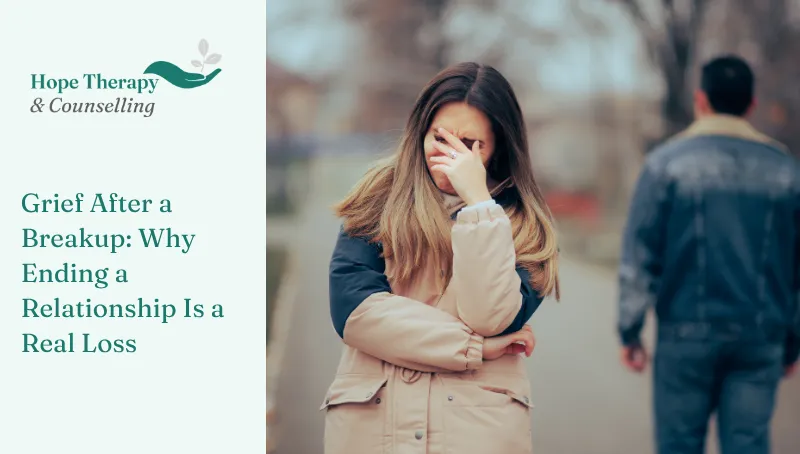
Grief After a Breakup: Why Ending a Relationship Is a Real Loss
- By Steve Pointon
- Person-Centred Counsellor, Hope Therapy & Counselling Services
- 23rd August 2026
- 6–9 minutes

The grief that follows the end of a relationship is real grief. It has the same components, shock, denial, bargaining, sadness, anger, the particular exhaustion of carrying something heavy that nobody else can see, and it can be just as destabilising as the grief that follows a death.
That this is not always acknowledged, either by the person experiencing it or by the people around them, is one of the reasons grief after a breakup can be so isolating and so poorly understood.
This article is intended for general information and educational purposes only and should not be considered medical, psychiatric, psychological, or therapeutic advice. Every person’s circumstances are unique, and reading this article does not create a therapeutic relationship with Hope Therapy & Counselling Services. If you are concerned about your mental health or emotional wellbeing, we encourage you to seek support from a suitably qualified healthcare or mental health professional. Hope Therapy & Counselling Services offers a free 15-minute consultation – book yours now.
Why Does a Breakup Feel Like Grief?
A breakup involves real loss, and real loss produces grief. The relationship that is ending was not just a set of shared activities or a living arrangement. It was a context: the container in which daily life happened, in which the future was imagined, in which the person you were becoming was being shaped. When that ends, it is not just a person who is gone. It is a version of the future, a version of yourself, and a set of assumptions about how life was going to be.
This is why grief after a breakup can feel disproportionate to what has apparently happened. Nobody died. You can still, in principle, speak to this person. The loss is invisible to a large degree, no funeral, no formal acknowledgement, no social script for how those around you should respond. And yet the ground has shifted completely.
Why breakup grief is often minimised
One of the most painful features of grief after a breakup is that it is frequently minimised, by the person experiencing it and by others. There is a cultural script that suggests romantic relationships are by definition survivable, that time will heal it, that being ‘over’ someone should happen within a predictable period, and that to still be grieving after a few months is a sign of weakness or unhealthy attachment rather than normal human pain.
None of this is accurate. The depth of grief after a breakup is not a measure of the quality of the relationship, or whether it was a good relationship, or whether ending it was the right decision. A relationship can have been difficult, even harmful, and still be grieved genuinely and for a long time. The grief is not for the relationship as it was at its worst. It is for what was hoped for, what was invested, and what has now been lost.
Is Grieving a Relationship Normal?
Grieving a relationship is entirely normal, and it follows recognisable patterns that share much with the grief that follows a death. The early phase often involves shock and disbelief, even when the ending was expected. This is followed by a period of acute pain: the intrusive thoughts, the involuntary replaying of conversations, the physical sensation of loss that can feel like an ache in the chest or difficulty breathing.
The five stages model and breakup grief
The five stages framework for grief, denial, anger, bargaining, depression, acceptance, is widely referenced but is easily misapplied in the context of breakup grief. The model was never intended to describe a fixed sequence. It describes states that people in grief often move through, not in order and not on a schedule. What is useful about the model is that it names the anger and bargaining that grief after a breakup frequently involves, neither of which is always expected by the person experiencing them.
What tends to be true is that grief moves when it is allowed to move, when there is enough space to feel it rather than manage it, when the loss is acknowledged as real rather than minimised, and when support is available. It stalls when it is suppressed, rushed, or denied legitimacy.
Why Does Grief After a Breakup Last So Long?
Grief after a breakup lasts as long as it lasts, and there is no honest answer that involves a specific number of weeks. The factors that influence how long grief after a breakup takes to move through include the length and intensity of the relationship, the circumstances of the ending, whether there are children or shared living involved, and what other losses and griefs the breakup activates.
Long-term relationships that ended by choice, where the decision was right but the loss is still real, often involve a particular kind of grief: the grief of having chosen to end something that still mattered. This is no less valid than the grief of being left, though it is often accompanied by an additional layer of guilt that makes it harder to acknowledge publicly.
Relationships that ended badly, with betrayal, conflict, or sudden change, may involve more complex grief that includes anger, shame, and unresolved questions alongside the sadness.
Do you need support with grief after a breakup?
A free 15-minute consultation is a good place to start, whatever stage of this you are at. No preparation needed, no commitment.
What Makes Grief After a Breakup Harder?
Several things tend to make grief after a breakup harder to process. The continued presence of the other person, on social media, in mutual circles, in places that were shared, means the loss is never fully discrete. Grief for a death involves an ending; grief for a relationship can be perpetually interrupted by reminder.
Ambiguity makes grief harder. When the relationship ended inconclusively, when contact continues, when one person has more clarity than the other, or when hope of reconciliation remains alive, grief cannot settle. It continues to be re-triggered rather than moving forward.
Social minimisation makes it harder still. When those around you treat the breakup as a recoverable event rather than a genuine loss, the grief has no legitimate container and can become more disorganised as a result.
How Can Counselling Help With Grief After a Breakup?
Counselling can offer what is often most needed following the end of a relationship: a space where the loss is taken seriously, where its full weight can be named without apology, and where the specific features of this particular grief can be explored without being rushed toward resolution.
A counsellor can help identify what specifically is being grieved, the relationship, the future, the self that existed within it, and can support the work of distinguishing between these different losses. Where grief is complicated by guilt, anger, or ambiguity, counselling can provide a structure for working through what would otherwise remain entangled.
Support from Hope Therapy & Counselling Services is available online nationwide and face-to-face across England. Practitioners experienced in both grief and relationship counselling work with people navigating the end of relationships at any stage of the process.
Ready to Take the First Step?
Grief after a breakup is real grief, and it deserves real support. You do not need to justify the depth of what you are feeling or compare it to other losses before reaching out.
A free, no-obligation 15-minute conversation is a good place to start. No preparation needed, no commitment required.
- Free 15-minute consultation
- No commitment
- Qualified & registered therapists
- LGBTQIA+ affirming support
- NCPS organisational member
- Online nationwide
- Face-to-face across England
- Established 2014
This article is intended for general information and educational purposes only and should not be considered medical, psychiatric, psychological, or therapeutic advice. Every person’s circumstances are unique, and reading this article does not create a therapeutic relationship with Hope Therapy & Counselling Services. If you are concerned about your mental health or emotional wellbeing, we encourage you to seek support from a suitably qualified healthcare or mental health professional. Hope Therapy & Counselling Services offers a free 15-minute consultation – book yours now.
Frequently Asked Questions
Why does a breakup feel like grief?
A breakup involves real loss, not just of a person, but of a version of the future, a version of yourself, and the assumptions about how life was going to be. Real loss produces real grief. The fact that nobody died does not diminish the loss; it only makes it less formally acknowledged, which is part of what makes it so difficult.
Is grieving a relationship normal?
Yes. Grieving a relationship is entirely normal and follows recognisable patterns similar to grief after a death. The depth of grief is not a measure of the quality of the relationship or whether ending it was the right decision. It is a natural response to genuine loss.
How long does grief after a breakup last?
There is no fixed timeline. How long grief after a breakup lasts depends on the length and intensity of the relationship, the circumstances of the ending, whether children or shared living are involved, and what other losses the breakup activates. Grief moves when it is allowed to move, when the loss is taken seriously and support is available.
Find the Right Support for You
Our general counselling services page can help you determine what sort of therapy may be suitable for you.
Get Help With Other Conditions
Our general conditions page is a great place to start.
THE AUTHOR
Registered Member of the BACP · BSc (Hons) Person-Centred Counselling · Level 2 & 3 Person-Centred Counselling · Acceptance and Commitment Therapy (ACT)
Before qualifying as a counsellor, Steve built a varied career centred on supporting and advocating for others. Alongside his work in a hospice supporting palliative patients, families, and bereaved individuals, he has worked as a telephone counsellor, Community Development Officer, and Patient Advocate, giving him extensive experience helping people through some of life’s most challenging circumstances.
Steve holds a BSc (Hons) in Person-Centred Counselling from the University of Derby and is a Registered Member of the British Association for Counselling and Psychotherapy (BACP). His practice is grounded in the Person-Centred approach and complemented by training in Acceptance and Commitment Therapy (ACT), providing clients with both a compassionate therapeutic relationship and practical tools for navigating difficult thoughts and emotions.
His specialist interests include bereavement and grief, cancer support, life-limiting illness, anxiety, depression, life transitions, relationship difficulties, and personal growth. His hospice experience has given him a particular depth of understanding when supporting people facing loss, serious illness, and profound life change.
Steve provides a warm, genuine, and accepting environment where clients can explore their experiences at their own pace. He believes that feeling truly heard and understood creates the foundation for meaningful change, helping people build resilience, find clarity, and move forward with greater confidence.
- MBACP Registered
- BSc (Hons) Person-Centred Counselling
- Acceptance & Commitment Therapy (ACT)
- Person-Centred Counsellor
- Bereavement & Grief
- Hospice Experience
- Life-limiting Illness & Palliative Support
- Cancer Support
- Life Transitions
Free 15-minute consultation
A no-pressure conversation to find the right therapist for you. No commitment needed.
ABOUT THE AUTHOR

Steve Pointon
MBACP
Person-Centred counsellor with a hospice background, supporting adults through bereavement, cancer, life-limiting illness, anxiety, depression, and life’s major transitions.
ABOUT HOPE THERAPY
Qualified registered therapists
Online nationwide across UK
Face-to-face across England
LGBTQIA+ & neurodivergent affirming
Mon–Sun, 9am–9pm
NCPS organisational member
Est 2014
Published: 23rd August 2026 | Written by a registered MBACP counsellor | Reviewed for clinical accuracy before publishing | Review due: August 2028