
BLOG
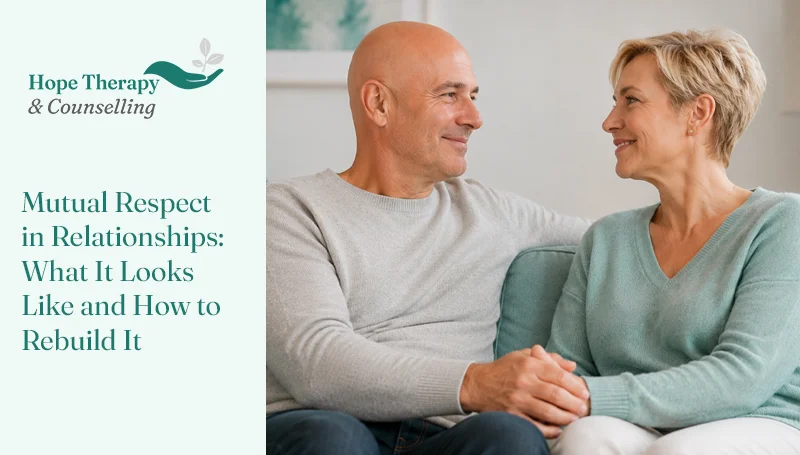
Mutual Respect in Relationships: What It Looks Like and How to Rebuild It
- By Ian Stockbridge
- Founder & Clinical Director, Hope Therapy & Counselling Services
- 17 August 2026
- 9–13 minutes

Respect is one of those qualities in a relationship that tends to be noticed most acutely by its absence. When it is present, it is part of the atmosphere rather than a named feature — the quality of how disagreements are handled, how each person is spoken about when the other is not present, how differences are treated. When it begins to erode, the change can be subtle at first: a sharper edge in tone, a dismissal that would previously not have been said out loud, a sense that the other person is listening less carefully than they once did.
What is mutual respect in a relationship?
Mutual respect in a relationship is the quality of genuine regard for each other as people — not merely as partners in a practical arrangement. It is present when both people treat each other’s thoughts, feelings, needs, and perspectives as genuinely worth taking into account, even when they disagree. It is visible in how conflict is handled, how each person speaks about the other, how differences of opinion are received, and how each person responds when the other is vulnerable. Mutual respect does not require agreeing; it requires treating the other person with consistent dignity, whether or not agreement is present.
This article is intended for general information and educational purposes only and should not be considered medical, psychiatric, psychological, or therapeutic advice. Every person’s circumstances are unique, and reading this article does not create a therapeutic relationship with Hope Therapy & Counselling Services. If you are concerned about your mental health or emotional wellbeing, we encourage you to seek support from a suitably qualified healthcare or mental health professional. Hope Therapy & Counselling Services offers a free 15-minute consultation – book yours now.
What Mutual Respect Actually Looks Like
Mutual respect in a relationship is easier to recognise in practice than to define in the abstract. It shows up in a consistent set of qualities that are present across different situations and different emotional registers — not just in the easy moments but in the difficult ones.
One of its clearest expressions is the quality of attention. In a relationship characterised by mutual respect, each person genuinely listens to the other — not to formulate a counter-argument, but to understand what the other person is actually saying and to take it seriously. This quality of attention is most visible during disagreement, when the temptation to dismiss or override is highest. When two people who respect each other disagree, the disagreement is characterised by engagement with what the other person actually said, rather than with a version of it that is easier to counter.
Respect in Conflict
The way a couple handles conflict is one of the most reliable indicators of the level of mutual respect in the relationship. Conflict in relationships characterised by mutual respect tends to be specific rather than global: the disagreement is about the specific issue, not about the other person’s character. It tends to be contained — it does not involve bringing in every historical grievance, questioning the relationship itself, or attacking the person rather than the problem. And it tends to be resolved without requiring one person to abandon their position entirely, because both people’s perspectives are genuinely considered.
How Each Person Speaks About the Other
Mutual respect is also visible in how each person speaks about the other in contexts where the other is not present. The partner who consistently speaks about their other half with warmth, without mockery or condescension, and who does not use external conversations as an outlet for contempt that is held back in direct interaction, is demonstrating a form of respect that is often more revealing than how they behave when their partner is watching. Conversely, the pattern of speaking dismissively about a partner in their absence often precedes the erosion of respectful behaviour in direct interaction.
How Mutual Respect Erodes
Respect in a relationship rarely disappears suddenly. It more typically erodes gradually, through the accumulation of small interactions that each seem manageable but that collectively shift the register of the relationship.
Familiarity and the Declining Margin
One of the most common mechanisms of respect erosion is the declining margin that comes with familiarity. In the early stages of a relationship, both people typically extend considerable care and deliberateness to how they behave. Over time, as the relationship becomes more established, the quality of attention and care can reduce with it. The partner who was treated with consideration in the first year of the relationship may find, a decade later, that their opinions are more likely to be talked over and their feelings more likely to be minimised. None of this is usually intentional; it is the drift that happens when deliberate attention is not paid to the quality of the relationship over time.
Contempt and the Accumulation of Unresolved Conflict
Research on relationship breakdown has identified contempt — the combination of superiority, mockery, and dismissal — as one of the most corrosive forces in close relationships. Contempt typically develops from the accumulation of unresolved grievances: when conflict is avoided rather than addressed, the unresolved dissatisfaction tends to transform, gradually, into a more generalised negative evaluation of the other person. What began as a specific complaint becomes, over time, a settled view that the other person is inadequate or not worthy of serious consideration. This view tends to express itself in micro-interactions — the eye-roll, the dismissive tone, the sigh — that communicate contempt even without explicit articulation.
Respect eroding in your relationship?
Hope Therapy offers couples counselling — online across England, no GP referral needed.
Signs That Respect Is Diminishing
Because respect erodes gradually, it can be difficult to identify when the shift has become significant. Several indicators tend to precede or accompany the erosion of mutual respect, and recognising them early provides more options for addressing the dynamic.
Changes in How Conflict Is Handled
One of the earliest and most reliable signals is a change in the character of conflict. Disagreements that previously ended in some form of genuine resolution begin to end in one of two patterns instead: either escalation, where conflict becomes more intense and more personal than the subject warrants, or avoidance, where the subject is abandoned without resolution and both people carry the unresolved tension. Both patterns tend to indicate that the quality of listening and genuine consideration that characterises respectful conflict has diminished.
The Experience of Being Dismissed
A consistent experience of feeling dismissed — of raising something that matters to you and finding that it is not genuinely received, countered without being engaged with, or simply not taken as seriously as you think it warrants — is one of the most reliable subjective indicators of declining respect. The question worth asking is whether the experience is consistent and pattern-forming, or whether it is occasional and context-specific.
How to Rebuild Mutual Respect
Rebuilding respect in a relationship after it has eroded requires more than simply deciding to be more considerate. It requires understanding how the erosion happened, what the specific expressions of diminished respect have been, and what each person needs in order to feel genuinely regarded.
Naming What Has Changed
The most important and most difficult early step in rebuilding respect is naming, honestly, what has changed — which requires the kind of conversation that couples who are experiencing diminished respect often find hardest to have. The conversation needs to include both people’s experience: not only the person who feels disrespected naming what they have experienced, but also an honest examination of what has happened in the relationship that has produced this pattern, what both people have contributed to it, and what both people need from each other.
The Role of Repair
Rebuilding respect involves repair — the acknowledgement of specific instances where respect was not shown, and the genuine effort to do differently. Repair in relationships is not primarily about formal apology; it is about the quality of attention and care that follows. The partner who listens more carefully, who responds to the other person’s experience without dismissal, and who holds the relationship’s quality as something worth attending to actively rather than passively, is doing the practical work of repair. This work is ongoing rather than once-and-done.
When Professional Support Can Help
There are situations in which the erosion of mutual respect has progressed to a point where the couple cannot address it productively alone. The patterns that have developed — the contempt, the avoidance, the accumulation of unresolved grievances — tend to produce exactly the conditions that make the necessary conversation most difficult: both people are carrying hurt, both are likely to become defensive, and neither has a reliable outside perspective on what has actually happened.
Couples counselling provides this outside perspective, and the structured space in which the conversation about respect can happen with the support of a skilled third party. A counsellor who can hold both people’s experience, interrupt the patterns that have developed, and help both people articulate what they need can facilitate progress that the couple cannot make alone. Respect, once lost, can be rebuilt — but the conditions for its rebuilding usually need to be different from the conditions in which it eroded.
What to Expect From Couples Counselling
Couples counselling for respect-related issues typically involves some exploration of the history of the dynamic — how the relationship began, what the quality of the early interaction was, and how and when the quality changed. This historical perspective is useful because it provides evidence that a different way of relating has been possible, and helps identify the specific conditions or events that began the erosion. From this foundation, the work moves towards developing a shared understanding of what mutual respect looks like for this particular couple — what each person needs to feel genuinely regarded — and practical approaches to rebuilding it in daily life.
Ready to Take the First Step?
If respect has been eroding in your relationship and you would like support in understanding what has happened and rebuilding something different, the counsellors at Hope Therapy can help. We offer individual and couples counselling online across England, with no waiting list and no GP referral required. Your first 15-minute consultation is free.
- Free 15-minute consultation
- No commitment
- Online across England
- No GP Referral needed
- Qualified & registered therapists
- LGBTQIA+ affirming support
- NCPS organisational member
- Online nationwide
- Face-to-face across England
- Established 2014
This article is intended for general information and educational purposes only and should not be considered medical, psychiatric, psychological, or therapeutic advice. Every person’s circumstances are unique, and reading this article does not create a therapeutic relationship with Hope Therapy & Counselling Services. If you are concerned about your mental health or emotional wellbeing, we encourage you to seek support from a suitably qualified healthcare or mental health professional. Hope Therapy & Counselling Services offers a free 15-minute consultation – book yours now.
Frequently Asked Questions About Mutual Respect in Relationships
Can a relationship survive without mutual respect?
In the short term, yes — many relationships continue for long periods with diminished mutual respect, particularly when other bonds are strong. But the quality of the relationship tends to deteriorate progressively when respect is consistently absent, and the psychological cost for both people tends to increase over time. A relationship characterised by contempt, dismissal, or consistent disregard for one or both people’s experience is one that is causing active harm to both people’s wellbeing, even when it continues. The question is not usually whether the relationship can survive without respect, but whether it should be asked to.
What is the difference between respect and agreement?
They are entirely separate. Mutual respect does not require two people to agree, to share values, or to have compatible preferences. It requires them to treat each other’s perspectives as genuinely worth taking into account, even when those perspectives are different. Two people who disagree consistently but who engage with each other’s positions seriously, who handle conflict without contempt or dismissal, and who maintain a consistent quality of regard for each other as people, are demonstrating more genuine mutual respect than two people who agree on everything but manage that agreement through one person consistently deferring to the other.
How long does it take to rebuild respect in a relationship?
There is no single timeline. The pace of rebuilding tends to depend on how long the erosion has been happening, how deep the accumulated grievances are, and how genuinely both people engage with the work of change. Where the erosion is relatively recent and both people are genuinely invested in addressing it, change can be meaningful and visible within a relatively short period of therapeutic work. Where the erosion has been long-term and contempt has become an established feature of the dynamic, the work tends to be longer and more gradual. In both cases, the direction of change is more important than its pace.
Find the Right Support for You
Our general counselling services page can help you determine what sort of therapy may be suitable for you.
Get Help With Other Conditions
Our general conditions page is a great place to start.
THE AUTHOR

Ian Stockbridge
- MBACP (Senior Accredited)
Founder & Clinical Director — Hope Therapy & Counselling Services
MBACP (Senior Accredited) · SNCPS (Acc) · BSc (Hons) CBT · PGCert Clinical Supervision
Founder of Hope Therapy, published author, clinical supervisor, and co-presenter of The Talk Room Podcast. Practising therapist with 25+ years of senior leadership experience.
Before Ian Stockbridge was a therapist, he was a leader. For more than 25 years he worked in senior management and directorial roles across commercial organisations — at times managing teams of more than 200 people. He was effective at it. But the longer he did it, the harder something became to ignore. The people around him were struggling. Capable, committed, often high-achieving people carrying invisible weight that had nowhere to go. Stress accumulated quietly across months and years. Anxiety managed behind professionalism. Relationships and mental health dealt with in the margins of a working life that left little room for either.
- SCoPEd Band C
- 25+ Years Leadership
- Clinical Supervisor
- Published Author
- Podcast Co-Host
- BSc (Hons) CBT
- PGCert Clinical Supervision
- LGBTQIA+ Affirming
Free 15-minute consultation
A no-pressure conversation to find the right therapist for you. No commitment needed.
ABOUT THE AUTHOR
Ian Stockbridge
MBACP (Senior Accredited)
Founder of Hope Therapy, published author, clinical supervisor, and co-presenter of The Talk Room Podcast. Practising therapist with 25+ years of senior leadership experience.
ABOUT HOPE THERAPY
Qualified registered therapists
Online nationwide across UK
Face-to-face across England
LGBTQIA+ & neurodivergent affirming
Mon–Sun, 9am–9pm
NCPS organisational member
Est 2014
Published: 17 August 2026 | Written by a registered MBACP counsellor | Reviewed for clinical accuracy before publishing | Review due: August 2028
More Articles About Relationships
Signs of a Toxic Friendship — and What to Do About Them
Narcissistic Patterns in Relationships: Recognising Emotional Manipulation