BLOG
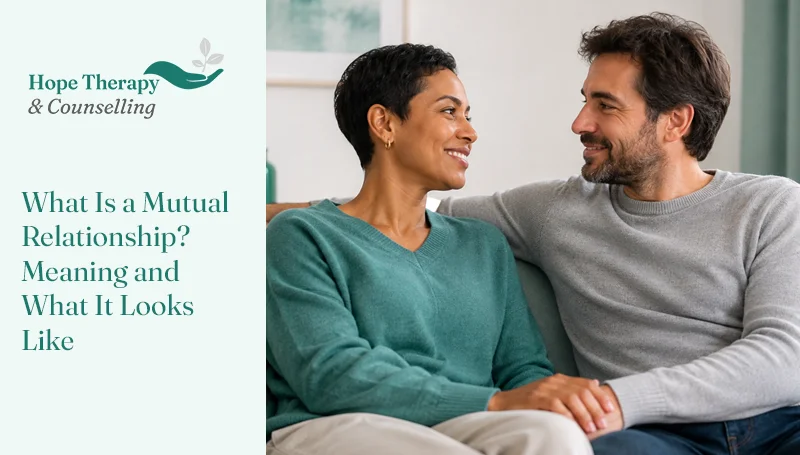
What Is a Mutual Relationship? Meaning and What It Looks Like
- By Ian Stockbridge
- Founder & Clinical Director, Hope Therapy & Counselling Services
- 17 August 2026
- 7–11 minutes

The word “mutual” appears frequently in conversations about love and relationships — and it gets used in ways that are sometimes vague. A mutual relationship is not simply one in which two people like each other, or one that has lasted a long time. It has a specific meaning that matters, particularly when it comes to understanding whether a relationship is genuinely working for both people involved.
What is a mutual relationship?
A mutual relationship is one in which care, effort, respect, and emotional investment flow in both directions. Both people contribute to the relationship, both people’s needs receive attention, and both people feel valued and considered by the other. Mutuality is what distinguishes a relationship that is genuinely shared from one that is primarily serving one person’s needs.
This article is intended for general information and educational purposes only and should not be considered medical, psychiatric, psychological, or therapeutic advice. Every person’s circumstances are unique, and reading this article does not create a therapeutic relationship with Hope Therapy & Counselling Services. If you are concerned about your mental health or emotional wellbeing, we encourage you to seek support from a suitably qualified healthcare or mental health professional. Hope Therapy & Counselling Services offers a free 15-minute consultation – book yours now.
What Does Mutual Mean in a Relationship?
The word “mutual” means shared or experienced by two people in the same way or to a similar degree. In the context of relationships, mutuality refers to the quality of the exchange between two people — whether the giving, the care, the emotional presence, and the effort are genuinely reciprocal.
It does not mean that both people contribute in identical ways or at identical times. Mutuality is not about symmetry in any given moment. It is about the broader pattern: over time, do both people invest? Do both people’s needs get addressed? Does each person feel that the other genuinely cares about their experience, not just their own?
Mutual vs One-Sided
The clearest way to understand mutual is by contrast with one-sided. A one-sided relationship is one where the investment, care, or effort is primarily flowing from one person to the other without comparable return. One person initiates contact; one person makes adjustments; one person’s feelings and needs take up the space in the relationship while the other’s are rarely acknowledged or addressed.
A mutual relationship is not one that is entirely free of imbalance — all relationships have periods of imbalance, particularly during difficulty, illness, or transition. What makes a relationship mutual is that the imbalance is temporary, acknowledged, and tends to rebalance over time rather than becoming a fixed pattern.
Mutual Relationship Meaning in Love
In romantic contexts, the phrase “mutual relationship” is often used to mean that both people have feelings for each other — that the attraction or love is reciprocated rather than one-sided. A mutual relationship in this sense is one where both people are choosing each other, where the emotional investment, the desire for connection, and the commitment are genuinely shared. This is distinct from a situation where one person is significantly more invested than the other, which is a common source of relational pain.
What Does a Mutual Relationship Look Like in Practice?
Understanding the concept of mutuality is one thing. Recognising it — or its absence — in an actual relationship is another. The signs of a genuinely mutual relationship are not always dramatic. They tend to be quieter, more accumulated, more present in the texture of ordinary interaction than in grand gestures.
Both People Initiate
In a mutual relationship, contact, plans, and connection are not consistently initiated by one person. Both people reach out. Both people suggest spending time together. Both people check in on the other when they sense something is wrong. A pattern where one person is almost always the one reaching out, and the other is almost always responding (or not), suggests an imbalance in interest or investment.
Both People’s Needs Are Addressed
In a mutual relationship, both people’s emotional needs receive genuine attention. When one person is struggling, the other notices and responds. Conversations are not consistently dominated by one person’s experience while the other listens. Decisions that affect both people are made with both people’s preferences in mind. Each person’s experience matters to the other, and this shows up in how they treat each other.
There Is Genuine Interest in Each Other
One of the quieter signs of mutuality is the presence of genuine curiosity about the other person: interest in their inner life, their experiences, their thoughts and feelings, not only as they relate to the relationship but as they relate to the person themselves. A mutual relationship involves two people who are actually interested in each other, not just in what the other person provides for them.
Questioning whether your relationship is mutual?
Hope Therapy offers a free 15-minute consultation — online across England, no GP referral needed.
When Mutuality Is Missing: What One-Sidedness Feels Like
For people in relationships where mutuality is significantly absent, the experience is recognisable: the sense of working hard for something that does not come back. Of caring more than the other person seems to care. Of adjusting, accommodating, and giving ground while the other person’s needs, preferences, and feelings consistently take precedence.
This experience often produces a specific kind of confusion, because the relationship may have periods or aspects that feel good — moments of genuine connection, the other person’s positive qualities, the shared history — and these make it difficult to see the overall pattern clearly.
The Gradual Erosion of Self
A longer-term effect of sustained one-sidedness is a gradual diminishment of the person doing most of the work. The adjustments accumulate. The self-expression that was edited to avoid the other person’s reaction. The needs that went unexpressed because they did not seem to register. Over time, this kind of relationship tends to leave the person less themselves than when they entered it — smaller in some way that is hard to precisely articulate but clearly felt.
What Keeps People in One-Sided Relationships
People remain in significantly one-sided relationships for reasons that make psychological sense. Anxious attachment produces a particularly strong pull towards maintaining a connection even when it is painful — the anxiety of potential loss outweighs the chronic discomfort of the imbalance. Sunk cost — the investment already made, the time, the effort, the hope — makes it difficult to acknowledge that the situation is not likely to change.
Building Mutuality: What It Actually Requires
Mutuality is not simply a property of compatible people — it is something that is actively built and maintained. Some couples have good natural compatibility but do not develop genuine mutuality because neither person has the skills or habits that mutuality requires. Others develop deep mutuality across significant differences because both people are genuinely committed to understanding and attending to each other.
The Role of Communication
Mutuality requires the kind of communication that allows both people’s needs, preferences, and experiences to be expressed and heard. A person who learned to suppress their needs to maintain connection will struggle to contribute to mutuality even when their partner is genuinely interested in meeting them, because the suppression is automatic — the information about what they need does not reach the surface of the conversation.
Mutuality and Attachment Security
The capacity for mutuality is closely related to attachment security. Securely attached people find it relatively natural to both give and receive — to be genuinely attentive to a partner’s needs without losing sight of their own. People with insecure attachment tend to have characteristic difficulties with one or both sides of this equation. Anxious attachment may produce over-giving and under-asserting. Avoidant attachment may produce under-giving and difficulty accepting closeness. Both patterns are obstacles to mutuality, and both respond to therapeutic work.
Mutual Relationships in Different Contexts
The concept of mutuality applies across different types of relationships, not only romantic partnerships. In friendships, mutuality means that both people invest in the connection, both people show up for each other, and the relationship is not consistently organised around one person’s needs and preferences. In family relationships, mutuality within appropriate structural roles means that respect, care, and genuine interest flow in both directions.
Mutual Relationships and Mental Health
Research on wellbeing and mental health consistently identifies the quality of close relationships as one of the strongest predictors of mental health outcomes. Not the number of relationships, not their length, but their quality — and mutuality is central to quality. People in genuinely mutual close relationships tend to have better mental health, better physical health, and greater resilience in the face of difficulty. The experience of being genuinely known, valued, and considered by another person appears to meet something fundamental in human psychological need.
Ready to Take the First Step?
If you are questioning the mutuality in your relationship — whether in a long-term partnership or in something newer — the counsellors at Hope Therapy can help. We offer individual and couples counselling online across England, with no waiting list and no GP referral required. Your first 15-minute consultation is free.
- Free 15-minute consultation
- No commitment
- Online across England
- No GP Referral needed
- Qualified & registered therapists
- LGBTQIA+ affirming support
- NCPS organisational member
- Online nationwide
- Face-to-face across England
- Established 2014
This article is intended for general information and educational purposes only and should not be considered medical, psychiatric, psychological, or therapeutic advice. Every person’s circumstances are unique, and reading this article does not create a therapeutic relationship with Hope Therapy & Counselling Services. If you are concerned about your mental health or emotional wellbeing, we encourage you to seek support from a suitably qualified healthcare or mental health professional. Hope Therapy & Counselling Services offers a free 15-minute consultation – book yours now.
Frequently Asked Questions About Mutual Relationships
What is the difference between a mutual relationship and a one-sided one?
In a mutual relationship, care, effort, interest, and emotional investment flow in both directions. Both people initiate, both people’s needs receive attention, and both people feel genuinely valued by the other. In a one-sided relationship, these things primarily flow from one person to the other without comparable return. The person on the giving end typically experiences this as exhausting, confusing, or gradually demoralising — even when the relationship has real positive aspects.
Can a relationship become mutual if it started one-sided?
Yes — though it typically requires both people to recognise the imbalance and both people to be genuinely motivated to address it. One-sidedness often develops gradually rather than being a fixed feature from the start, which means it can also shift gradually in the other direction. Couples therapy can be particularly useful here: it provides a supported space in which the pattern can be named clearly by both people without the defensiveness that naming it in an ordinary conversation often produces.
Does a mutual relationship mean both people feel exactly the same about each other?
No — mutuality is about the quality and direction of the exchange, not about identical feelings. Two people in a genuinely mutual relationship may feel differently about many things, may have different levels of expressiveness, and may come from different relational backgrounds. What makes the relationship mutual is that both people are choosing it, both people are invested in it, and both people’s wellbeing matters to the other.
Find the Right Support for You
Our general counselling services page can help you determine what sort of therapy may be suitable for you.
Get Help With Other Conditions
Our general conditions page is a great place to start.
THE AUTHOR

Ian Stockbridge
- MBACP (Senior Accredited)
Founder & Clinical Director — Hope Therapy & Counselling Services
MBACP (Senior Accredited) · SNCPS (Acc) · BSc (Hons) CBT · PGCert Clinical Supervision
Founder of Hope Therapy, published author, clinical supervisor, and co-presenter of The Talk Room Podcast. Practising therapist with 25+ years of senior leadership experience.
Before Ian Stockbridge was a therapist, he was a leader. For more than 25 years he worked in senior management and directorial roles across commercial organisations — at times managing teams of more than 200 people. He was effective at it. But the longer he did it, the harder something became to ignore. The people around him were struggling. Capable, committed, often high-achieving people carrying invisible weight that had nowhere to go. Stress accumulated quietly across months and years. Anxiety managed behind professionalism. Relationships and mental health dealt with in the margins of a working life that left little room for either.
- SCoPEd Band C
- 25+ Years Leadership
- Clinical Supervisor
- Published Author
- Podcast Co-Host
- BSc (Hons) CBT
- PGCert Clinical Supervision
- LGBTQIA+ Affirming
Free 15-minute consultation
A no-pressure conversation to find the right therapist for you. No commitment needed.
IN THIS ARTICLE
ABOUT THE AUTHOR
Ian Stockbridge
MBACP (Senior Accredited)
Founder of Hope Therapy, published author, clinical supervisor, and co-presenter of The Talk Room Podcast. Practising therapist with 25+ years of senior leadership experience.
ABOUT HOPE THERAPY
Qualified registered therapists
Online nationwide across UK
Face-to-face across England
LGBTQIA+ & neurodivergent affirming
Mon–Sun, 9am–9pm
NCPS organisational member
Est 2014
Published: 17 August 2026 | Written by a registered MBACP counsellor | Reviewed for clinical accuracy before publishing | Review due: August 2028
More Articles About Relationships
Signs of a Toxic Friendship — and What to Do About Them
Narcissistic Patterns in Relationships: Recognising Emotional Manipulation