
BLOG
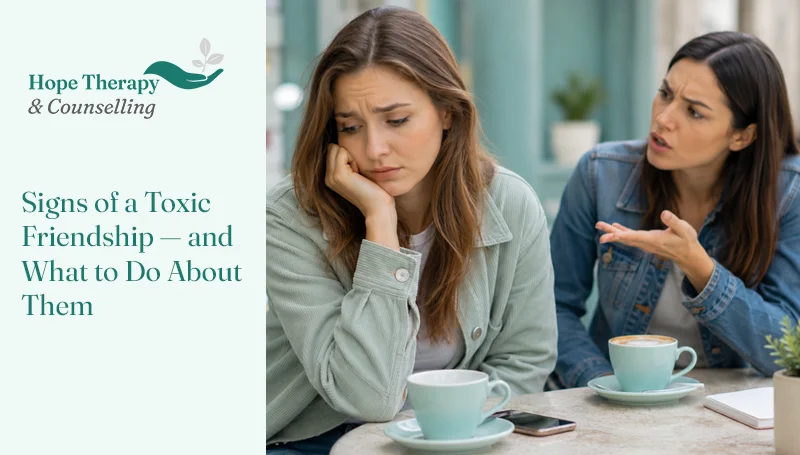
Signs of a Toxic Friendship — and What to Do About Them
- By Ian Stockbridge
- Founder & Clinical Director, Hope Therapy & Counselling Services
- 19 August 2026
- 8–12 minutes

Most people who end up in a toxic friendship did not see it coming. The pattern typically establishes itself gradually, through accumulations of small things — a comment here, a missed reciprocation there, a recurring dynamic that leaves one person consistently drained and the other consistently fine. By the time the question “is this friendship actually good for me?” surfaces consciously, the person asking it has usually been carrying the answer for some time without quite letting themselves know it.
What are the signs of a toxic friendship?
The signs of a toxic friendship include consistently feeling drained, dismissed, or anxious after time with the person; one-sided investment where your needs and feelings are regularly minimised or ignored; a pattern of criticism, comparison or subtle put-downs; feeling that you must manage the other person’s reactions rather than expressing yourself freely; and a persistent sense that the friendship costs more than it gives. A single difficult episode does not make a friendship toxic — the signs are patterns, not one-off events.
This article is intended for general information and educational purposes only and should not be considered medical, psychiatric, psychological, or therapeutic advice. Every person’s circumstances are unique, and reading this article does not create a therapeutic relationship with Hope Therapy & Counselling Services. If you are concerned about your mental health or emotional wellbeing, we encourage you to seek support from a suitably qualified healthcare or mental health professional. Hope Therapy & Counselling Services offers a free 15-minute consultation – book yours now.
What Makes a Friendship Toxic?
The word “toxic” is used broadly, and not always precisely. A difficult friendship goes through hard patches: conflict, misunderstanding, periods of distance, friction that comes from two people both having needs and not always managing them well. These difficulties are normal, and working through them can strengthen a friendship. A toxic friendship is characterised by a different quality: a consistent pattern in which one person is repeatedly diminished, depleted, or destabilised by the dynamics of the relationship. The damage is not incidental but structural — it is how the friendship routinely operates.
The Role of Intention
Toxicity in a friendship does not require the other person to intend harm. Many toxic friendships involve a person who is genuinely unaware of their impact, who would be distressed to know the effect they are having, and who is operating from their own unaddressed wounds rather than from malice. The question of intention matters for understanding and for compassion — it does not change whether the friendship is causing harm or whether it needs to change.
Signs of a Toxic Friendship: Energy and Reciprocity
The most consistent signs of a toxic friendship are relational rather than dramatic. They show up not in single explosive events but in the accumulated experience of how the friendship leaves you feeling and what it consistently requires from you.
Feeling Consistently Drained
One of the earliest signs that a friendship may be toxic is the experience of consistent depletion after spending time with the person. Where healthy friendships tend to leave people feeling broadly energised, supported, or connected — even after difficult conversations — a toxic friendship leaves a particular residue: a tiredness that is not simply the tiredness of a long evening, but a deeper sense of having given more than was received. If you reliably feel worse after time with a particular person, and better when you have some distance from them, that pattern is worth taking seriously.
One-Sided Investment
Reciprocity — the sense that care, attention, and effort move in both directions — is fundamental to a healthy friendship. In toxic friendships, this reciprocity is consistently absent in one direction. One person’s needs, problems, and feelings are reliably centred; the other person’s are minimised, dismissed, or simply never asked about. People in one-sided friendships often find themselves working very hard to explain or justify the asymmetry. The sign of a toxic dynamic is when the asymmetry is structural and enduring — not an exception caused by specific circumstances but the consistent pattern of how the friendship operates.
If this feels familiar
The fact that you are reading this article and recognising patterns in a friendship you care about is itself significant. It takes honesty to look clearly at something that has history, warmth, and investment attached to it.
Trying to make sense of a difficult friendship?
Hope Therapy offers a free 15-minute consultation — online across England, no GP referral needed.
Signs of a Toxic Friendship: Criticism and Control
Some of the clearest signs of a toxic friendship show up in patterns of communication — in how the person speaks to you, how they respond when things go well for you, and what happens when you try to express your own perspective.
Criticism, Comparison and Put-Downs
Chronic low-level criticism — often delivered as a joke, as concern, or as honesty — is a consistent feature of toxic friendships. The person may regularly comment on your choices, appearance, relationships, or achievements in ways that seem casual but reliably leave you feeling smaller. There may be a pattern of comparison that positions your life as less successful, less interesting, or less admirable. The comments may be individually deniable — each one could be written off as a bad day or a clumsy delivery — but the cumulative pattern tells a clearer story.
Jealousy is a specific variation of this pattern. A toxic jealous friend may celebrate your successes publicly while undermining them privately, compete with you for attention or status, or respond to your good news with a lack of warmth that you learn, over time, not to share good news at all.
Walking on Eggshells
A significant sign of a toxic friendship is the experience of self-editing in order to manage the other person’s reactions. If you find yourself thinking carefully about how to phrase things to avoid upset, withholding honest feelings because the response will be unpredictable, or softening your actual views to keep the peace, you are operating in a friendship that requires more self-management than most healthy friendships do. The sign of a toxic dynamic is when the tact becomes a persistent, effortful performance driven by anxiety about the other person’s responses rather than simple consideration for their feelings.
The Emotional and Psychological Impact
The impact of a toxic friendship on the person experiencing it is not always immediately legible as being caused by the friendship. It often shows up as a more general deterioration in mood, confidence, or self-perception that is hard to attribute precisely.
Self-Doubt and Reduced Confidence
One of the more insidious effects of a toxic friendship is the gradual erosion of confidence and self-trust. When someone who is supposed to know you well consistently implies that your judgements are poor, your feelings are excessive, or your achievements are ordinary, their voice eventually begins to participate in your internal commentary. Many people who have been in long-term toxic friendships describe a pronounced reduction in self-confidence — a change that they often do not connect to the friendship until they have some distance from it.
Anxiety and Dread
The experience of dread before seeing a friend — a reluctance or mild anxiety about an upcoming interaction with someone who is supposed to be a source of support — is a reliable indicator that something is wrong. Healthy friendships are generally looked forward to, even when they involve difficult conversations. The consistent experience of not wanting to see someone you call a friend, of feeling relieved when plans fall through, of feeling anxious about what mood they will be in, is worth paying attention to. These are the body’s honest reporting on an experience the mind may be working hard to justify or excuse.
Is It a Toxic Friendship or a Difficult Patch?
The question of whether a friendship is genuinely toxic or simply going through a difficult period is one that many people find hard to answer, particularly when the friendship has history or when the other person is intermittently warm and caring.
The most useful frame is temporal pattern. A difficult patch in an otherwise healthy friendship is bounded in time — it has a cause, it is not the norm, and the friendship tends to return to its baseline. A toxic dynamic is the baseline. The way to distinguish between them is to look honestly at what is consistently true about the friendship over time, rather than at the best moments or the hardest moments. Is the warmth the norm with occasional difficulty, or is the difficulty the norm with occasional warmth?
When the Friendship Has History
Long-standing friendships are particularly hard to assess honestly because the shared history creates a powerful sense of investment and obligation. People often apply a more lenient standard to a friend they have known for twenty years than they would to a newer relationship, even when the dynamics are objectively more damaging. The length of a friendship is not a reason to tolerate harm — it is a reason to approach the assessment with care and honesty, which is different from indefinitely excusing a pattern that is not good for you.
Ready to Take the First Step?
If the dynamics in a friendship are affecting your wellbeing and you would like support in understanding them and working out what to do, the counsellors at Hope Therapy are here to help. We offer individual counselling online across England, with no waiting list and no GP referral required. Your first 15-minute consultation is free.
- Free 15-minute consultation
- No commitment
- Online across England
- No GP Referral needed
- Qualified & registered therapists
- LGBTQIA+ affirming support
- NCPS organisational member
- Online nationwide
- Face-to-face across England
- Established 2014
This article is intended for general information and educational purposes only and should not be considered medical, psychiatric, psychological, or therapeutic advice. Every person’s circumstances are unique, and reading this article does not create a therapeutic relationship with Hope Therapy & Counselling Services. If you are concerned about your mental health or emotional wellbeing, we encourage you to seek support from a suitably qualified healthcare or mental health professional. Hope Therapy & Counselling Services offers a free 15-minute consultation – book yours now.
Frequently Asked Questions About Toxic Friendships
Can a toxic friendship be repaired?
Some can, if both people are genuinely willing to be honest about the dynamics and to work on changing them. The conditions for repair are typically: the other person is able to hear honest feedback without becoming defensive or retaliatory; they are willing to acknowledge the impact of their behaviour rather than minimising it; and there is evidence over time — not just promises — that things are actually changing. Where one person is doing all the work and absorbing all the disappointment when change does not materialise, repair is not happening in any meaningful sense.
Am I being too sensitive, or is the friendship genuinely toxic?
This is one of the most common questions people carry about a friendship they are uncertain about. Sensitivity is not a disqualifying characteristic — the fact that something hurts does not mean you are wrong about it. A more useful question than “am I too sensitive?” is “would most people in my situation feel the same way, and is this pattern consistent?” If the discomfort is consistent rather than occasional, if others who know the situation validate your perception, and if you feel clearer and better when you have some distance from the friendship, your assessment is likely more accurate than the self-doubt suggests.
Do I have to end the friendship, or are there other options?
Ending the friendship is one option, not the only one. Depending on the nature of the dynamics and the other person’s capacity for honest engagement, other options include: having a direct conversation about the specific patterns that are causing harm; reducing the frequency and depth of contact without a formal ending; changing the terms of the friendship so that less of yourself is invested; or seeking individual counselling to help you understand the dynamics and make a decision that is genuinely yours. A counsellor can help you think through your options without prescribing what you should do.
Find the Right Support for You
Our general counselling services page can help you determine what sort of therapy may be suitable for you.
Get Help With Other Conditions
Our general conditions page is a great place to start.
THE AUTHOR

Ian Stockbridge
- MBACP (Senior Accredited)
Founder & Clinical Director — Hope Therapy & Counselling Services
MBACP (Senior Accredited) · SNCPS (Acc) · BSc (Hons) CBT · PGCert Clinical Supervision
Founder of Hope Therapy, published author, clinical supervisor, and co-presenter of The Talk Room Podcast. Practising therapist with 25+ years of senior leadership experience.
Before Ian Stockbridge was a therapist, he was a leader. For more than 25 years he worked in senior management and directorial roles across commercial organisations — at times managing teams of more than 200 people. He was effective at it. But the longer he did it, the harder something became to ignore. The people around him were struggling. Capable, committed, often high-achieving people carrying invisible weight that had nowhere to go. Stress accumulated quietly across months and years. Anxiety managed behind professionalism. Relationships and mental health dealt with in the margins of a working life that left little room for either.
- SCoPEd Band C
- 25+ Years Leadership
- Clinical Supervisor
- Published Author
- Podcast Co-Host
- BSc (Hons) CBT
- PGCert Clinical Supervision
- LGBTQIA+ Affirming
Free 15-minute consultation
A no-pressure conversation to find the right therapist for you. No commitment needed.
ABOUT THE AUTHOR
Ian Stockbridge
MBACP (Senior Accredited)
Founder of Hope Therapy, published author, clinical supervisor, and co-presenter of The Talk Room Podcast. Practising therapist with 25+ years of senior leadership experience.
ABOUT HOPE THERAPY
Qualified registered therapists
Online nationwide across UK
Face-to-face across England
LGBTQIA+ & neurodivergent affirming
Mon–Sun, 9am–9pm
NCPS organisational member
Est 2014
Published: 19 August 2026 | Written by a registered MBACP counsellor | Reviewed for clinical accuracy before publishing | Review due: August 2028
More Articles About Toxic Relationships

What Is Trauma Bonding?

What Is an Exploitative Relationship? Signs and What to Do