BLOG
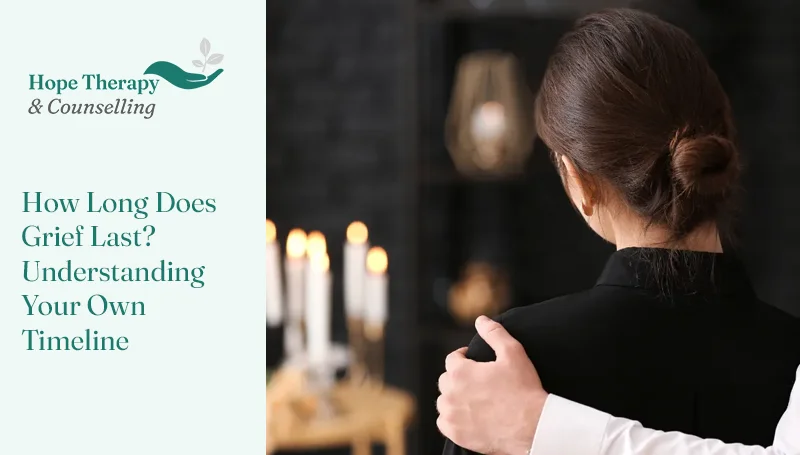
How Long Does Grief Last? Understanding Your Own Timeline
- By Ian Stockbridge
- Founder & Clinical Director, Hope Therapy & Counselling Services
- 28th July 2026
- 8–11 minutes

In the rawness of loss, or even months and years later, one question often surfaces, quietly or aloud: how long does grief last? Perhaps you are wondering when the pain will ease, or worrying that you should somehow be further along by now.
Perhaps someone you love has died and you simply want to know what to expect. It is one of the most human questions there is, and it deserves an honest answer rather than a tidy one. This article gently explores how long grief lasts, why there is no set timeline, and how support can help you carry it. There is no right or wrong way to grieve.
This article is intended for general information and educational purposes only and should not be considered medical, psychiatric, psychological, or therapeutic advice. Every person’s circumstances are unique, and reading this article does not create a therapeutic relationship with Hope Therapy & Counselling Services. If you are concerned about your mental health or emotional wellbeing, we encourage you to seek support from a suitably qualified healthcare or mental health professional. Hope Therapy & Counselling Services offers a free 15-minute consultation which can be booked at – books yours here.
How long does grief last?
So, how long does grief last? The honest answer is that grief has no fixed timeline. It lasts as long as it lasts, and that is genuinely different for every person and every loss. Rather than ending on a schedule, grief tends to change over time, gradually softening and shifting as you slowly learn to live alongside what has happened.
It can be painful to hear that there is no neat answer, especially when you long for the hurt to ease. Yet the idea that grief should be finished by a certain point is a myth, and often a harmful one, because it can leave people feeling they are grieving wrongly when they are simply grieving. There is no deadline here, and no correct pace.
Some days will feel lighter and some much heavier, sometimes years apart, and all of that can be a completely normal part of loving someone and losing them. Being gentle with yourself, rather than measuring yourself against an imagined schedule, is often the kindest and most helpful place to begin.
Why is there no fixed timeline for grief?
Grief resists a tidy timeline because it is not a single event to get through, but a deeply personal process shaped by who you are and what you have lost. Two things in particular explain why no two experiences look the same, and why comparison rarely helps
Grief is as individual as the relationship
Every relationship is unique, so every grief is unique too. The depth of your bond, the part that person played in your daily life, and the countless small ways you shared the world all shape how their absence feels.
A loss that reshapes your everyday routine may be felt differently from one that does not, though neither is more or less valid. Because your relationship was unlike anyone else’s, your grief will be unlike anyone else’s, which is exactly why other people’s timelines are not a fair measure of your own.
It comes in waves, not a straight line
Grief rarely moves in neat, predictable steps, however much we might wish it did. Far more often it arrives in waves, easing for a while and then returning, sometimes without warning. A song, a smell, an anniversary or an ordinary Tuesday can bring it flooding back long after you thought the worst had passed.
This is not a sign of going backwards or failing to cope. It is simply how grief tends to move, and understanding that can take away some of the fear when a wave arrives unexpectedly.
What can affect how grief unfolds?
While no two griefs are the same, some things do influence how the experience unfolds over time. These are not rules or predictors, simply factors that can shape the shape of grief for different people.
The nature of the loss and the relationship
The circumstances of a loss often matter. A death that was sudden or traumatic can feel different from one that was expected, and a relationship that was complicated can bring its own tangle of feelings, including ones that surprise or trouble you.
None of this makes grief better or worse, only different. Whatever the nature of your loss, the feelings that come with it are valid, even the ones that are difficult to admit to. There is room for all of it here.
Support, circumstances and how a loss is acknowledged
Whether you feel supported, and whether those around you recognise your loss, can also shape how grief is carried. Losses that others quietly dismiss, or do not think to acknowledge, can be especially lonely to bear.
Practical pressures, from work to caring for others, can leave little room to grieve at all. Having space, and people who allow you to feel what you feel without rushing you, tends to make grief a little more bearable, even when nothing can take the pain away.
Does grief ever fully go away?
For most people, grief does not vanish so much as change. In time, the sharp, constant ache often softens into something you carry rather than something that overwhelms you. You do not get over the person, and you would not want to. Instead, you gradually learn to live a full life around the loss.
One helpful way to picture this is that grief does not necessarily shrink, but your life slowly grows around it. The loss remains part of you, and moments of deep sadness can still surface, especially at significant times. Yet, alongside them, room returns for joy, connection and meaning.
This is also the deeper truth behind the question of how long does grief last: it is less about reaching an end point, and more about how, over time, the loss settles into a different and more bearable place in your life. Carrying grief and living fully are not opposites.
Over time, and often with support, most people find they can hold both, keeping love for the person alive while still moving forward with their own life.
When might it help to seek support?
There is no threshold of suffering you must reach before you are allowed support, and you never have to grieve alone. That said, there are times when reaching for help can matter especially. If your grief feels unrelenting rather than slowly shifting, if it is severely affecting your ability to function day to day, or if you feel stuck and unable to move at all, talking to someone can help.
It is also worth being gentle and honest with yourself about how you are coping. If you find yourself feeling that you cannot go on, or that life is not worth living, please treat that as a sign to speak to your GP or a qualified professional as soon as you can, so you do not have to hold it alone. Seeking support is never a sign of weakness or of grieving wrongly. It is simply a way of making sure you have someone alongside you while you carry something heavy.
Grief can be so much to hold on your own. If you would value a gentle first conversation, a free, no-obligation 15-minute chat is a place to be heard, you can book one here:
How can counselling help with grief?
Counselling does not aim to speed grief up or to help you get over your loss, because grief is not a problem to be solved. Instead, bereavement counselling offers a quiet, steady space to feel what you feel, to say the things that are hard to say elsewhere, and to be met with understanding rather than expectation.
For some people, that means finding room to express feelings they have been holding in for the sake of others. For others, it is a place to make sense of a complicated loss, or to sit with sadness without being hurried through it. A counsellor will not tell you how long your grief should take, or push you toward any particular outcome. The work simply unfolds at your pace. Because we also offer online counselling alongside our wider counselling support, help can be there in whatever way feels most manageable, whenever you feel ready for it.
Where to go from here
There is no single right way to respond to any of this. Some people want to understand their grief, while others simply want to feel less alone in it. Both are completely valid, and neither has to be worked out today, or on anyone else’s schedule.
If reading this has offered even a little reassurance, that matters. You are allowed to grieve in your own way and your own time, and to be as gentle with yourself as you would be with someone you love. When and if you feel ready, talking it through with someone who understands loss can be a steady next step, at whatever pace feels right for you.
Visit our general services page and conditions page if you are unsure where to start or what type of counselling may be suitable for you.
Ready to Take the First Step?
If something here has resonated, we would be glad to talk it through with you. Hope Therapy & Counselling Services offers a free, no-obligation 15-minute consultation, a relaxed chance to ask questions and explore whether working together might suit you.
There is no pressure and no commitment. When you feel ready, you can book your free consultation here:
- Free 15-minute consultation
- No commitment
- Qualified & registered therapists
- LGBTQIA+ affirming support
- NCPS organisational member
- Online nationwide
- Face-to-face across England
- Established 2014
This article is intended for general information and educational purposes only and should not be considered medical, psychiatric, psychological, or therapeutic advice. Every person’s circumstances are unique, and reading this article does not create a therapeutic relationship with Hope Therapy & Counselling Services. If you are concerned about your mental health or emotional wellbeing, we encourage you to seek support from a suitably qualified healthcare or mental health professional. Hope Therapy & Counselling Services offers a free 15-minute consultation which can be booked at – books yours here.
Frequently Asked Questions
How long does grief last?
The honest answer is that grief has no fixed timeline. It lasts as long as it lasts, and that is different for every person and every loss. Rather than ending on a schedule, grief tends to change over time, gradually softening as you learn to live alongside the loss. There is no deadline and no correct pace.
Why is there no fixed timeline for grief?
Grief is not a single event to get through but a deeply personal process shaped by who you are and what you have lost. Every relationship is unique, so every grief is unique. It also tends to come in waves rather than neat, predictable steps, which is why comparing your timeline to anyone else’s rarely helps.
Does grief ever fully go away?
For most people grief does not vanish so much as change. The sharp, constant ache often softens into something you carry rather than something that overwhelms you. A helpful image is that grief does not shrink, but your life gradually grows around it, leaving room for joy and meaning alongside the loss.
Find the Right Support for You
Our general counselling services page can help you determine what sort of therapy may be suitable for you.
Get Help With Other Conditions
Our general conditions page is a great place to start.
THE AUTHOR

Ian Stockbridge
- MBACP (Senior Accredited)
Founder & Clinical Director — Hope Therapy & Counselling Services
MBACP (Senior Accredited) · SNCPS (Acc) · BSc (Hons) CBT · PGCert Clinical Supervision
Founder of Hope Therapy, published author, clinical supervisor, and co-presenter of The Talk Room Podcast. Practising therapist with 25+ years of senior leadership experience.
Before Ian Stockbridge was a therapist, he was a leader. For more than 25 years he worked in senior management and directorial roles across commercial organisations — at times managing teams of more than 200 people. He was effective at it. But the longer he did it, the harder something became to ignore. The people around him were struggling. Capable, committed, often high-achieving people carrying invisible weight that had nowhere to go. Stress accumulated quietly across months and years. Anxiety managed behind professionalism. Relationships and mental health dealt with in the margins of a working life that left little room for either.
- SCoPEd Band C
- 25+ Years Leadership
- Clinical Supervisor
- Published Author
- Podcast Co-Host
- BSc (Hons) CBT
- PGCert Clinical Supervision
- LGBTQIA+ Affirming
Free 15-minute consultation
A no-pressure conversation to find the right therapist for you. No commitment needed.
IN THIS ARTICLE
Why is there no fixed timeline for grief?
Grief is as individual as the relationship
It comes in waves, not a straight line
What can affect how grief unfolds?
The nature of the loss and the relationship
Support, circumstances and how a loss is acknowledged
Does grief ever fully go away?
When might it help to seek support?
ABOUT THE AUTHOR
Ian Stockbridge
MBACP (Senior Accredited)
Founder of Hope Therapy, published author, clinical supervisor, and co-presenter of The Talk Room Podcast. Practising therapist with 25+ years of senior leadership experience.
ABOUT HOPE THERAPY
Qualified registered therapists
Online nationwide across UK
Face-to-face across England
LGBTQIA+ & neurodivergent affirming
Mon–Sun, 9am–9pm
NCPS organisational member
Est 2014
Published: 28th July 2026 | Written by a registered MBACP counsellor | Reviewed for clinical accuracy before publishing | Review due: July 2028