
BLOG
Perimenopause Anxiety: Why It Happens and What Actually Helps
- By Lisa Capper
- Integrative Counsellor, Hope Therapy & Counselling Services
- 6th September 2026
- 5–8 minutes
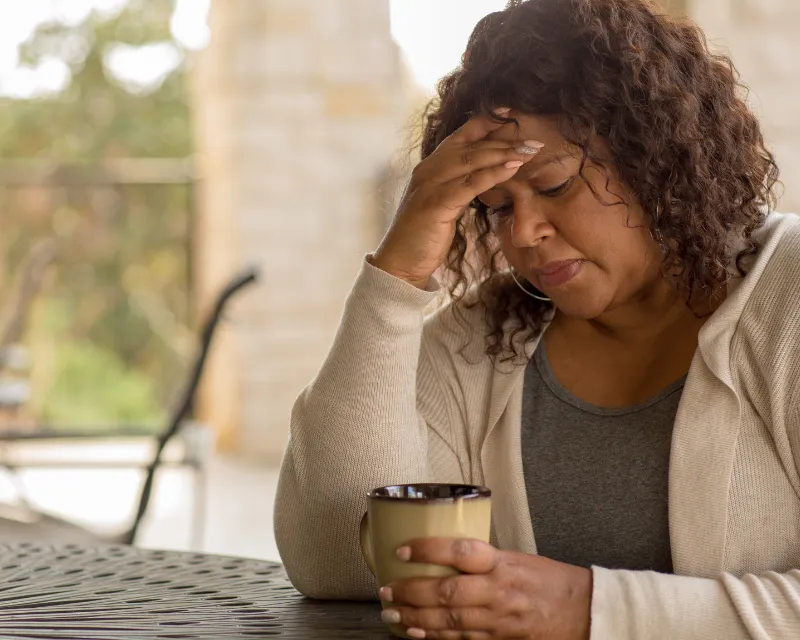
If your anxiety has changed, or arrived for the first time, and you are somewhere in your forties or early fifties, perimenopause may be the reason. Not the only possible reason, but a far more common one than most women are told. Perimenopause anxiety is not a character flaw or a sign that something has broken. It is a biological response to hormonal change that affects a significant proportion of women during this transition, and it deserves to be understood properly, not dismissed.
This article is intended for general information and educational purposes only and should not be considered medical, psychiatric, psychological, or therapeutic advice. Every person’s circumstances are unique, and reading this article does not create a therapeutic relationship with Hope Therapy & Counselling Services. If you are concerned about your mental health or emotional wellbeing, we encourage you to seek support from a suitably qualified healthcare or mental health professional. Hope Therapy & Counselling Services offers a free 15-minute consultation – book yours now.
Does Perimenopause Cause Anxiety?
Perimenopause can cause anxiety, and the mechanism is well established. Oestrogen plays a direct role in the regulation of serotonin and other neurotransmitters that influence mood, emotional regulation, and the brain’s threat-response system. As oestrogen levels fluctuate during perimenopause, and the fluctuation is the key word, not simply the decline, the systems those hormones support become less stable.
This means that the brain’s threat-detection response becomes more reactive. Things that would previously have registered as manageable become disproportionately alarming. The internal experience is anxiety that does not match the external circumstances, worry about things that have always been there, or a new, generalised sense of dread without any obvious target.
Why perimenopause anxiety often arrives without warning
One of the most disorienting features of perimenopause anxiety is that it frequently arrives before other, more well-known menopause symptoms. It does not politely announce itself as hormonal. It simply appears, at three in the morning, in the middle of an ordinary day, as a sudden racing heart in a meeting, and feels for all the world like anxiety always feels: real, present, and threatening.
Women who have never experienced anxiety before are often entirely unprepared for this. Those who have managed anxiety throughout their lives find that the strategies that used to work are suddenly less reliable. In both cases, not knowing that perimenopause is a likely cause leaves a significant gap in understanding.
Why Does Perimenopause Cause Anxiety?
The short answer is that oestrogen is not just a reproductive hormone. It is deeply involved in brain chemistry, in how the nervous system regulates stress responses, how serotonin is produced and maintained, and how the hippocampus, which is central to memory and emotional regulation, functions. When oestrogen fluctuates unpredictably, these systems fluctuate with it.
The role of progesterone in perimenopause anxiety
Progesterone also plays a significant role. Progesterone has a calming, anti-anxiety effect, it works on the same receptors as GABA, the brain’s main inhibitory neurotransmitter. As progesterone declines during perimenopause, this natural calming influence reduces. The nervous system becomes less buffered against stress, which means smaller triggers produce larger responses.
Sleep disruption compounds this further. Poor sleep impairs the brain’s capacity to regulate emotional responses and increases sensitivity to threat. For many women in perimenopause, disrupted sleep and anxiety form a self-reinforcing cycle, each making the other worse.
What Does Perimenopause Anxiety Feel Like?
Perimenopause anxiety does not always present as classic worry. Many women describe it as a generalised sense of unease or doom, a feeling that something is wrong without being able to name what. Others experience it as sudden, intense panic with physical symptoms: racing heart, tightness in the chest, difficulty breathing, a strong urge to leave wherever they are.
Irritability that escalates quickly, a reduced ability to tolerate uncertainty, difficulty making decisions that used to feel straightforward, and a sense of being permanently on edge, these are all common presentations of perimenopause anxiety that may not be immediately recognised as anxiety at all.
The experience can also involve intrusive thoughts, persistent, unwanted worries that return despite attempts to address them. Health anxiety in particular is common during perimenopause, partly because the physical symptoms of hormonal change (palpitations, dizziness, headaches, changes in skin and hair) can feel alarming and are easy to misinterpret.
Are you struggling with perimenopause?
When you are ready to talk to someone, a free 15-minute consultation is a good place to start. No preparation needed, no pressure to commit.
How Long Does Perimenopause Anxiety Last?
How long perimenopause anxiety lasts varies considerably between women. It is tied to how long the perimenopausal transition itself lasts, which ranges from a few years to a decade. The most intense symptoms of hormonal fluctuation, and the anxiety that accompanies them, tend to cluster in the years immediately before the final menstrual period.
This does not mean the anxiety will be constant or unchanging throughout that period. Many women find it comes in waves, corresponding to periods of particularly erratic hormonal fluctuation. Understanding this pattern can itself be helpful: it transforms an apparently random and frightening experience into something with a comprehensible structure.
What is clear is that anxiety symptoms that are well supported, through appropriate professional help, lifestyle adjustments, and understanding of what is causing them, tend to be less severe and more manageable than those that are faced without context or support.
What Actually Helps With Perimenopause Anxiety?
Perimenopause anxiety responds to the same approaches that help with anxiety more broadly, with some specific considerations. Understanding that the anxiety has a hormonal component is itself important, it reframes the experience as something happening to her, not something wrong with her.
Counselling can offer a space to understand how the anxiety is showing up, to identify the specific thoughts and patterns it is generating, and to develop approaches to managing it that account for the hormonal context. Cognitive behavioural approaches, particularly CBT, have a strong evidence base for anxiety and translate well to the perimenopause context.
Physical approaches that support the nervous system, consistent sleep, regular movement, reducing caffeine and alcohol, can make a meaningful difference to the baseline anxiety level, even when they feel difficult to maintain during a period of disrupted sleep and fluctuating energy.
Support from Hope Therapy & Counselling Services is available online nationwide and face-to-face across England. Practitioners with experience of women’s mental health and the specific presentation of anxiety in perimenopause work with women at every stage of this transition.
Ready to Take the First Step?
Perimenopause anxiety can feel very isolating, particularly when it arrives without explanation, or when the people around you do not connect the change in you to a stage of life they may not fully understand.
A free, no-obligation 15-minute conversation is a good place to start. No preparation needed, no pressure to commit.
- Free 15-minute consultation
- No commitment
- Qualified & registered therapists
- LGBTQIA+ affirming support
- NCPS organisational member
- Online nationwide
- Face-to-face across England
- Established 2014
This article is intended for general information and educational purposes only and should not be considered medical, psychiatric, psychological, or therapeutic advice. Every person’s circumstances are unique, and reading this article does not create a therapeutic relationship with Hope Therapy & Counselling Services. If you are concerned about your mental health or emotional wellbeing, we encourage you to seek support from a suitably qualified healthcare or mental health professional. Hope Therapy & Counselling Services offers a free 15-minute consultation – book yours now.
Frequently Asked Questions
Does perimenopause cause anxiety?
Yes. Oestrogen plays a direct role in regulating serotonin and the brain’s threat-response system. As oestrogen fluctuates during perimenopause, the threat-detection system becomes more reactive, producing anxiety that does not match external circumstances.
Why does perimenopause cause anxiety?
Oestrogen is deeply involved in brain chemistry, including serotonin regulation. When oestrogen fluctuates, these systems become unstable. Progesterone’s decline removes its calming effect on the nervous system. Sleep disruption, common in perimenopause, further amplifies anxiety.
How long does perimenopause anxiety last?
Duration varies significantly between women and is tied to how long the perimenopausal transition lasts. The most intense symptoms tend to cluster in the years immediately before the final menstrual period. Anxiety that is well supported tends to be less severe and more manageable.
Find the Right Support for You
Our general counselling services page can help you determine what sort of therapy may be suitable for you.
Get Help With Other Conditions
Our general conditions page is a great place to start.
THE AUTHOR
Lisa Capper
- MNCPS
Integrative Counsellor, Clinical Supervisor & Coach — Hope Therapy & Counselling Services
Accredited Member of the NCPS · L4 Diploma in Therapeutic Counselling · Advanced CBT Diploma · Certificate in Supervision · Certificate in Rewind Therapy · Certificate in Transactional Analysis · Certificate in EFT · Certificate in Life Coaching
Lisa is an experienced integrative counsellor, clinical supervisor, and coach with a background in the care sector, where she developed a deep understanding of supporting neurodivergent individuals and their families. Her experience enables her to adapt therapy to each person’s unique needs and life circumstances.
Lisa holds an L4 Diploma in Therapeutic Counselling, an Advanced CBT Diploma, and additional qualifications in Clinical Supervision, Rewind Therapy, Transactional Analysis (TA), Emotionally Focused Tapping (EFT), and Life Coaching. She is an Accredited Member of the National Counselling & Psychotherapy Society (NCPS) and is committed to ongoing professional development.
Her specialist interests include PMDD, perimenopause and menopause, neurodivergence, bereavement, domestic and narcissistic abuse, anxiety, and trauma. Lisa also brings lived experience of PMDD to her work, combining professional expertise with personal insight into the challenges of hormonal mental health.
Lisa provides a warm, compassionate, and collaborative environment where clients can explore their experiences safely and without judgement. Drawing on an integrative approach, she tailors therapy to each individual, helping clients better understand themselves, overcome life’s challenges, and create lasting positive change.
- NCPS Accredited Member
- L4 Diploma in Therapeutic Counselling
- Advanced CBT Diploma
- Clinical SupervisorIntegrative Counsellor
- PMDD Specialist
- Women’s Hormonal Mental Health
- Neurodivergent-Affirming
Free 15-minute consultation
A no-pressure conversation to find the right therapist for you. No commitment needed.
ABOUT THE AUTHOR
Lisa Capper
MNCPS
Integrative counsellor, clinical supervisor, and coach specialising in PMDD, neurodivergence, trauma, and women’s hormonal mental health.
ABOUT HOPE THERAPY
Qualified registered therapists
Online nationwide across UK
Face-to-face across England
LGBTQIA+ & neurodivergent affirming
Mon–Sun, 9am–9pm
NCPS organisational member
Est 2014
Published: 6th September 2026 | Written by Lisa Capper | Reviewed for clinical accuracy before publishing | Review due: September 2028
More Articles About Perimenopause & Menopause
PMDD and Perimenopause: How to Tell the Difference
