BLOG
Sleep, Social Media and Your Teenager’s Mental Health
- By Jayne Russell
- Person-Centred Counsellor
- 19th August 2026
- 7–11 minutes
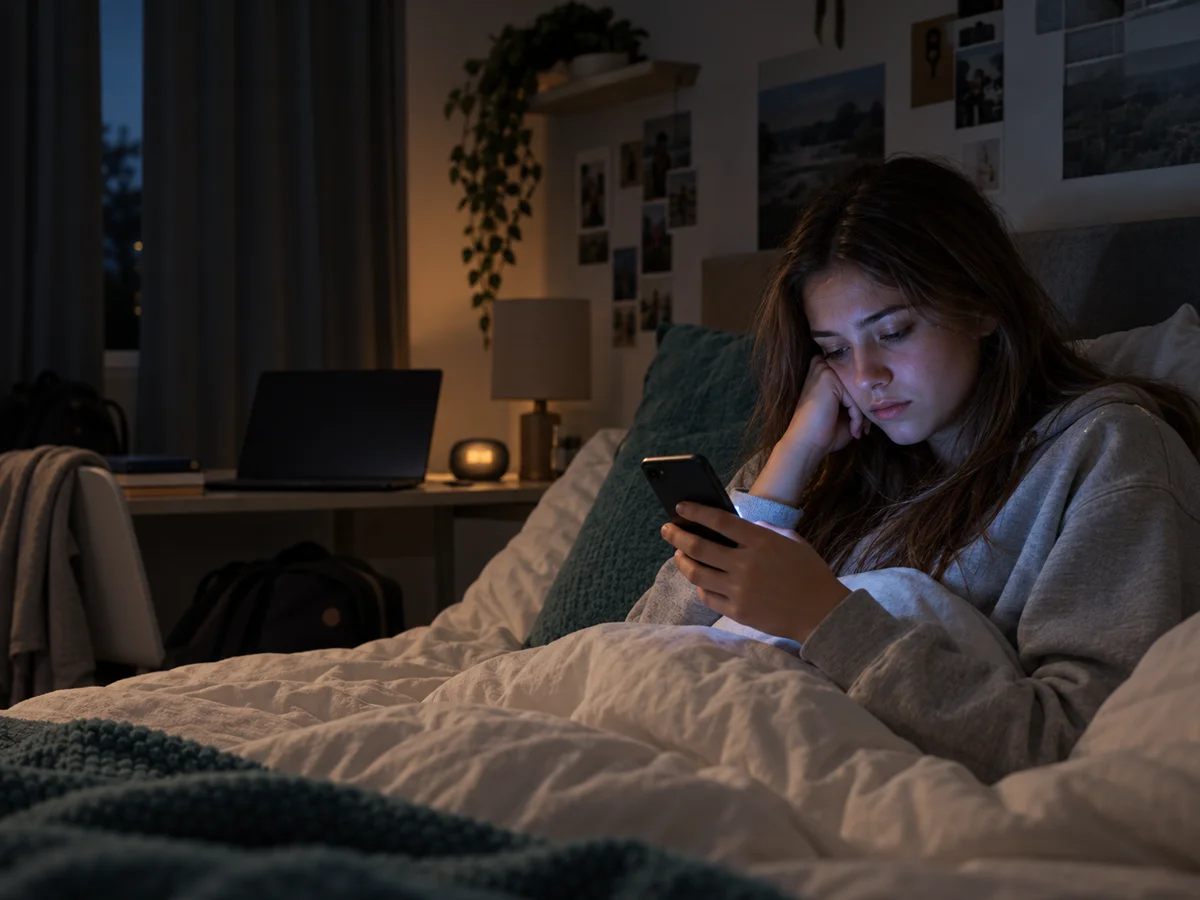
It’s a familiar sight: a strip of light under the bedroom door at midnight, a phone still glowing, and a teenager who can barely surface the next morning. If you’ve wondered how much sleep should a teenager get, and why yours never seems to get it, you’re asking exactly the right question.
Sleep, screens, and mental health are tightly bound together in the teenage years, each one pulling on the others.
This guide explains how much sleep teenagers really need, the part social media and screens play, and practical, realistic ways to help your teenager rest better, without turning every evening into a battle.
This article is intended for general information and educational purposes only and should not be considered medical, psychiatric, psychological, or therapeutic advice. Every person’s circumstances are unique, and reading this article does not create a therapeutic relationship with Hope Therapy & Counselling Services. If you are concerned about your mental health or emotional wellbeing, we encourage you to seek support from a suitably qualified healthcare or mental health professional. Hope Therapy & Counselling Services offers a free 15-minute consultation – book yours now.
How much sleep should a teenager get?
Most teenagers need between eight and ten hours of sleep a night, more than many adults, and considerably more than most actually get. The exact amount varies from one young person to the next, but if your teenager is regularly running on six or seven hours, they’re very likely building a sleep debt that shows up in their mood, motivation, and concentration.
That eight-to-ten-hour guide, used by the NHS and sleep specialists for 13 to 18-year-olds, often surprises parents. Part of the reason teenagers fall short is biological: during the teenage years the body clock shifts later, so falling asleep before 11pm can feel genuinely difficult.
Set against early school starts, that late sleep onset leaves a nightly gap. So when you ask how much sleep should a teenager get and then look at what yours is getting, a shortfall is common, and it isn’t simply a matter of willpower or laziness.
Parents often ask how much sleep should a teenager get in the hope of a single tidy number, and eight to ten hours is the honest answer, but consistency matters as much as the total.
A teenager who gets nine hours some nights and five on others will still feel the effects of the short ones. Aiming for a roughly steady pattern, even an imperfect one, tends to do more good than the occasional heroic early night after a run of late ones.
Why teenagers don’t get enough sleep
Two forces work against teenage sleep at once: a real shift in the body clock during puberty that pushes sleep later, and the powerful pull of phones and social media right at the point they should be winding down. Together, they chip away at the night from both ends.
The body clock shift
During puberty, the timing of melatonin, the hormone that signals sleep, shifts later by a couple of hours. That moves a teenager’s natural sleep window back, so they’re genuinely not tired at the time you’d like them to settle.
Early school starts then cut the morning short, and weekend lie-ins are the body trying to repay what it lost, not teenage indulgence. Understanding this helps, because it reframes late nights as partly biological rather than purely a discipline problem.
The pull of the phone
Social media is built to hold attention, and it does its best work at night. Notifications, group chats, streaks, and the quiet fear of missing something keep the brain switched on when it should be powering down.
The light from the screen plays a part, but the bigger issue is mental arousal, one more message, one more video, and ‘just five minutes’ becomes an hour. For many teenagers, the phone is the single biggest thing standing between them and an earlier night.
What is the average screen time for a teenager?
Research consistently finds that teenagers spend several hours a day on screens for leisure, and a large share of that lands in the evening. Screens aren’t automatically harmful, it’s the timing, and what they push out, that does the damage.
Not all screen time is equal. A video call with a friend, a shared game, or messaging a supportive group is worlds apart from lying in the dark scrolling alone at 1am.
The problem is less the total number of hours and more what those hours displace: sleep, daylight, movement, and face-to-face time. When screens eat into the wind-down hour and then into the night itself, the cost lands on sleep first, and, before long, on mood.
It’s natural to want a benchmark, and to ask what is the average screen time for a teenager so you can see where yours sits. The honest answer is that averages hide a lot: two teenagers with identical screen totals can have very different experiences depending on what they’re doing and when.
A more useful question is less ‘how many hours?’ and more ‘is any of this costing them sleep, daylight, or real-world time with people?’
How sleep, screens and mental health feed each other
Poor sleep, heavy screen use, and low mood tend to form a loop. Short sleep makes anxiety and irritability worse; feeling low or anxious makes late-night scrolling more tempting; and that scrolling costs yet more sleep. Any one of the three can tip the other two.
The link runs in both directions. Broken sleep is one of the most reliable ways to worsen a young person’s mood, focus, and resilience, while anxiety and low mood are themselves common causes of lying awake.
That’s also why sleep is such a useful place to start: it’s more changeable than many other things, and steadier sleep often takes some of the pressure off everything else. If anxiety seems to be part of the picture, our guide to anxiety in teenagers and our anxiety pages go into more depth.
How to help your teenager sleep better
You can’t force sleep, but you can shape the conditions for it, mostly by protecting the wind-down hour and getting the phone out of the bed. The aim is steady, collaborative habits, not a nightly stand-off.
Screens and the bedroom
The single most effective change for most families is simple: the phone charges somewhere other than the bedroom overnight, a hallway or kitchen charging point works well. Agree a screens-down time together rather than imposing one out of the blue, and be honest that it applies to the whole household, you included.
Night-mode settings help a little, but putting the device in another room helps far more, because it removes the temptation as well as the light.
If anxiety is keeping them awake
Racing thoughts at bedtime are one of the most common reasons teenagers can’t drop off. A predictable wind-down, the same steps in the same order, signals safety to an anxious brain. Moving worry earlier in the evening, so bed isn’t where problems get chewed over, can help, as can slow breathing or a calming routine.
If you’re looking specifically at how to help an anxious teenager sleep, it’s worth treating the anxiety and the sleep together rather than as separate problems. Alongside all of this, the ordinary basics still matter: fairly consistent sleep and wake times, daylight in the morning, movement during the day, and cutting back on caffeine and energy drinks from the afternoon on.
Concerned about your teenager’s sleep or mental health?
A free 15-minute consultation is a chance to talk through what’s going on for your teenager, or for you, with no pressure either way.
When broken sleep is a red flag
The odd bad night is normal. But sleep that’s been disrupted for weeks, especially alongside low mood, withdrawal, falling grades, or a loss of interest in things they used to enjoy, can be a sign of something more, such as anxiety or depression, and is worth taking seriously rather than waiting out.
Sleep problems can both cause and signal a mental health difficulty, which is why a persistent change is worth a closer look. If broken sleep comes bundled with other shifts in behaviour, it may be one of several red flags in teenage behaviour pointing to something underneath.
A chat with your GP is a sensible next step, and can help you work out whether this is habit, stress, or something that would benefit from more support.
None of this means panicking over a few late nights before an exam, or a growth spurt of extra sleeping. It’s the settled, weeks-long change, and the company it keeps, that’s worth paying attention to. Trusting your instinct as the person who knows them best counts for a lot here.
Ready to Take the First Step?
If your teenager’s sleep, screen use, or mood has you worried, you don’t have to work it out alone.
Hope Therapy offers a free, no-obligation 15-minute consultation, a chance to talk through what’s going on and explore whether counselling might help, whether that’s support for your teenager or for you.
We work with young people aged 16 and over, and with parents. There’s no pressure in either direction, when you’re ready, we’re here.
- Free 15-minute consultation
- No commitment
- Qualified & registered therapists
- LGBTQIA+ affirming support
- NCPS organisational member
- Online nationwide
- Face-to-face across England
- Established 2014
This article is intended for general information and educational purposes only and should not be considered medical, psychiatric, psychological, or therapeutic advice. Every person’s circumstances are unique, and reading this article does not create a therapeutic relationship with Hope Therapy & Counselling Services. If you are concerned about your mental health or emotional wellbeing, we encourage you to seek support from a suitably qualified healthcare or mental health professional. Hope Therapy & Counselling Services offers a free 15-minute consultation – book yours now.
Frequently Asked Questions
Is 7 hours of sleep enough for a teenager?
For most teenagers, seven hours is a little short, the usual guide is eight to ten. An occasional seven-hour night won’t do any harm, but if it becomes the norm, it tends to build into a sleep debt that shows up in mood, focus, and health. If your teenager consistently can’t manage more, it’s worth looking at what’s eating the extra hour, which is often the phone.
Should I take my teenager’s phone away at night?
Getting the phone out of the bedroom overnight is one of the most effective things you can do for their sleep. It tends to land far better as a shared household habit, a charging point outside bedrooms that everyone uses, than as a punishment aimed at them. Collaboration works better than confiscation, and it keeps the conversation open rather than driving it underground.
Can too much screen time cause anxiety in teenagers?
Screens don’t single-handedly cause anxiety, but heavy late-night use and the lost sleep that comes with it can certainly feed low mood and anxious feelings. It works as a loop rather than a straight line, which is also good news, because improving sleep and evening screen habits can ease some of the pressure on their mental health.
Find the Right Support for You
Our general counselling services page can help you determine what sort of therapy may be suitable for you.
Get Help With Other Conditions
Our general conditions page is a great place to start.
THE AUTHOR

Jayne Russell
- MBACP
Person-Centred Counsellor — Hope Therapy & Counselling Services
MBACP · Diploma in Therapeutic Counselling (L4) · MA (JNC) Youth & Community Studies · Foundation Degree Working with Young People
Before qualifying as a counsellor, Jayne spent more than 16 years working with young people in organisational and community settings, gaining extensive experience supporting their emotional wellbeing, development, and resilience. Her background gives her a deep understanding of the challenges facing young people, alongside the skills to support adults through life’s difficulties.
Jayne is a qualified Person-Centred counsellor and coach, holding a Diploma in Therapeutic Counselling, an MA (JNC) in Youth & Community Studies, and a Foundation Degree in Working with Young People. She is a Registered Member of the BACP and has completed additional training in CBT, Mindfulness, the Freedom Programme, Solution-Focused Brief Therapy, and suicide awareness. Her specialist interests include young people (14+), ADHD, anxiety, trauma, and domestic violence and abuse.
Jayne provides a warm, supportive, and collaborative environment where clients can explore their experiences at their own pace. Alongside counselling, she also offers coaching to help people navigate personal and professional change with greater confidence and clarity.
- MBACP Registered
- MA (JNC)
- Diploma L4 Counselling
- Freedom Programme Trained
- Person-Centred Counsellor
- ADHD Support
- Young People (14+)
- Counsellor & Coach
Free 15-minute consultation
A no-pressure conversation to find the right therapist for you. No commitment needed.
ABOUT THE AUTHOR
Jayne Russell
MBACP
Person-Centred counsellor, coach, and youth specialist with 16+ years’ experience supporting young people, adults, and those affected by domestic abuse.
ABOUT HOPE THERAPY
Qualified registered therapists
Online nationwide across UK
Face-to-face across England
LGBTQIA+ & neurodivergent affirming
Mon–Sun, 9am–9pm
NCPS organisational member
Est 2014
Published: 19th August 2026 | Written by Jayne Russell | Reviewed for clinical accuracy before publishing | Review due: August 2028