
Anxiety
Health anxiety — when worry about your health takes over
What health anxiety is, how it shows up, what keeps it going, and how counselling can help you step out of the cycle of checking and reassurance. Support across England — online nationwide and face-to-face.
NCPS Organisational Member
Professionally registered therapists
Free 15-minute consultation
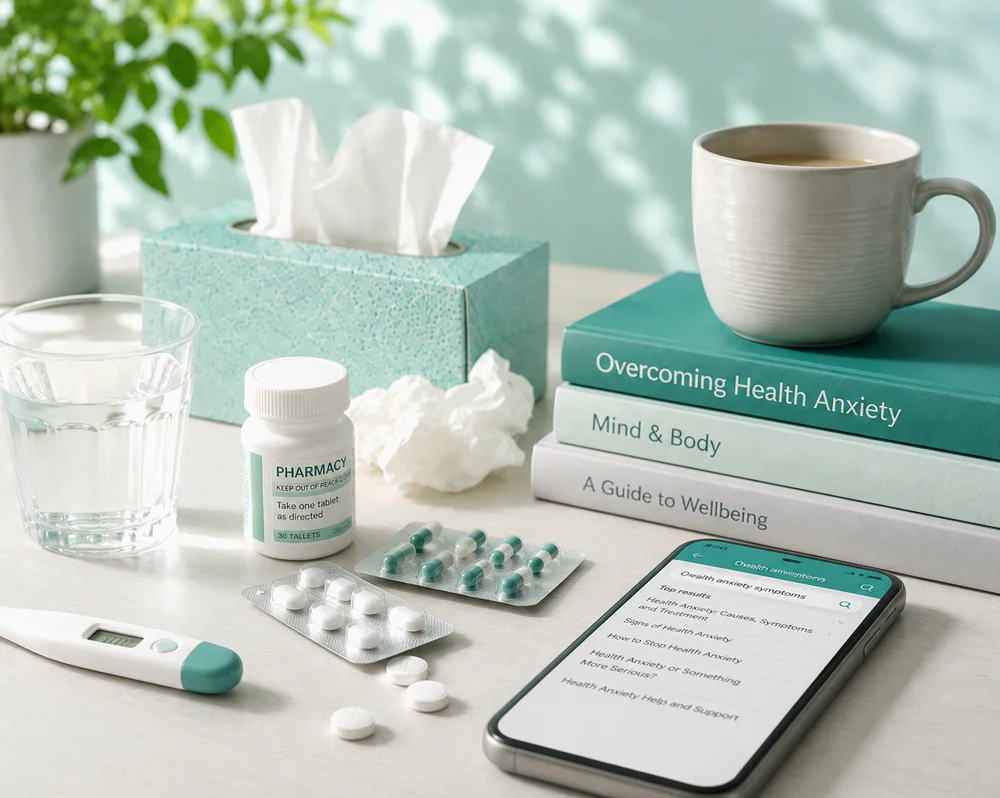
★ ★ ★ ★ ★“Every twinge sent me straight to the internet, then to the GP. My therapist helped me understand the cycle I was stuck in — and slowly, the fear loosened its grip.”
Client who sought support for health anxiety
5,000+
People supported
90+
Qualified therapists
5 ★
Website testimonials
20+
Counties across England
This page is part of our anxiety hub
What health anxiety actually feels like
Health anxiety is a persistent, distressing preoccupation with the fear that you have — or will develop — a serious illness, even when medical tests and reassurance say otherwise. It goes beyond ordinary concern about your health, and it can take over your thoughts, your time, and the way you live your daily life.
It often starts small. A headache that will not shift. A lump you had not noticed before. A skipped heartbeat, a strange sensation, a symptom you read about somewhere. For most people, the thought passes. But if you live with health anxiety, it does not pass — it takes hold. You check. You search. You look for reassurance. And for a little while it helps, until the fear comes back, often stronger than before.
You might find yourself examining your body several times a day, or reading the same medical websites over and over. You might book appointments, then feel unconvinced when you are told nothing is wrong. Some people do the opposite — avoiding doctors, tests and health information altogether, because facing them feels unbearable. Both are ways of trying to manage a fear that has become exhausting to carry.
If any of this sounds familiar, you are not being dramatic and you are not making it up. Health anxiety is common, it is recognised, and it is something counselling can help with. The relief of understanding what is actually happening — that the problem is anxiety, not the illness you fear — is often where change begins.
The symptoms of health anxiety
The symptoms of health anxiety show up in three ways: in the body, in your thinking, and in what you do. Common signs include checking your body for changes, seeking reassurance from doctors or loved ones, researching symptoms online, and either over-using or completely avoiding medical care.
What makes health anxiety particularly difficult is that it produces real physical sensations of its own. These can then be misread as proof of the very illness you fear. Recognising the pattern is often the first step toward loosening it.
Physical symptoms
Anxiety keeps the body’s stress response switched on, producing genuine physical effects — a racing heart, muscle tension, dizziness, stomach problems, shortness of breath, and trouble sleeping. With health anxiety these sensations matter especially, because they can become the focus of the fear itself: a tension headache becomes a suspected tumour, a racing heart a suspected heart problem. The sensations are real; the catastrophic explanation is what anxiety adds.
Psychological symptoms
In the mind, health anxiety can feel like a constant background scanning for signs that something is wrong. You might notice intrusive thoughts about illness or death, and difficulty concentrating on anything else. There can be a sense of dread that does not lift even after a clear test result. Many people describe knowing, rationally, that they are probably fine — while feeling, at the same time, utterly convinced that they are not. That gap between what you know and what you feel is one of the hardest parts.
Behavioural symptoms
Health anxiety strongly shapes behaviour. Common patterns include repeatedly checking your body, searching symptoms online (sometimes called “cyberchondria”), seeking reassurance from family or medical professionals, and booking frequent appointments. For others it drives the opposite — refusing to see a doctor, skipping screenings, or being unable to read anything health-related. Both the checking and the avoiding are understandable attempts to cope, and both, over time, tend to keep the anxiety going rather than ease it.
Health anxiety and hypochondria — and why the words matter
Health anxiety and hypochondria describe the same experience — the older word “hypochondria” has largely been replaced by “health anxiety” in clinical use. The shift matters: it recognises the genuine distress a person is in, rather than dismissing it as imagining or exaggerating illness.
For a long time, “hypochondriac” was used almost as an insult — a word for someone thought to be making a fuss, attention-seeking, or inventing symptoms. That understanding was wrong, and it caused real harm, because it left people feeling ashamed of something they could not simply talk themselves out of. In current clinical language, the experience is more often described as health anxiety or, in some diagnostic frameworks, illness anxiety disorder.
The distinction is not just about being polite. It reframes the whole problem. The difficulty is not that you are wrong about being ill. It is that anxiety has attached itself to your health, and it behaves like any other anxiety: convincing, persistent, and resistant to reassurance. Understanding it as anxiety, rather than as a character flaw, is what makes it something that can be worked with.
What causes health anxiety
Health anxiety rarely has a single cause. It often develops after a serious illness or health scare — your own, or someone close to you. It can also be shaped by how illness was handled in your family, by a natural tendency toward anxiety, or by a period of stress that left your nervous system on alert.
For many people, it can be traced to a specific experience. Losing a parent to illness at a young age. A frightening diagnosis, your own or a loved one’s. A missed or delayed diagnosis that taught you not to trust reassurance. When health has genuinely let you or someone you love down, the mind can respond by staying permanently vigilant — as though constant watchfulness might keep the danger away.
Family and upbringing play a part too. Growing up around frequent worry about illness can shape how you learn to interpret bodily sensations. So can having had a parent who was very anxious about health. So can a general tendency toward anxiety — if you are someone who worries, health can become one of the places that worry settles.
Wider circumstances matter as well. Periods of high stress, major life changes, and easy access to endless health information online can all feed health anxiety. None of these causes mean you have done anything wrong. They simply help explain why your mind has learned to respond to uncertainty about health with fear — and understanding that is part of what counselling can help with.
The cycle that keeps health anxiety going
Health anxiety is kept going by a cycle. A normal body sensation triggers fear, the fear drives checking or a search for reassurance, and the relief never quite lasts — so the checking begins again. Understanding this loop is often the first real step toward stepping out of it.
It usually runs like this. You notice a sensation — a twinge, an ache, a change. Anxiety attaches a frightening meaning to it. That fear makes you check, search, or seek reassurance. For a moment, you feel better. But reassurance is temporary, and anxiety soon finds the doubt again: what if the doctor missed something? What if the test was wrong? And so the loop restarts, often faster and more intense than before.
The cruel part is that the very things that seem to help are what keep it alive. Checking your body makes you more aware of every sensation. Searching online turns up worst-case explanations. Reassurance teaches your mind that it needs reassurance to feel safe — so the relief never lasts, and the need for it grows. This is not a failure of willpower. It is how anxiety works, and it is exactly the kind of pattern counselling is designed to interrupt.
Confidentiality note: before any work begins, your therapist will explain how confidentiality works. They will also explain the limited circumstances in which it may need to be reviewed — for example, where there is a serious risk of harm. Knowing this in advance means there are no surprises later.
Who health anxiety affects
Health anxiety can affect anyone, at any age. It often begins in early or middle adulthood, and is common in people who are naturally conscientious or who have lived through illness — their own or a loved one’s. It is far more common than most people realise, and having it is not a personal weakness.
It affects people of every background and profession — including, sometimes especially, those who work in or around healthcare and know exactly how much can go wrong. It can appear for the first time after becoming a parent, when the stakes of staying well suddenly feel higher. It can flare during stressful periods and quieten during settled ones. And it frequently travels alongside other forms of anxiety, low mood, or obsessive-compulsive patterns.
Whatever shape it takes for you, the important thing to know is that health anxiety is treatable. Many people carry it silently for years, embarrassed to admit how much time and energy it takes, or afraid of being dismissed. You do not have to prove how real it is before you deserve support — and you do not have to keep managing it alone.
How counselling can help with health anxiety
Counselling can help you understand what is driving your health anxiety and respond to it differently, rather than staying caught in the cycle of checking and reassurance. Rather than trying to prove you are healthy — which reassurance can never do for long — the work focuses on changing your relationship with the fear itself.
Approaches vary from person to person. Cognitive Behavioural Therapy (CBT) is well-researched for health anxiety and helps you notice and step back from the checking-and-reassurance loop. Where the anxiety is rooted in a past health scare or loss, EMDR can help the mind process that experience so it stops driving the present-day fear. Person-centred counselling offers space to understand what your anxiety about health is really protecting you from. Your therapist will talk through what suits you.
Our anxiety counselling service explains what working with us involves, the approaches we offer, and how to begin. Sessions start from £65; you can see the options and full detail on the service page and our fees page. When you are ready, a free 15-minute consultation is a no-pressure way to talk it through and see whether we feel like the right fit.
A printable overview of our anxiety counselling service — useful to keep or share.
A note on what we do and do not offer: Hope Therapy provides counselling and psychotherapy for adults. We do not offer diagnosis, medical treatment, or crisis care, and counselling is not a substitute for medical advice — if you have a physical symptom that worries you, it is always right to have it checked by your GP. If you are in immediate danger or crisis, please call , contact , or text SHOUT to 85258 — free, confidential, and available 24/7. Confidentiality is discussed with you before any work begins, including the limited circumstances in which it may need to be reviewed.
What our clients say
Real experiences
★ ★ ★ ★ ★
I’d spent years convinced every symptom was something terrible. My therapist didn’t just tell me I was fine — she helped me understand why I could never believe it. That changed everything.
Client who sought support for health anxiety
★ ★ ★ ★ ★
The constant Googling and checking was exhausting. Working with someone who actually understood the cycle, rather than just reassuring me, made more difference than I expected.
Client who accessed anxiety counselling online
★ ★ ★ ★ ★
I was embarrassed about how much time my health worries took up. From the first session I felt taken seriously, never judged. I finally feel like I have my life back.
Client who sought support for health anxiety
Client experiences are unique. Results vary between individuals.
Common Questions
Frequently asked questions
Is health anxiety a real condition?
Yes. Health anxiety is a recognised form of anxiety in which a person is persistently preoccupied with the fear of having or developing a serious illness. The distress is genuine, even when medical tests come back clear. It is not a matter of imagining symptoms or seeking attention — it is a real and treatable difficulty.
What is the difference between health anxiety and hypochondria?
They describe the same experience. “Hypochondria” is an older term that has largely been replaced by “health anxiety” in clinical use. The change in language matters — it recognises the real distress a person is in, rather than dismissing them as imagining or exaggerating illness.
Can CBT help with health anxiety?
Many people find that CBT helps with health anxiety. It works by helping you notice and step back from the cycle of checking, researching, and seeking reassurance, and by developing a different relationship with the bodily sensations that trigger fear. Other approaches, including EMDR, can also help — particularly where the anxiety is linked to a past health scare. During a free consultation we can talk through what might suit you.
What are the physical symptoms of health anxiety?
Health anxiety can produce very real physical sensations — a racing heart, muscle tension, dizziness, stomach problems, and difficulty sleeping. These are caused by the body’s stress response. The difficulty is that these same sensations can then be read as evidence of illness, which feeds the anxiety further.
Is health anxiety counselling available online?
Yes. Our therapists offer health anxiety counselling online via secure video call or telephone, so you can access support from anywhere in the UK. Face-to-face sessions are also available in locations across England. Research consistently shows online therapy can be as effective as in-person sessions for anxiety.
Related Support
You might also find these helpful
Related conditions
Therapy approaches
Meet Our Founder
Built by someone who saw the need from the inside

★
SCoPEd Band C
MBACP & SNCPS Senior Accredited
“Having worked for more than 25 years in senior management, I saw the same thing repeatedly — people struggling with mental health and relationship challenges, and so often struggling to access the right support when it was needed. It was out of this recognition of human need that Hope was born.”
Ian Stockbridge founded Hope Therapy after 25+ years leading large commercial teams – watching colleagues carry stress, anxiety, and personal difficulty with nowhere to turn. He retrained rigorously, now holding Senior Accredited status with both the BACP and NCPS, alongside SCoPEd Band C — the highest independent competence verification in the UK counselling profession.
He remains a practising therapist, clinical supervisor, published author of PMDD Uncovered, and co-presenter of The Talk Room Podcast. Hope Therapy was built on the things he saw were most broken – and designed, from the ground up, to do better.
MBACP (Senior Accredited)
SNCPS (Acc)
SCoPEd Band C
BSc (Hons) CBT
PGCert Supervision L7
Quality Award 2024 — 95%+

You do not have to keep carrying this on your own
A free, no-obligation 15-minute conversation. No pressure, no script — just a chance to be heard, ask questions, and see whether we feel like the right fit.
Get in Touch
Start your enquiry
Not sure where to start? Send us a message and a member of our team will get back to you. All enquiries are treated in the strictest confidence.
★ ★ ★ ★ ★
“From the very first phone call, I felt heard. They didn’t rush me — they helped me work out what I needed.”
Hope Therapy enquiry feedback
NCPS Organisational Member
Est 2014
90+ Qualified Therapists

National Counselling & Psychotherapy Society
British Association for Counselling and Psychotherapy

British Association for Behavioural & Cognitive Psychotherapies
Individual registrations vary per therapist. Last reviewed: May 2026.