BLOG
Anger Issues Test: What a Self-Assessment Can and Cannot Tell You
- By Ian Stockbridge
- Founder & Clinical Director, Hope Therapy & Counselling Services
- 12th September 2026
- 8–13 minutes

A great many people go looking for an anger issues test for one of two reasons. Either something has happened and they want to know how worried they ought to be, or somebody has told them there is a problem and they would quite like an impartial second opinion.
Both are entirely understandable, and both run into the same difficulty: a score out of twenty cannot actually answer the question being asked. This article sets out what self-assessment can honestly establish, which questions matter far more than any total, and what to do with whatever conclusion you end up reaching.
This article is intended for general information and educational purposes only and should not be considered medical, psychiatric, psychological, or therapeutic advice. Every person’s circumstances are unique, and reading this article does not create a therapeutic relationship with Hope Therapy & Counselling Services. If you are concerned about your mental health or emotional wellbeing, we encourage you to seek support from a suitably qualified healthcare or mental health professional. Hope Therapy & Counselling Services offers a free 15-minute consultation – book yours now.
What Can an Anger Issues Test Actually Tell You?
It is worth being straightforward about the limits before anything else. An online anger issues test is not a diagnostic instrument. It cannot establish whether you have any clinical condition, and no article, including this one, can do that either. That is a matter for a suitably qualified professional, and the route to one is your GP.
What a well-constructed set of questions can do is more modest and still useful. It can prompt you to notice patterns you have been carrying without examining. It can give you language for something that has been a vague unease. And it can move you from a general sense that something is wrong towards specific observations you could actually describe to somebody.
That is genuinely worth something. Most people who eventually seek help describe a long period of knowing something was not right without being able to articulate what. Any process that shortens that period has earned its place.
What a test cannot do is give you permission, either way. A reassuring score does not mean the person you shouted at last week is fine. A concerning one does not mean you are dangerous. The score is not the information.
There is a further problem with scored tests specifically. They tend to weight how often something happens, because frequency is easy to count. But a person who loses control twice a year in a way that badly frightens their family is in a more serious position than someone who is mildly irritable most days and never crosses a line. A total cannot hold that distinction, and it will usually get it the wrong way round.
“A reassuring score does not mean the person you shouted at last week is fine. A concerning one does not mean you are dangerous. The score is not the information.”
The Questions That Matter More Than a Score
If you set aside the idea of a total and instead consider a handful of honest questions, the picture usually clarifies quickly. These are the ones a therapist would tend to ask early on.
What happens afterwards?
This is the most revealing question there is, and it is rarely on any questionnaire. Anger that passes and is genuinely finished behaves very differently from anger that leaves something behind. If you spend the following day replaying it, or apologising, or noticing that someone in your house is being careful around you, that is more informative than how loud it was at the time. The aftermath is where the actual cost shows up.
Who is on the receiving end?
Anger that is expressed at the person or situation that caused it is one thing. Anger that is held in all day and released at whoever is safest, a partner, a child, someone who cannot leave, is a different pattern, and it is the more common one. If the people closest to you are consistently receiving what other people caused, that is worth knowing regardless of frequency or volume.
How Do You Tell Ordinary Anger From a Problem?
There is no threshold, which is precisely why questionnaires struggle. Anger is a normal and useful emotion, it signals that a boundary has been crossed or that something matters, and people who cannot access it at all tend to struggle just as much as people who cannot contain it.
What tends to distinguish a problem is not intensity but three other things. Proportion: does the response match the situation, or does a minor irritation produce a response scaled to something much larger. Control: is there a point at which you could stop and choose not to, or does it arrive already past the point of intervention. And consequence: is it costing you something, a relationship strained, a child wary, a job at risk, or simply your own sense of who you are.
Frequency matters less than people assume. Someone who loses control twice a year in a way that badly frightens their family has a more serious situation than someone who is irritable most days but never crosses a line. Questionnaires weight frequency heavily because it is easy to count, which is one reason they mislead.
There is one further marker worth applying, and it is the one people find hardest. Ask what the people who live with you would say if they were answering honestly and knew you would never see it. Most people know the answer to that immediately, and it is generally a more accurate instrument than anything you could complete online.
Consequence is the one people underweight most consistently. It is easy to treat an episode as finished once the immediate situation has passed, and much harder to track what it has quietly cost over a year, a partner who has stopped raising certain subjects, a child who has become watchful, friends seen less often because of what happened once. Those costs accumulate silently and rarely feature in anybody’s self-assessment.
If this feels familiar
If you are reading this at all, some part of you has already reached a conclusion. People who are genuinely fine about their anger do not search for tests. That instinct is usually more accurate than any score you would arrive at.
What If Someone Else Says You Have a Problem?
A great many people arrive at this question because a partner or family member raised it, and there is a particular difficulty in that starting point.
The instinct is to weigh their account against your own and decide who is right. That is usually the wrong frame. Two things can be true at once: the provocation may have been real and their experience of the response may also be real. Establishing that you were justified does not address the fact that someone you live with is frightened.
It is also worth noticing how the conversation went. If your response to being told was itself angry, that is information. Many people describe recognising the problem precisely at that moment, not from the original incident but from what happened when it was raised.
None of this means every accusation is accurate. Anger is occasionally used as a label to dismiss legitimate objection, and if you are being consistently told you are angry when you are disagreeing reasonably, that is a different situation and possibly its own kind of problem.
It is also worth asking why they raised it now. People rarely start this conversation lightly, and in most cases it has been building for a considerable time before it was ever said aloud. Whatever prompted them to finally say something is usually worth understanding in its own right.
What Should You Do With Your Answer?
Whatever conclusion you reach, the useful next step is roughly the same, and it is smaller than people expect.
If it seems manageable
It is still worth paying attention to the conditions rather than filing the question away. Anger is heavily influenced by sleep, chronic stress, physical pain and general depletion, and most people who describe a sudden deterioration are describing a change in circumstances rather than a change in themselves. If that sounds relevant, our page on stress may be a more useful starting point than this one.
If it seems like a problem
The next step is a conversation rather than a commitment. Counselling for anger is voluntary work chosen by you, Hope Therapy does not run court-mandated or employer-mandated programmes, and it begins by understanding what is actually happening rather than by correcting you. Our anger counselling page sets out how we work. And if the answer is that you are simply not sure, that is an entirely reasonable place to begin from; uncertainty is a common starting point rather than an obstacle.
When It Needs More Than a Conversation
There are situations where none of the above is the right response, and it would be dishonest to leave them out.
If anger is being expressed physically towards a partner, a child, or anyone else, that requires a different and more urgent kind of help than a self-assessment or a weekly appointment. Specialist services exist for exactly this and a responsible therapist will be direct with you about it.
If you are on the receiving end of someone else’s anger and do not feel safe, please do not start from an article about testing. Our page on relationship difficulties is a better beginning, and specialist domestic abuse services will be better placed than we are.
And where episodes are frequent, extreme and markedly out of proportion, a conversation with your GP is sensible alongside anything else. Sleep problems, pain, hormonal change and some neurodevelopmental differences all affect emotional regulation, and a counsellor is not the person to assess those.
None of this is written to put you off. Most people searching for an anger test are describing something that ordinary talking therapy is well suited to, and the fact that you are examining it honestly is itself a reasonable indicator of where you sit.
Ready to Take the First Step?
Working out whether anger has become a problem is difficult to do alone, partly because the person best placed to judge is also the least objective. A free 15-minute consultation is simply a conversation, you describe what has been happening, we talk about whether support would help, and you decide afterwards. Nobody will judge what you say, and there is no obligation to book.
- Free 15-minute consultation
- No commitment
- Qualified & registered therapists
- LGBTQIA+ affirming support
- NCPS organisational member
- Online nationwide
- Face-to-face across England
- Established 2014
This article is intended for general information and educational purposes only and should not be considered medical, psychiatric, psychological, or therapeutic advice. Every person’s circumstances are unique, and reading this article does not create a therapeutic relationship with Hope Therapy & Counselling Services. If you are concerned about your mental health or emotional wellbeing, we encourage you to seek support from a suitably qualified healthcare or mental health professional. Hope Therapy & Counselling Services offers a free 15-minute consultation – book yours now.
Frequently Asked Questions
Is an online anger issues test accurate?
No online test is a diagnostic instrument, and none can establish whether you have a clinical condition, that is a matter for a suitably qualified professional accessed through your GP. What a good set of questions can do is prompt you to notice patterns you have not examined and give you language for something that has been a vague unease.
How do I know if my anger is a problem?
Three things matter more than intensity. Proportion, does the response match the situation. Control, is there a point at which you could stop. And consequence, is it costing you a relationship, a job, or your own sense of yourself. Frequency matters less than people assume, since one severe episode can matter more than daily irritability.
What if my partner says I have anger issues but I disagree?
Two things can be true at once, the provocation may have been real and their experience of your response may also be real. Establishing that you were justified does not address someone in your home feeling frightened. It is also worth noticing how you responded to being told, since many people recognise the pattern at that moment rather than from the original incident.
Is anger counselling the same as a court-ordered programme?
No. Hope Therapy offers voluntary counselling for people who want help with their anger, not court-mandated or employer-mandated programmes. Mandated programmes follow a fixed curriculum and measure attendance; counselling follows what is actually happening for the individual and begins with understanding rather than correction.
Find the Right Support for You
Our general counselling services page can help you determine what sort of therapy may be suitable for you.
Get Help With Other Conditions
Our general conditions page is a great place to start.
THE AUTHOR

Ian Stockbridge
- MBACP (Senior Accredited)
Founder & Clinical Director — Hope Therapy & Counselling Services
MBACP (Senior Accredited) · SNCPS (Acc) · BSc (Hons) CBT · PGCert Clinical Supervision
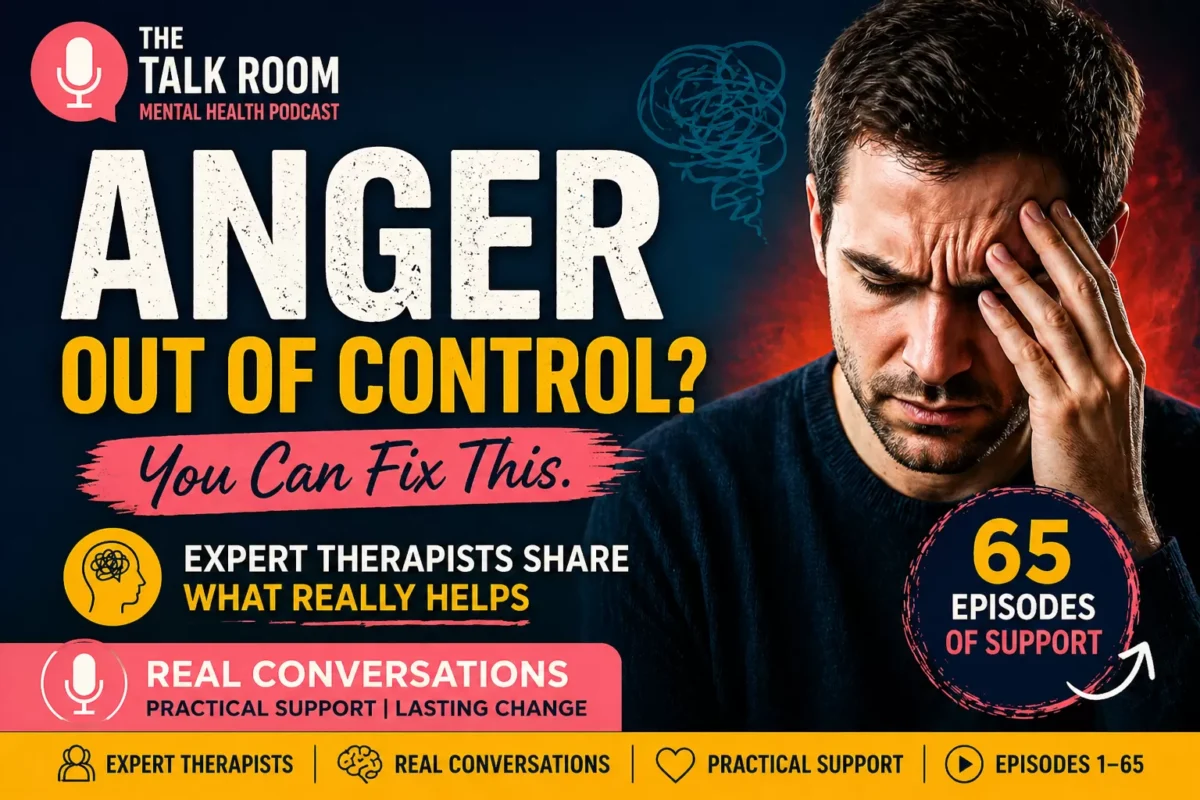
Founder of Hope Therapy, published author, clinical supervisor, and co-presenter of The Talk Room Podcast. Practising therapist with 25+ years of senior leadership experience.
Before Ian Stockbridge was a therapist, he was a leader. For more than 25 years he worked in senior management and directorial roles across commercial organisations — at times managing teams of more than 200 people. He was effective at it. But the longer he did it, the harder something became to ignore. The people around him were struggling. Capable, committed, often high-achieving people carrying invisible weight that had nowhere to go. Stress accumulated quietly across months and years. Anxiety managed behind professionalism. Relationships and mental health dealt with in the margins of a working life that left little room for either.
- SCoPEd Band C
- SNCPS (Acc)
- BSc (Hons) CBT
- PGCert Clinical Supervision
- Diploma — Person-Centred Counselling
- Diploma — Mindfulness-Based Cognitive Therapy
- Certificate — Acceptance & Commitment Therapy
- Certificate — Trauma
- Certificate — CBT for Insomnia
- 25+ Years Leadership
- Clinical Supervisor
- Published Author
- Podcast Co-Host
- LGBTQIA+ Affirming
Free 15-minute consultation
A no-pressure conversation to find the right therapist for you. No commitment needed.
IN THIS ARTICLE
ABOUT THE AUTHOR
Ian Stockbridge
MBACP (Senior Accredited)
Founder of Hope Therapy, published author, clinical supervisor, and co-presenter of The Talk Room Podcast. Practising therapist with 25+ years of senior leadership experience.
ABOUT HOPE THERAPY
Qualified registered therapists
Online nationwide across UK
Face-to-face across England
LGBTQIA+ & neurodivergent affirming
Mon–Sun, 9am–9pm
NCPS organisational member
Est 2014
Published: 12th September 2026 | Written by Ian Stockbridge | Reviewed for clinical accuracy before publishing | Review due: September 2028