
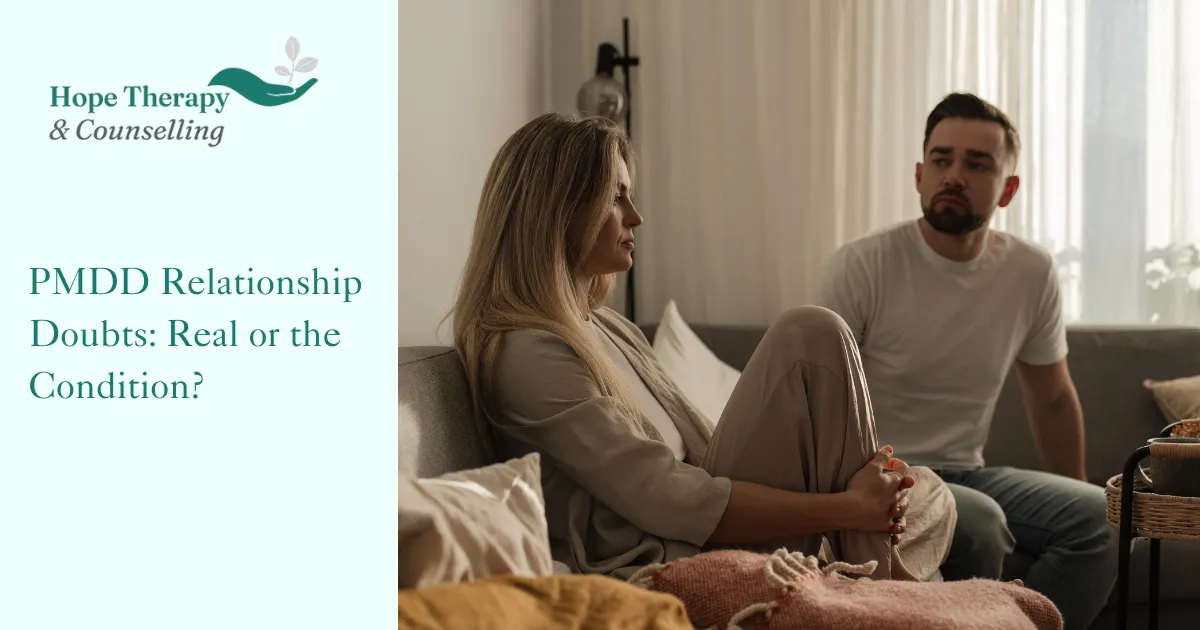
One of the most frightening features of PMDD, and one of the least discussed, is what it can do to how a relationship feels during the luteal phase. Not just the irritability and the emotional distance, but the thoughts themselves.
The thought that you don’t love your partner. That the relationship is wrong. That you would be better off alone. That the life you have built together is not the life you actually want. These thoughts arrive with the certainty that PMDD characteristically produces, the heightened emotional conviction of the luteal phase, which makes everything feel more true than it is. And then the follicular phase comes, and the thoughts lift, and you are left trying to work out whether what you felt was the condition speaking, or whether it was telling you something real.
This article is for informational purposes only and does not constitute medical or clinical advice. If you are concerned about your mental health or the mental health of someone you know, please speak with a qualified professional. Hope Therapy & Counselling Services offers a free 15-minute consultation book yours at https://calendly.com/hopetherapy/15-minute-consultation
Are My Relationship Doubts From PMDD, or Are They Real?
This is the question at the heart of the experience, and it is genuinely difficult to answer, because the honest answer is: sometimes both, sometimes neither, and almost always harder to assess than it appears during either phase of the cycle.
During the luteal phase, the PMDD nervous system amplifies emotional conviction. Thoughts that arrive in that window feel more certain, more urgent, and more final than they would at other points in the cycle. This includes thoughts about the relationship. A small recurring irritation that is manageable in the follicular phase can become, in the luteal phase, compelling evidence that the relationship is fundamentally wrong. The person experiencing PMDD is not fabricating these thoughts, they feel completely real. But the neurological environment that is generating them is producing a level of certainty that the thoughts themselves do not deserve.
The follicular phase creates the opposite problem. In the relative clarity of the follicular phase, the doubts may feel completely resolved, so resolved that it seems impossible the luteal-phase version of you could have felt that way. This retrospective minimisation, ‘I was just being hormonal, the relationship is fine’, is also a misreading. The luteal-phase thoughts may have contained something worth examining, even if the intensity in which they were experienced was distorted.
The most clinically useful position is neither dismissing the doubts as ‘just PMDD’ nor treating them as definitive verdicts. The luteal phase is not a reliable time to make relationship decisions. The follicular phase is a better time to examine what the doubts were actually pointing at — with curiosity rather than urgency, and ideally with support.
Is PMDD Ruining My Relationship?
The feeling that PMDD is ruining a relationship is real and common, and it is worth separating what is actually happening from what the luteal phase is making it feel like.
What PMDD does to relationships is significant and cumulative. The cyclical intensification of mood, the periods of withdrawal and emotional reactivity, the way the luteal phase can make normal relational friction feel catastrophic, these place genuine strain on both partners. That strain is real. And it tends to compound over time if it is not acknowledged and addressed.
What PMDD does not do, in most cases, is create damage to a relationship that cannot be understood and worked through. The cyclical quality of PMDD, its predictability, the way it lifts, means that couples who develop a shared understanding of the condition and a shared language for navigating it are in a significantly different position from couples where PMDD is unacknowledged or misattributed.
What Does the Research Actually Show About PMDD and Relationships?
The question of whether PMDD relationships have higher breakdown rates is one that people search for with some frequency, and the honest answer is that the evidence is limited. Studies on PMDD and relationship outcomes are not abundant, and the research that exists tends to show that the relational impact of PMDD is significant but not deterministic. The condition creates strain; it does not create an inevitable outcome.
What the clinical evidence more consistently shows is that couples who seek support, whether through couples counselling, individual therapy, or psychoeducation about the condition, tend to fare better than those who manage alone. The specific quality of PMDD, the cyclical improvement that can produce a false sense that things have resolved, can make seeking support feel less urgent than it actually is.
PMDD relationship strain is real, and it does not have to be faced alone.
Couples counselling gives both of you a space to understand the condition together. A free 15-minute consultation is a first step. https://calendly.com/hopetherapy/15-minute-consultation
When Should You Act on Relationship Doubts?
The short answer is: not during the luteal phase. This is not to say that relationship decisions should never be made by people with PMDD, they can and should be made, with the same autonomy as anyone else. But decisions made at the peak of luteal-phase distress are made in a neurological environment that amplifies urgency and certainty in ways that are not reliable guides to action.
If relationship doubts persist across multiple cycles, present in both phases, even in different intensities, that is a different picture from doubts that appear exclusively in the luteal phase and completely resolve. Both are worth taking seriously, but they warrant different responses. Doubts that persist across the cycle warrant exploration, possibly in couples counselling or individual therapy. Doubts that are exclusively luteal-phase and fully resolve may warrant tracking, noticing the pattern, examining what it points to, and distinguishing between what is the condition and what is something else.
What Partners Need to Understand
For partners trying to understand why a relationship that feels good in the follicular phase feels difficult, even doomed, in the luteal phase, the most important thing to grasp is that the person with PMDD is not performing two different relationships. They are experiencing two different neurological states, and those states produce genuinely different perceptions of the same relationship.
The luteal-phase version of the relationship is not less real, but it is less reliable as a guide to what is actually true. A partner who understands this is in a very different position from one who takes luteal-phase statements as considered verdicts, or who interprets follicular-phase warmth as evidence that the luteal phase never really happened.
What tends to be damaging in PMDD relationships is not the luteal phase itself, but the patterns that develop around it, the unspoken agreement to let it pass without discussion, the partner who holds luteal-phase statements as evidence of underlying feeling, the person with PMDD who makes repair attempts driven by guilt rather than connection. These patterns are amenable to change, but typically require both people to examine them, which is easier to do with support than alone.
When the Doubts Are Worth Taking Seriously
Not every relationship doubt that arises during PMDD is purely a product of the condition. Sometimes the luteal phase surfaces things that are genuinely present in the relationship, resentments, mismatches, unmet needs, with an intensity that is disproportionate but in a direction that is meaningful. The question is how to tell the difference.
A useful practice is examining, during the follicular phase, whether anything from the luteal-phase thoughts has a quieter presence. Not the intensity, that is the condition, but whether there is a kernel of something that persists in a reduced form once the neurological environment has settled. If the follicular phase brings complete resolution, the doubts were almost certainly condition-generated. If there is something still present, smaller, calmer, but there, that is worth exploring with someone who can hold both the condition and the relationship in view at the same time.
Our post on PMDD and relationships covers the broader landscape of how PMDD affects relational dynamics and communication. Our PMDD counselling page explains the therapeutic approaches available for individuals. And our couples counselling page covers the support available for both partners together.
Ready to Take the First Step?
PMDD relationship doubts are real, they are distressing, and they deserve to be examined rather than dismissed or acted on impulsively. Hope Therapy offers a free 15-minute consultation, no obligation, no commitment required https://calendly.com/hopetherapy/15-minute-consultation
This article is for informational purposes only and does not constitute medical or clinical advice. If you are concerned about your mental health or the mental health of someone you know, please speak with a qualified professional. Hope Therapy & Counselling Services offers a free 15-minute consultation, book yours at https://calendly.com/hopetherapy/15-minute-consultation
Ian Stockbridge — MBACP (Senior Accredited) · SNCPS (Acc.) · SCoPEd Band C · BSc (Hons) CBT · PGCert Clinical Supervision (Level 7)
Ian Stockbridge is the founder of Hope Therapy & Counselling Services and a Senior Accredited member of the BACP. He holds SCoPEd Band C status, is a practising therapist, clinical supervisor, co-presenter of The Talk Room Podcast, and the published author of PMDD Uncovered: Understanding the Storm Within. Ian works with individuals and couples online across England and in person where availability allows.
Profile page: https://www.hopefulminds.co.uk/ian-stockbridge/