Anxiety
When your mind won’t stop checking
If you spend hours worrying about your health, googling symptoms, or seeking reassurance that something is not seriously wrong — you are not overreacting. Health anxiety is common, it is well understood, and counselling can help you break the cycle.
NCPS Organisational Member
Professionally registered therapists
Free 15-minute consultation
5,000+
People supported
90+
Qualified therapists
5 ★
Website Testimonials
20+
Counties across England
This page is part of our anxiety hub — visit for a full overview of how we support those suffering with anxiety.
What is health anxiety?
Health anxiety is when worry about your health takes up more space in your life than it should. It might start with a headache that makes you think of a brain tumour. A heart flutter that sends you to Google. A mole that you cannot stop checking. The worry feels rational in the moment — but the relief you get from a doctor’s reassurance or a negative test result never seems to last.
If that pattern is familiar, you are far from alone. Health anxiety — sometimes called illness anxiety disorder or hypochondria — affects a significant number of people. It is not a sign that you are weak or irrational. It is a specific form of anxiety with well-understood patterns, and it responds well to the right kind of support.
What makes health anxiety particularly exhausting is that the checking and reassurance-seeking that are supposed to make you feel better often end up making things worse. Each Google search, each doctor’s visit, each body scan provides a moment of relief — followed by another wave of doubt. Counselling can help you understand that cycle and find a way out of it.
What health anxiety actually feels like
The clinical descriptions talk about “excessive preoccupation with illness.” But for the person living with it, health anxiety feels more like being trapped inside a mind that will not stop sounding the alarm.
You might notice a sensation in your body — a twinge, a tightness, something that feels slightly different from yesterday — and within minutes your mind has constructed a worst-case scenario. You know you are probably overthinking it. You tell yourself to stop. But the thought has already taken hold, and the only thing that seems like it could help is checking — googling the symptom, asking someone if they think it sounds serious, or booking yet another appointment with your GP.
The reassurance works, briefly. But then something else catches your attention. A different symptom. A news story about an illness. A friend mentioning a health scare. And the cycle starts again.
What makes this so draining is not just the fear itself — it is the amount of time and energy it consumes. Hours lost to searching. Concentration broken by intrusive thoughts. Relationships strained by the constant need for reassurance. A background noise of dread that never fully goes quiet.
The checking and reassurance cycle
At the heart of health anxiety is a behaviour pattern that feels helpful in the moment but maintains the problem over time. It works like this: you notice a symptom or have a frightening thought about your health. The anxiety spikes. You do something to reduce it — google the symptom, check your body, ask your partner if they think you look okay, or see your GP.
The relief is real, but temporary. And each time you seek reassurance, you reinforce the belief that the anxiety was justified — that you needed to check, that the symptom really was something to worry about. Over time, the threshold for what triggers the anxiety gets lower, and the reassurance lasts for shorter and shorter periods.
This is not a character flaw. It is a well-documented anxiety pattern, and understanding it is the first step towards changing it.
Health anxiety and the body
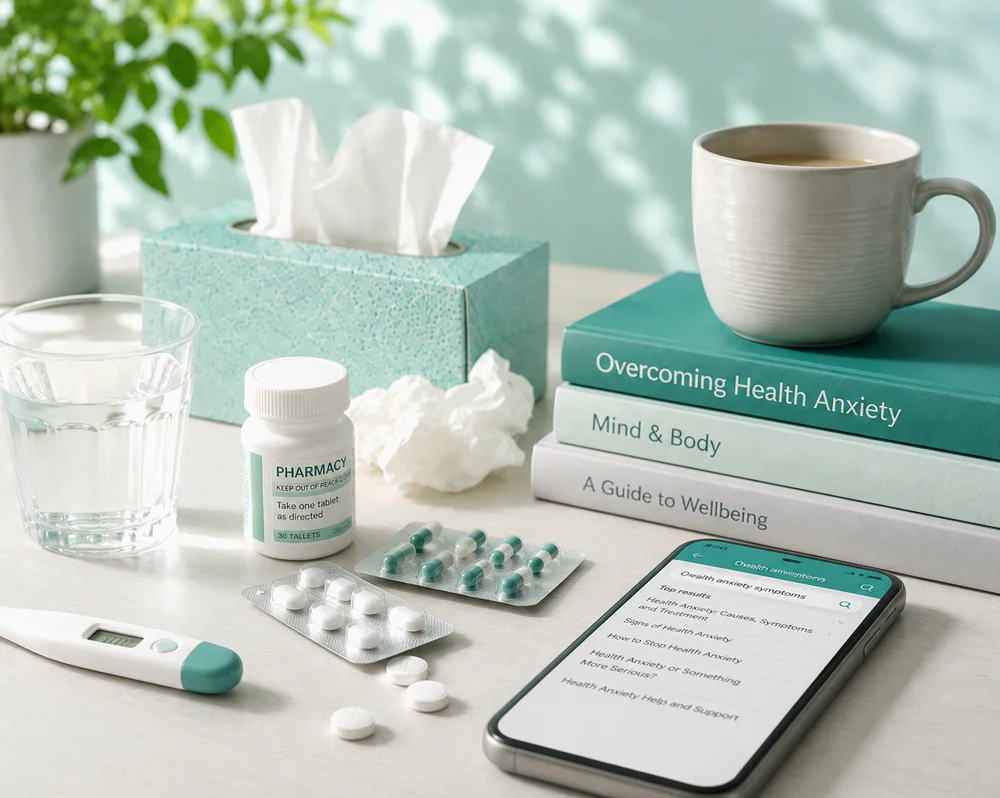
There is a painful irony at the centre of health anxiety: the anxiety itself produces physical symptoms. A racing heart, muscle tension, dizziness, digestive problems, fatigue — all of which can then become the focus of the next wave of worry. The anxiety creates the very sensations you are most afraid of.
Many people with health anxiety have had extensive medical investigations — blood tests, scans, specialist referrals — all of which come back normal. This can be deeply confusing. If nothing is wrong, why do you feel this way? The answer, usually, is that anxiety is generating the sensations — but the sensations feel indistinguishable from something more serious.
Where health anxiety comes from
Health anxiety can develop for many reasons. A serious illness in childhood — your own or a family member’s — can leave you hypervigilant about your body. A frightening medical experience, a misdiagnosis, or the sudden loss of someone to illness can all create a template for worry. For some people, health anxiety develops gradually during a stressful period, without any obvious trigger.
The internet has also changed the landscape. It has never been easier to search for symptoms — and the information available online is often alarming, poorly contextualised, or designed to generate clicks rather than reassure. Research suggests that health-related internet searching is one of the strongest maintaining factors in health anxiety.
Recognising the Pattern
You might be experiencing health anxiety if…
These are some of the common patterns. You do not need to recognise all of them.
Googling symptoms
Spending significant time researching symptoms online — and finding that the information you read makes you feel worse, not better.
Body checking
Repeatedly examining your body for lumps, marks, or changes — pressing, prodding, or looking in the mirror for signs of illness.
Seeking reassurance
Asking your partner, friends, or GP whether they think your symptoms are serious — and finding the relief only lasts a short time before the worry returns.
Avoiding health information
Or the opposite — avoiding anything related to illness (TV programmes, news stories, conversations) because it triggers a spiral of worry.
Frequent GP visits
Visiting your doctor more often than most people, requesting tests, or struggling to accept reassurance when results come back normal.
Intrusive thoughts about illness
Persistent, unwanted thoughts about having or developing a serious illness — thoughts that feel impossible to shake and that interrupt your daily life.
How counselling helps with health anxiety
A good therapist will never tell you your symptoms are not real or that you are making a fuss. What they will do is help you understand the pattern that is keeping you stuck — the cycle of noticing, worrying, checking, and temporarily relieving, only for the anxiety to return.
Counselling for health anxiety typically involves learning to sit with uncertainty rather than trying to eliminate it. That might sound uncomfortable — and initially, it is. But over time, many people find that their tolerance for “not knowing” increases, and with it, the intensity of the anxiety decreases.
Your therapist will also help you explore what is underneath the health worry. For some people, health anxiety is connected to a past experience — an illness, a loss, or a period of vulnerability. For others, it is part of a broader pattern of anxiety that has found its way to health as a focus. Understanding the roots often helps loosen the grip.
At Hope Therapy, we match you with a therapist who has experience working with health anxiety and anxiety-related conditions. The matching process is part of your free consultation — we find the right person for you.
Our Approach
Therapeutic approaches that can help
Different approaches work for different people. Here are the ones our therapists most commonly use for health anxiety.
Cognitive Behavioural Therapy (CBT)
CBT is the most widely recommended approach for health anxiety. It helps you identify the thinking patterns and behaviours that maintain the cycle — catastrophic interpretations of body sensations, compulsive checking, reassurance-seeking — and develop healthier ways of responding. NICE recommends CBT as a first-line treatment for health anxiety.
Learn more about CBT →
EMDR
Where health anxiety is connected to a specific frightening experience — a medical scare, a misdiagnosis, the illness or death of someone close to you — EMDR can help process that memory so it no longer drives your current anxiety. This can be especially helpful when you can trace the start of your health worry to a particular event.
Learn more about EMDR →
Integrative Counselling
Integrative counselling explores the broader picture — not just the health anxiety itself, but what might be driving it. This approach can be especially valuable when health anxiety sits alongside other difficulties such as low self-esteem, perfectionism, or a need for control, or when you want to understand why your mind has settled on health as its primary worry.
Learn more about counselling →
Our booking team and your therapist will discuss which approach — or combination — feels most appropriate for what you are bringing. You do not need to know which is right before you start.
What our clients say
Real experiences
★ ★ ★ ★ ★
I spent years trapped in a cycle of checking and Googling. My therapist helped me see the pattern for what it was and I finally feel like I can trust my body again.
★ ★ ★ ★ ★
Being matched with someone who really understood health anxiety made all the difference. I did not have to explain myself — they just got it.
★ ★ ★ ★ ★
The free consultation was so reassuring. No pressure, just someone listening and explaining how they could help. I wish I had called sooner.
Client experiences are unique. Results vary between individuals.
Getting started
How it works
Three simple steps. No pressure, no obligation.
1
Book a free consultation
A relaxed 15-minute conversation with a member of our team. We listen to what has been going on and answer any questions you have. You can do this from home — by phone or online.
2
We find the right therapist
Based on what you tell us, we carefully match you with a therapist from our team of 90+ who has the right experience and approach for your needs. This is not random — it is a considered process.
3
Begin your sessions
Start your sessions online from wherever you feel comfortable. Your therapist will help you understand the patterns driving your health anxiety and develop a different relationship with uncertainty — at a pace that feels right for you.
Most clients hear back from us the same working day, and typically begin sessions within a week of the free consultation — depending on your preferences and therapist availability.
Standards you can trust
How we match you with the right therapist for health anxiety
Choosing a therapist is a personal decision, and we take time to get the match right.
A careful match, not a long list
Therapist availability changes from week to week, so rather than asking you to choose from a directory, we take time during your free 15-minute consultation to understand what you are looking for — and then match you with a therapist suited to your needs.
During the consultation, we will ask about:
- What you would like the work to focus on, and any specific concerns
- Whether you would prefer face-to-face, online, or combination
- Any preferences around therapy approach (counselling, CBT, EMDR, hypnotherapy, mindfulness, ACT, compassion focused therapy and others)
- Day and time availability
- Any specialisms (LGBTQIA+ affirming, neurodiversity-affirming, particular life experiences)
- Practical preferences (therapist gender, age range, shared lived experience)
All therapists we work with are qualified and registered with appropriate UK professional bodies, and we will confirm the most suitable options with you before any sessions begin.
Professional standards across our team
Hope Therapy & Counselling Services has been operating since 2014, and we hold Organisational Membership with the National Counselling & Psychotherapy Society (NCPS). We work in line with the NCPS Code of Ethics and BACP Good Practice, and our wider clinical standards include:
- Qualified, professionally registered therapists across the team — registrations vary per therapist and are confirmed before matching
- Ongoing clinical supervision in line with professional body requirements
- Continuing professional development to maintain and develop practice
- Clear confidentiality standards, with limits explained before sessions begin
- Client-centred, non-judgemental and inclusive practice across all areas of identity and experience
- Founder-led clinical oversight from Ian Stockbridge — MBACP (Senior Accredited) – who continues to lead the practice and oversee its standards
Whether you choose face-to-face counselling near you or online therapy from anywhere in the UK, you can expect to be matched with a therapist who is appropriately qualified and suited to the support you are looking for.
Transparent Pricing
Our fees
No hidden costs. Your therapist and fees are discussed during your free consultation.
Individual Counselling
From £65
per 50-minute session
- Online via Zoom or telephone
- Face-to-face where available
- Mon–Fri, limited weekend availability
CBT
From £85
per 50-minute session
- NICE-recommended for health anxiety
- Structured, evidence-based approach
- Online or face-to-face
EMDR
From £95
per 50-minute session
- Specialist trauma processing
- Trained EMDR practitioners
- Online or face-to-face
Looking for a more affordable option? We may be able to offer sessions at a reduced rate — just ask during your free consultation.
London clients: Location-adjusted rates may apply. Please ask during your free consultation and we will confirm the exact fee before you commit to anything.
Common Questions
Frequently asked questions
What is health anxiety?
Health anxiety is when you spend a significant amount of time worrying about your health — checking your body for symptoms, researching illnesses online, or seeking reassurance from doctors — to the point where it starts to take over your daily life. It is sometimes called hypochondria or illness anxiety disorder.
How do I know if it is health anxiety or a real illness?
If your GP has run tests and found no medical cause, health anxiety is a common explanation. The key pattern is that reassurance from a doctor helps only temporarily — the worry comes back, often about a different symptom or illness. A counsellor can help you understand this cycle.
Can counselling help with health anxiety?
Yes. CBT has a strong evidence base for health anxiety and is recommended by NICE. It helps you identify the thinking patterns and behaviours that keep the anxiety going and develop healthier ways of responding to worry about your health.
Will the therapist tell me my symptoms are not real?
No. The physical sensations you feel are real. What counselling explores is the interpretation you give those sensations — and whether the way you respond (checking, googling, seeking reassurance) is helping or making things worse.
Do I need a GP referral?
No. You do not need a referral to begin counselling with us. However, if you have new or unexplained physical symptoms, we always recommend seeing your GP first to rule out other causes. Many people come to us alongside their GP care.
How much does health anxiety counselling cost?
Individual counselling starts from £65 per 50-minute session. CBT starts from £85. We also offer a reduced rate for those who need it. Fees are discussed during your free consultation so you are clear before committing.
You are not making it up
If you have been told to “stop worrying” or “just relax,” you know how unhelpful that advice is. Health anxiety is not a choice. The worry feels real because, in the moment, it is real. And the physical sensations are not imagined — they are your body’s response to a mind that is on constant alert.
You do not need to have a formal diagnosis. You do not need to have stopped all your checking behaviours before you reach out. You do not even need to be sure it is health anxiety. A free 15-minute consultation is simply a conversation — a chance to talk about what you have been experiencing and to find out whether we can help.
If any of this has felt familiar, book a free consultation or call us on . We answer the phone 9am to 9pm.
Related Support
You might also find these helpful
Related conditions
Therapy approaches
From our Blog
Understanding health anxiety
From Overwhelmed to Empowered: Transforming Your Stress Response
Stress is an inevitable part of life. It can be a powerful motivator, but when it becomes overwhelming,…
Finding a Health Anxiety Therapist Nearby
Health anxiety can be a debilitating condition, often leaving individuals in a constant state of worry about their…
Using CBT to Manage Health Anxiety
Health anxiety, a condition marked by excessive worry about having a serious illness, can be debilitating. It can…
Meet Our Founder
Built by someone who saw the need from the inside

★
SCoPEd Band C
MBACP & SNCPS Senior Accredited
“Having worked for more than 25 years in senior management, I saw the same thing repeatedly — people struggling with mental health and relationship challenges, and so often struggling to access the right support when it was needed. It was out of this recognition of human need that Hope was born.”
Ian Stockbridge founded Hope Therapy after 25+ years leading large commercial teams – watching colleagues carry stress, anxiety, and personal difficulty with nowhere to turn. He retrained rigorously, now holding Senior Accredited status with both the BACP and NCPS, alongside SCoPEd Band C — the highest independent competence verification in the UK counselling profession.
He remains a practising therapist, clinical supervisor, published author of PMDD Uncovered, and co-presenter of The Talk Room Podcast. Hope Therapy was built on the things he saw were most broken – and designed, from the ground up, to do better.
MBACP (Senior Accredited)
SNCPS (Acc)
SCoPEd Band C
BSc (Hons) CBT
PGCert Supervision L7
Quality Award 2024 — 95%+

You do not have to keep carrying this worry alone
A free, no-obligation 15-minute conversation. No pressure, no script — just a chance to be heard, ask questions, and see whether we feel like the right fit.
Get in Touch
Start your enquiry
Not sure where to start? Send us a message and a member of our team will get back to you. All enquiries are treated in the strictest confidence.
★ ★ ★ ★ ★
“From the very first phone call, I felt heard. They didn’t rush me — they helped me work out what I needed.”
Hope Therapy enquiry feedback
NCPS Organisational Member
Est 2014
90+ Qualified Therapists

National Counselling & Psychotherapy Society
British Association for Counselling and Psychotherapy

British Association for Behavioural & Cognitive Psychotherapies
Individual registrations vary per therapist. Last reviewed: May 2026.