Anxiety
When every message feels like a test
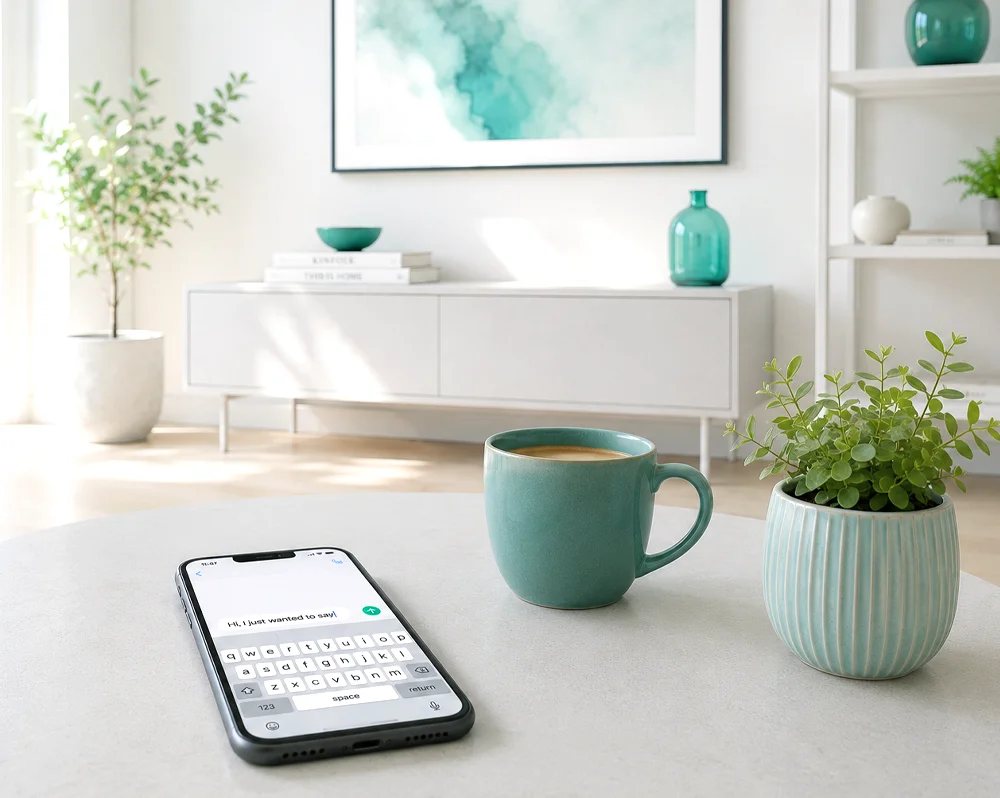
If you dread opening messages, agonise over every word before hitting send, or feel a wave of panic when someone does not reply — texting anxiety is real, it is more common than you think, and counselling can help you understand what is going on.
NCPS Organisational Member
Professionally registered therapists
Free 15-minute consultation
5,000+
People supported
90+
Qualified therapists
5 ★
Website Testimonials
20+
Counties across England
This page is part of our anxiety hub — visit for a full overview of how we support those suffering with anxiety.
You type a message. You re-read it. You delete a word. You add it back. You stare at it for another thirty seconds. Then you either send it and immediately feel a spike of dread — or you close the app altogether and tell yourself you will deal with it later.
If that pattern is familiar, you are experiencing something that millions of people recognise but few talk about: texting anxiety — sometimes called text anxiety or message anxiety. The stress of communicating through messages — whether that is WhatsApp, email, dating apps, or plain SMS — has become one of the most common anxiety experiences in modern life.
It is not trivial. Texting is how most of us stay connected. When every message feels like a test, the cumulative effect on your wellbeing, your relationships, and your confidence can be significant. And the good news is that it is something counselling can genuinely help with.
What texting anxiety actually feels like
Texting anxiety is not just “being bad at replying.” It is a genuine stress response triggered by digital communication. For some people it shows up as a dread of opening messages. For others it is the agonising gap between sending a message and getting a reply. For many, it is both — plus a constant low-level worry about whether they said the right thing, in the right way, at the right time.
You might find yourself reading a message five times before you feel confident about what it means. Interpreting a one-word reply as anger. Feeling your stomach drop when you see a message notification. Spending twenty minutes crafting a response that should take twenty seconds. Or avoiding your phone altogether because the anxiety of dealing with messages has become too much.
The experience can feel disproportionate — and you might tell yourself it is ridiculous to feel this stressed about a text message. But the anxiety is not really about the message. It is about what the message represents: a moment of social exposure with no safety net.
Why texting makes anxiety worse
In face-to-face conversation, your brain receives a constant stream of information — tone of voice, facial expressions, body language, the pace of the exchange — that helps you gauge how the other person is responding. This feedback loop is what allows most conversations to feel manageable, even for people who are socially anxious.
Texting strips all of that away. You are left with words on a screen — no tone, no expression, no context. And your brain, which evolved to detect social threats in real time, is forced to fill the gaps. For people prone to anxiety, those gaps get filled with doubt, self-criticism, and worst-case scenarios.
Add to that the visibility of read receipts, typing indicators, and last-seen timestamps, and you have a communication medium that is almost perfectly designed to trigger anxious monitoring. You can see that someone has read your message but not replied. You can watch the typing dots appear and disappear. Each of these micro-signals becomes data for an anxious mind to interpret — almost always in the most threatening way possible.
Texting anxiety and social anxiety
For many people, texting anxiety is one expression of a broader pattern of social anxiety. Social anxiety texting — a fear of being judged, misunderstood, or rejected. The same worries that make face-to-face interaction difficult can become even more intense in text, because the absence of feedback removes the very thing that might have reassured you.
But texting anxiety can also exist on its own. Some people who are perfectly comfortable in person find digital communication uniquely stressful — perhaps because of a past experience where a message was misunderstood, or because the permanent, visible nature of written communication feels more exposing than a spoken conversation that disappears as it happens.
The impact on daily life
Texting anxiety might sound minor compared to other forms of anxiety, but its effects can be quietly corrosive. You might avoid replying to friends and then feel guilty about the silence. You might miss professional opportunities because the thought of emailing someone new feels paralysing. Dating apps can become a source of dread rather than possibility. Even simple arrangements — confirming plans, replying to a group chat, responding to a work message — can take up disproportionate amounts of mental energy.
Over time, the avoidance can damage relationships. People stop reaching out. Connections fade. And the isolation that follows can make the underlying anxiety worse.
Recognising the Signs
You might have texting anxiety if…
These are some of the most common texting anxiety symptoms. You do not need to recognise all of them.
Over-editing messages
Re-reading and rewriting messages repeatedly before sending — changing words, adjusting tone, adding or removing emojis — worried about how you will come across.
Dreading replies
Feeling a spike of anxiety when a notification appears — or checking your phone obsessively when a reply has not come, interpreting the delay as a sign that something is wrong.
Avoiding sending messages
Wanting to reach out but finding yourself unable to start a conversation — the fear of bothering someone or saying the wrong thing stops you.
Misreading tone
Interpreting short, neutral, or ambiguous messages as negative — assuming someone is angry, annoyed, or upset based on minimal evidence.
Using filler to soften
Over-relying on emojis, exclamation marks, “haha,” or “lol” to manage how your messages sound — feeling unable to send anything without them.
Guilt about not replying
Messages pile up because replying feels too stressful — and then the guilt of not replying creates a new layer of anxiety that makes responding even harder.
How counselling helps with texting anxiety
Texting anxiety is often a window into something broader — a fear of judgement, a pattern of people-pleasing, a deep-seated worry about being rejected or misunderstood. Counselling helps you see through that window and understand what is really driving the distress.
A therapist will not tell you to simply “stop overthinking” — if you could do that, you would have done it already. Instead, they will help you understand the thinking patterns that make texting feel so threatening: the mind-reading, the catastrophising, the assumption that every ambiguous message is a sign of disapproval.
Over time, many people find that as they understand these patterns, the anxiety begins to loosen. Not because texting becomes effortless, but because they develop a more balanced perspective on what a message is — and what it is not. A text is not a test. A delayed reply is not a rejection. And your worth does not depend on getting the wording exactly right.
At Hope Therapy, we match you with a therapist who understands anxiety in the context of modern life — including the unique pressures of digital communication. The matching process is part of your free consultation.
Our Approach
Therapeutic approaches that can help
Different approaches work for different people. Here are the ones our therapists most commonly use for texting anxiety.
Cognitive Behavioural Therapy (CBT)
CBT is particularly well suited to texting anxiety because it targets the specific thinking errors that drive it — mind-reading, catastrophising, personalising. It also uses behavioural experiments to help you gradually test whether the things you fear actually happen, building confidence through direct experience rather than just discussion.
Learn more about CBT →
EMDR
If your texting anxiety is connected to a specific painful experience — a message that went badly wrong, online bullying, a public humiliation, or a relationship that ended over text — EMDR can help process that memory so it no longer shapes how you respond to every future message.
Learn more about EMDR →
Integrative Counselling
Integrative counselling explores the deeper roots of your texting anxiety — which often connect to broader themes of self-worth, fear of rejection, and how you learned to communicate in your earliest relationships. This approach is especially helpful when texting anxiety is part of a wider pattern of social anxiety or people-pleasing.
Learn more about counselling →
Our booking team and your therapist will discuss which approach — or combination — feels most appropriate for what you are bringing. You do not need to know which is right before you start.
What our clients say
Real experiences
★ ★ ★ ★ ★
I never thought I would talk to a therapist about texting. But it was affecting everything — my friendships, my work, my dating life. My therapist helped me see the patterns and I genuinely feel different about my phone now.
★ ★ ★ ★ ★
The matching process meant I got someone who understood social anxiety and how it shows up online. That made all the difference.
★ ★ ★ ★ ★
I was avoiding messages for days and losing friendships because of it. Counselling helped me understand why, and now I can reply without the spiral.
Client experiences are unique. Results vary between individuals.
Getting started
How it works
Three simple steps. No pressure, no obligation.
1
Book a free consultation
A relaxed 15-minute conversation with a member of our team. We listen to what has been going on and answer any questions you have. You can do this from home — by phone or online.
2
We find the right therapist
Based on what you tell us, we carefully match you with a therapist from our team of 90+ who has the right experience and approach for your needs. This is not random — it is a considered process.
3
Begin your sessions
Start your sessions online from wherever you feel comfortable. Your therapist will help you understand the patterns behind your texting anxiety and build confidence in digital communication — at a pace that feels right for you.
Most clients hear back from us the same working day, and typically begin sessions within a week of the free consultation — depending on your preferences and therapist availability.
Standards you can trust
How we match you with the right therapist for texting anxiety
Choosing a therapist is a personal decision, and we take time to get the match right.
A careful match, not a long list
Therapist availability changes from week to week, so rather than asking you to choose from a directory, we take time during your free 15-minute consultation to understand what you are looking for — and then match you with a therapist suited to your needs.
During the consultation, we will ask about:
- What you would like the work to focus on, and any specific concerns
- Whether you would prefer face-to-face, online, or combination
- Any preferences around therapy approach (counselling, CBT, EMDR, hypnotherapy, mindfulness, ACT, compassion focused therapy and others)
- Day and time availability
- Any specialisms (LGBTQIA+ affirming, neurodiversity-affirming, particular life experiences)
- Practical preferences (therapist gender, age range, shared lived experience)
All therapists we work with are qualified and registered with appropriate UK professional bodies, and we will confirm the most suitable options with you before any sessions begin.
Professional standards across our team
Hope Therapy & Counselling Services has been operating since 2014, and we hold Organisational Membership with the National Counselling & Psychotherapy Society (NCPS). We work in line with the NCPS Code of Ethics and BACP Good Practice, and our wider clinical standards include:
- Qualified, professionally registered therapists across the team — registrations vary per therapist and are confirmed before matching
- Ongoing clinical supervision in line with professional body requirements
- Continuing professional development to maintain and develop practice
- Clear confidentiality standards, with limits explained before sessions begin
- Client-centred, non-judgemental and inclusive practice across all areas of identity and experience
- Founder-led clinical oversight from Ian Stockbridge — MBACP (Senior Accredited) – who continues to lead the practice and oversee its standards
Whether you choose face-to-face counselling near you or online therapy from anywhere in the UK, you can expect to be matched with a therapist who is appropriately qualified and suited to the support you are looking for.
Transparent Pricing
Our fees
No hidden costs. Your therapist and fees are discussed during your free consultation.
Individual Counselling
From £65
per 50-minute session
- Online via Zoom or telephone
- Face-to-face where available
- Mon–Fri, limited weekend availability
CBT
From £85
per 50-minute session
- Targets the specific thinking patterns
- Structured, evidence-based approach
- Online or face-to-face
EMDR Therapy
From £95
per 50-minute session
- Specialist trauma processing
- Trained EMDR practitioners
- Online or face-to-face
Looking for a more affordable option? We may be able to offer sessions at a reduced rate — just ask during your free consultation.
London clients: Location-adjusted rates may apply. Please ask during your free consultation and we will confirm the exact fee before you commit to anything.
Common Questions
Frequently asked questions
What is texting anxiety?
Texting anxiety is the stress, dread, or fear people experience around sending, receiving, or waiting for text messages. It can involve obsessively re-reading messages before sending, panic when a reply is delayed, or overthinking the meaning behind short or ambiguous responses.
Is texting anxiety a real condition?
While it is not a formal clinical diagnosis, texting anxiety is a widely recognised manifestation of social and communication anxiety. The absence of tone, facial expressions, and immediate feedback in text-based communication creates a gap that anxious minds fill with worst-case interpretations.
Can counselling help with texting anxiety?
Yes. CBT in particular can help you understand the thinking patterns that drive texting anxiety, challenge the assumptions you make about other people’s responses, and gradually reduce the avoidance and overthinking.
Is texting anxiety linked to social anxiety?
Often, yes. Texting anxiety frequently overlaps with broader social anxiety. For some people it is one expression of a wider pattern. For others it is specific to digital communication. A therapist can help you understand which applies to you.
Why is texting harder than talking in person?
In person, you receive constant feedback — tone, expression, body language — that helps you gauge how the conversation is going. Texting removes all of these cues, leaving your brain to fill the gaps. For anxious minds, those gaps get filled with doubt and worst-case scenarios.
How much does counselling for texting anxiety cost?
Individual counselling starts from £65 per 50-minute session. CBT starts from £85. We offer a reduced rate for those who need it. Fees are discussed during your free consultation.
It is not silly. It is not small.
If you have been dismissing your texting anxiety as something you should just be able to get over, you are not alone — most people do. But the fact that it affects how you communicate, how you maintain relationships, and how much mental energy you spend on something as basic as a message makes it worth taking seriously.
You do not need to have a diagnosis. You do not need to have it all figured out. A free 15-minute consultation is simply a conversation — a chance to talk about what has been going on and to find out whether we can help.
If any of this has felt familiar, book a free consultation or call us on . We answer the phone 9am to 9pm.
Related Support
You might also find these helpful
Related conditions
Therapy approaches
From our Blog
Understanding texting anxiety

8 Signs You Have Texting Anxiety – And How Counselling Can Help
8 Signs You Have Texting Anxiety: In today’s world, texting is one of the most common ways we…

“Why Haven’t They Texted Back?”: The Real Struggle of Texting Anxiety in a Hyperconnected World
There’s a familiar churn in your stomach. You stare at your phone — no new messages. You sent…
Meet Our Founder
Built by someone who saw the need from the inside

★
SCoPEd Band C
MBACP & SNCPS Senior Accredited
“Having worked for more than 25 years in senior management, I saw the same thing repeatedly — people struggling with mental health and relationship challenges, and so often struggling to access the right support when it was needed. It was out of this recognition of human need that Hope was born.”
Ian Stockbridge founded Hope Therapy after 25+ years leading large commercial teams – watching colleagues carry stress, anxiety, and personal difficulty with nowhere to turn. He retrained rigorously, now holding Senior Accredited status with both the BACP and NCPS, alongside SCoPEd Band C — the highest independent competence verification in the UK counselling profession.
He remains a practising therapist, clinical supervisor, published author of PMDD Uncovered, and co-presenter of The Talk Room Podcast. Hope Therapy was built on the things he saw were most broken – and designed, from the ground up, to do better.
MBACP (Senior Accredited)
SNCPS (Acc)
SCoPEd Band C
BSc (Hons) CBT
PGCert Supervision L7
Quality Award 2024 — 95%+


Digital life does not have to feel this hard
A free, no-obligation 15-minute conversation. No pressure, no script — just a chance to be heard, ask questions, and see whether we feel like the right fit.
Get in Touch
Start your enquiry
Not sure where to start? Send us a message and a member of our team will get back to you. All enquiries are treated in the strictest confidence.
★ ★ ★ ★ ★
“From the very first phone call, I felt heard. They didn’t rush me — they helped me work out what I needed.”
Hope Therapy enquiry feedback
NCPS Organisational Member
Est 2014
90+ Qualified Therapists

National Counselling & Psychotherapy Society
British Association for Counselling and Psychotherapy

British Association for Behavioural & Cognitive Psychotherapies
Individual registrations vary per therapist. Last reviewed: May 2026.