LGBTQIA+ Counselling
When the weight of being different becomes anxiety or depression
Counselling for LGBTQIA+ people experiencing anxiety or depression — online nationwide and face-to-face across England. Support that understands where these feelings come from, not just how they show up.
NCPS Organisational Member
Reviewed May 2026
Free 15-minute consultation

★ ★ ★ ★ ★“I’d tried therapy before but always felt I had to explain the LGBTQIA+ part before we could get to the anxiety. Here, that context was already understood.”
Priya, who sought support for anxiety
5,000+
People supported
90+
Qualified therapists
5 ★
Website Testimonials
20+
Counties across England
The anxiety that comes with being different — even when you are proud of who you are
Anxiety and depression are common human experiences. But if you are LGBTQIA+, there is often an additional layer — one that a therapist who does not understand your experience might miss entirely.
Perhaps you carry a low-level alertness that never quite switches off. Scanning for how people might react when you mention your partner. Noticing who is in the room before you speak. Adjusting the way you hold yourself, the words you choose, the parts of your life you share — depending on whether you feel safe. This kind of vigilance is exhausting, even when nothing actually happens. It is the cost of living in a world that still, in many contexts, requires you to calculate risk before being yourself. And when it accumulates over months and years, it often shows up as anxiety, low mood, difficulty sleeping, or a persistent sense of emotional flatness that is hard to explain to anyone who has not lived it.
For some people, the connection between their LGBTQIA+ experience and their mental health is obvious. For others, it is not — the anxiety or depression might feel like it comes from nowhere, or from work, or from relationships, without the thread back to identity and minority stress being immediately visible. Both experiences are real. Both deserve support that understands the full picture.
Research consistently shows that LGBTQIA+ people are significantly more likely to experience anxiety and depression than the general population. This is not because of who they are — it is because of how the world responds to who they are. Counselling that recognises this distinction is better placed to help.
And yet, many LGBTQIA+ people who seek therapy find that their therapist does not understand this context — or worse, treats their identity as part of the problem. Having to educate your therapist about minority stress while also trying to address your anxiety is not therapeutic. It is another burden. At Hope Therapy, we match you with a therapist who already understands this landscape, so the work can begin where it matters.
What minority stress looks like in everyday life
Minority stress is a term from psychology research that describes the chronic, additional stress experienced by people who belong to marginalised groups. For LGBTQIA+ people, it can include:
- Hypervigilance — constantly assessing whether a situation is safe before being yourself, even in ordinary settings like a doctor’s waiting room or a work social
- Concealment — hiding parts of your identity to avoid negative reactions, and the emotional cost of maintaining that separation between your public and private self
- Anticipated rejection — expecting that people will respond badly, based on past experience, even when they might not
- Internalised negativity — absorbing messages from culture, family, or religion that your identity is wrong, shameful, or less valid — even when you consciously disagree with them
- Microaggressions — the small, repeated experiences that individually seem manageable but collectively wear you down: misgendering, assumptions, intrusive questions, being treated as a spokesperson for an entire community
- Actual discrimination — being treated unfairly at work, in healthcare, in housing, or in public spaces because of who you are
None of these things are your fault. But their cumulative effect on your nervous system, your mood, and your sense of safety in the world is real — and it often manifests as clinical anxiety, depression, or both. Understanding this pattern is the first step toward feeling less alone in it.
It is worth noting that minority stress does not only affect people who are visibly LGBTQIA+ or who are out in every context. People who pass as straight or cisgender may still carry the stress of concealment and the fear of being found out. People who came out years ago may still carry the effects of earlier experiences — family rejection, school bullying, workplace discrimination — even when their current circumstances are safer. The stress is cumulative, and it does not always resolve just because the external circumstances improve.
How affirming counselling helps with LGBTQIA+ anxiety and depression
Counselling that understands minority stress does not just treat the symptoms — it helps you see the patterns behind them. A therapist who gets this context can help you distinguish between anxiety that has an identifiable cause (discrimination, concealment, family tension) and anxiety that has become a generalised state — always present, no longer tied to a specific trigger.
That distinction matters, because the approach is different. Sometimes the work is about developing strategies for managing the anxiety itself — the racing thoughts, the physical tension, the avoidance. Sometimes it is about addressing what is underneath: the grief, the anger, the loneliness that comes from years of not being fully seen. Often it is both.
Your therapist may also help you notice the ways in which coping strategies that once protected you — keeping your guard up, staying private, avoiding vulnerability — may now be contributing to the depression or disconnection you are experiencing. This is not about blame. It is about understanding.
Many people also find that counselling helps them separate what belongs to them from what belongs to the world. The anxiety you feel before a family gathering, the exhaustion after a day of code-switching at work, the low mood that settles in after reading the news — these are responses to real external pressures. Recognising that they are not character flaws or personal failures can itself be a turning point.
Sessions are confidential. There are limited circumstances where confidentiality may need to be adjusted — for example, if there is a serious risk of harm to you or someone else — and your therapist will explain these clearly at the outset.
If you want to read more about anxiety or depression in general, we also have detailed pages on anxiety and depression that cover these conditions in depth. This page focuses specifically on how LGBTQIA+ experience shapes them.
Our Approach
How we work with LGBTQIA+ anxiety and depression
We offer several evidence-based approaches, and your therapist will recommend the one that best fits your situation.
What our clients say
Real experiences
★ ★ ★ ★ ★
I’d lived with this constant low-level anxiety for so long I thought it was just who I was. Counselling helped me see it was connected to years of hiding parts of myself. That understanding changed everything.
Ash, who sought support for anxiety
★ ★ ★ ★ ★
My depression got worse after coming out — which nobody expected, least of all me. My therapist understood that it was grief, not regret, and that made it possible to work through.
Rowan, who sought support for depression
★ ★ ★ ★ ★
I’d tried the NHS talking therapy route but never felt I could mention the LGBTQIA+ stuff without it becoming the whole focus. With Hope Therapy, it was just part of the context — and the anxiety was treated properly.
Sami, who sought support for anxiety and low mood
Client experiences are unique. Results vary between individuals.
Getting started
What to expect
Starting counselling can feel like a big step — especially when anxiety makes everything feel harder. Here is how it works.
1
Free consultation
A brief, relaxed 15-minute conversation with a member of our booking team. We listen to what is going on and explore whether counselling could help. No pressure, no obligation.
2
Matched with a therapist
Based on your needs and preferences, we carefully match you with one of our 90+ qualified therapists. If it doesn’t feel right, we’ll find someone else — at no extra cost.
3
Your first session
Your therapist will take time to understand your situation and what you are hoping to work on. There is no rush, no script, and nothing you have to share before you are ready.
Most clients hear back from us the same working day, and typically begin sessions within a week of the free consultation — depending on your preferences and therapist availability.
Standards you can trust
How we match you with the right therapist for anxiety and depression support
Choosing a therapist is a personal decision, and we take time to get the match right.
A careful match, not a long list
Therapist availability changes from week to week, so rather than asking you to choose from a directory, we take time during your free 15-minute consultation to understand what you are looking for — and then match you with a therapist suited to your needs.
During the consultation, we will ask about:
- What you would like the work to focus on, and any specific concerns you would like support with
- Whether you would prefer face-to-face counselling, online sessions, or a combination of the two
- Any preferences around therapy approach (counselling, CBT, EMDR, hypnotherapy, mindfulness, ACT, compassion focused therapy and others)
- Day and time availability that works around your life
- Any specialisms that matter to you — for example LGBTQIA+ affirming therapy, neurodiversity-affirming support, or particular life experiences
- Practical preferences — for example therapist gender, age range, or shared lived experience where that matters to you
All therapists we work with are qualified and registered with appropriate UK professional bodies, and we will confirm the most suitable options with you before any sessions begin.
Professional standards across our team
Hope Therapy & Counselling Services has been operating since 2014, and we hold Organisational Membership with the National Counselling & Psychotherapy Society (NCPS). We work in line with the NCPS Code of Ethics and BACP Good Practice, and our wider clinical standards include:
- Qualified, professionally registered therapists across the team — registrations vary per therapist and are confirmed before matching
- Ongoing clinical supervision in line with professional body requirements
- Continuing professional development to maintain and develop practice
- Clear confidentiality standards, with limits explained before sessions begin
- Client-centred, non-judgemental and inclusive practice across all areas of identity and experience
- Founder-led clinical oversight from Ian Stockbridge — MBACP (Senior Accredited) – who continues to lead the practice and oversee its standards
Whether you choose face-to-face counselling near you or online therapy from anywhere in the UK, you can expect to be matched with a therapist who is appropriately qualified and suited to the support you are looking for.
Transparent Pricing
Our fees for anxiety and depression counselling
No hidden costs. Your therapist and fees are discussed during your free consultation.
Counselling
From £65
per 50-minute session
- Person-centred or integrative approach
- Online via Zoom or telephone
- Face-to-face where available
CBT
From £85
per 50-minute session
- Structured, goal-focused approach
- Practical tools and strategies
- Online or face-to-face
EMDR
From £95
per 50-minute session
- Trauma processing and resolution
- Evidence-based approach
- Online or face-to-face
Looking for a more affordable option? We may be able to offer sessions at a reduced rate — just ask during your free consultation.
London clients: Location-adjusted rates may apply. Please ask during your free consultation and we will confirm the exact fee before you commit to anything.
A printable overview of our affirming counselling service — useful to keep or share.
Common Questions
Frequently asked questions
Is LGBTQIA+ anxiety different from other anxiety?
The experience of anxiety is the same — racing thoughts, physical tension, avoidance, difficulty sleeping. But the causes can be different. LGBTQIA+ people are more likely to experience anxiety connected to discrimination, concealment, hypervigilance, and minority stress. Counselling that understands this context can address the roots, not just the symptoms.
Do I need to talk about my identity in counselling?
Only if it feels relevant to you. Some people come because their anxiety or depression is directly connected to their LGBTQIA+ experience. Others come for reasons that have nothing to do with identity but want a therapist who already understands that part of their life. Both are equally valid.
Will my therapist understand minority stress?
We match you with a therapist who has experience working with LGBTQIA+ clients and understands the impact of minority stress on mental health. During your free consultation, we ask about your preferences so the match is right. If it does not feel right, we will find someone else at no extra cost.
Can I access LGBTQIA+ anxiety counselling online?
Yes. All of our therapists offer online sessions via Zoom or telephone, so you can access affirming support from anywhere in the UK. Face-to-face sessions are also available in locations across England.
Is everything I share in counselling confidential?
Yes. Sessions are confidential in line with professional ethical standards. There are some limited exceptions — for example, where there is a serious risk of harm to you or someone else — and your therapist will explain these clearly before you begin.
How much does LGBTQIA+ anxiety and depression counselling cost?
Individual counselling starts from £65 per 50-minute session. CBT starts from £85 and EMDR from £95. We may be able to offer a reduced rate — just ask during your free 15-minute consultation. There are no hidden fees, and your therapist and exact cost are confirmed before you commit to anything.
Related Support
You might also find these helpful
Related conditions
Therapy approaches
From our Blog
Articles you might find helpful
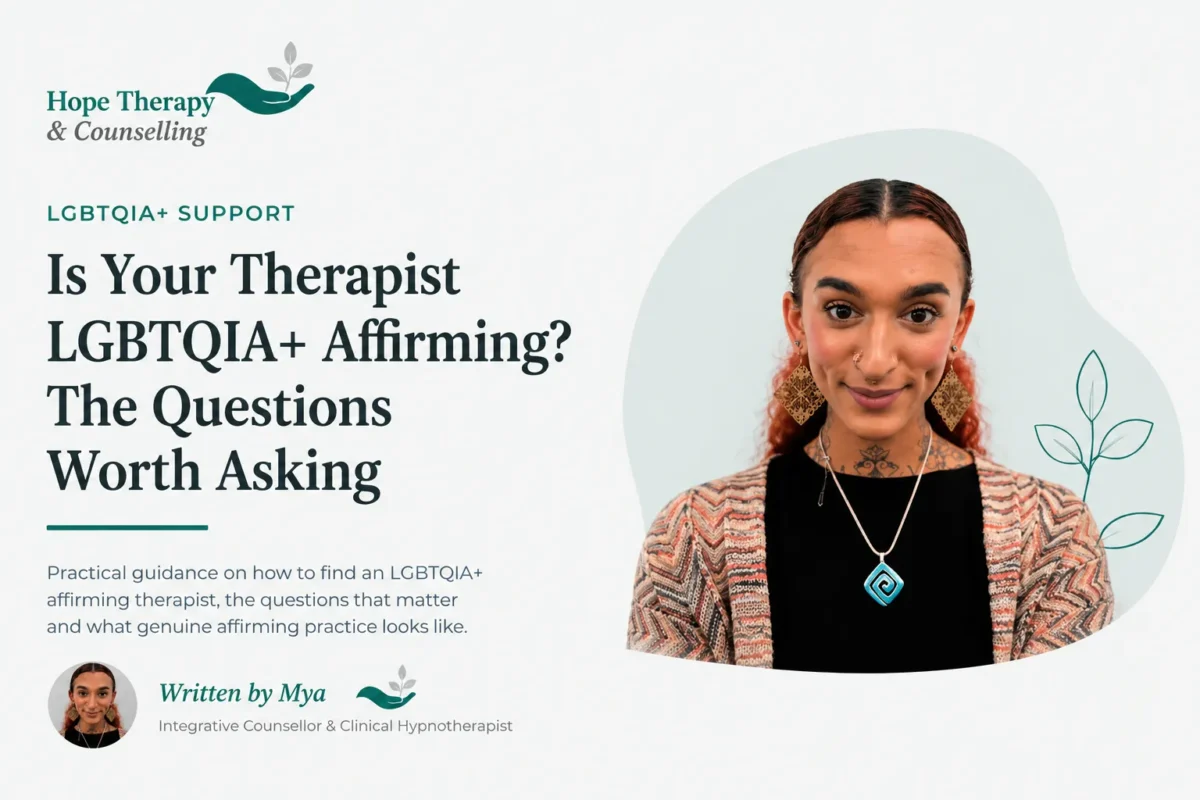
How Do You Know If a Therapist Is Actually LGBTQIA+ Affirming? The Questions Worth Asking
By Mya, MBACPIntegrative Counsellor & Clinical HypnotherapistJune 2026 · 7 min read Most therapists will tell you they…

The Talk Room: Episode 15 – LGBTQIA+ Mental Health – A Compassionate Conversation on Identity and Well-Being
LGBTQIA+ Mental Health podcast: In our exploration of “The Talk Room,” a mental health podcast series dedicated to…

LGBTQIA+ related issues and how Hope Therapy could support these
Although a lot has been achieved in relation to LGBTIQ+ rights, many from the community still face obstacles.…
Meet Our Founder
Built by someone who saw the need from the inside

★
SCoPEd Band C
MBACP & SNCPS Senior Accredited
“Having worked for more than 25 years in senior management, I saw the same thing repeatedly — people struggling with mental health and relationship challenges, and so often struggling to access the right support when it was needed. It was out of this recognition of human need that Hope was born.”
Ian Stockbridge founded Hope Therapy after 25+ years leading large commercial teams – watching colleagues carry stress, anxiety, and personal difficulty with nowhere to turn. He retrained rigorously, now holding Senior Accredited status with both the BACP and NCPS, alongside SCoPEd Band C — the highest independent competence verification in the UK counselling profession.
He remains a practising therapist, clinical supervisor, published author of PMDD Uncovered, and co-presenter of The Talk Room Podcast. Hope Therapy was built on the things he saw were most broken – and designed, from the ground up, to do better.
MBACP (Senior Accredited)
SNCPS (Acc)
SCoPEd Band C
BSc (Hons) CBT
PGCert Supervision L7
Quality Award 2024 — 95%+


You do not have to carry this on your own
A free, no-obligation 15-minute conversation. No pressure, no script — just a chance to be heard, ask questions, and see whether we feel like the right fit.
Get in Touch
Start your enquiry
Not sure where to start? Send us a message and a member of our team will get back to you. All enquiries are treated in the strictest confidence.
★ ★ ★ ★ ★
“From the very first phone call, I felt heard. They didn’t rush me — they helped me work out what I needed.”
Hope Therapy enquiry feedback
NCPS Organisational Member
Est 2014
90+ Qualified Therapists

National Counselling & Psychotherapy Society
British Association for Counselling and Psychotherapy

British Association for Behavioural & Cognitive Psychotherapies
Individual registrations vary per therapist. Last reviewed: May 2026.