LGBTQIA+ Counselling
The gap between knowing who you are and feeling it
Counselling for LGBTQIA+ people working through internalised shame — the quiet, persistent feeling that something about you is not quite right, even when you know it is. Online nationwide and face-to-face across England.
NCPS Organisational Member
Reviewed May 2026
Free 15-minute consultation

★ ★ ★ ★ ★“I knew I was proud of who I am — but there was still this quiet voice telling me I wasn’t quite right. Counselling helped me hear it clearly enough to challenge it.”
Casey, who sought support for self-acceptance
5,000+
People supported
90+
Qualified therapists
5 ★
Website Testimonials
20+
Counties across England
You know your identity is valid — so why does part of you still flinch?
You might be out. You might be proud. You might have friends who accept you, a partner who loves you, a life that looks, from the outside, like someone who has made peace with who they are. And yet there is still something. A hesitation before holding your partner’s hand in public. A flicker of discomfort when someone asks about your relationship. A quiet, internal voice that tells you — despite everything you know to be true — that you are somehow less. Less normal, less valid, less deserving of the life you want.
This is internalised shame. It is not a character flaw or a failure of pride. It is what happens when you grow up absorbing negative messages about LGBTQIA+ identity — from family, from culture, from religion, from the media, from the playground — and those messages settle into your nervous system before you have the language or the power to reject them. By the time you do, they are not just ideas you disagree with. They are feelings. And feelings do not respond to arguments. They respond to experience — specifically, the experience of being met with acceptance rather than judgement.
Internalised shame can look like internalised homophobia, biphobia, or transphobia. It can show up as self-criticism, perfectionism, a persistent feeling of being an imposter in your own life, difficulty accepting compliments or closeness, or a sense that you need to earn your place in the world by being exceptional rather than simply being yourself. For some people, it drives avoidance — of intimacy, of visibility, of community. For others, it fuels overcompensation — performing confidence they do not feel, or achieving relentlessly to prove their worth.
It is one of the most common issues LGBTQIA+ people bring to counselling. And it is one of the hardest to name, because shame, by its nature, hides.
You might not even use the word shame. You might describe it as feeling stuck, or guarded, or unable to let people in. You might notice it most in intimate relationships — a difficulty being vulnerable, a pattern of pulling away when things get close, a suspicion that if someone really knew you they would think less of you. Or you might feel it as a general heaviness — a sense that you are carrying something you cannot put down, even though you cannot quite see what it is.
How internalised shame develops — and why it persists
Shame is not something you choose. It is absorbed, often before you are old enough to know it is happening. A child who notices that their family speaks about LGBTQIA+ people with discomfort, silence, or contempt learns — without being told directly — that this part of themselves is dangerous. A teenager who hears casual homophobia at school learns to scan every room for safety before speaking. An adult who grew up in a religious community that condemned same-sex relationships may intellectually reject that teaching but still feel its grip in their body.
These experiences create what psychologists call a minority stress response — a chronic state of vigilance, concealment, and self-monitoring that becomes so familiar it feels like personality rather than a wound. You might describe yourself as private, cautious, independent, self-reliant — without recognising that some of those qualities developed as protection against being seen.
The persistence of internalised shame is not a failure to move on. It is a reflection of how deeply early experiences shape us. And the good news is that what was learned can be unlearned — not by willpower or positive thinking, but by working through it in a relationship where you are fully seen and fully accepted.
It is also worth knowing that internalised shame can intensify at particular life stages. Coming out, starting a new relationship, becoming a parent, entering midlife, losing a parent — any transition that surfaces questions about identity and belonging can reactivate shame that felt resolved. This does not mean you have gone backwards. It means there is a layer that is ready to be addressed.
How counselling can help with internalised shame
Counselling for internalised shame works because shame thrives in isolation — and dissolves in connection. The therapeutic relationship itself is part of the healing: being fully known by another person, without editing or performing, and experiencing acceptance rather than judgement. For many LGBTQIA+ people, this is a genuinely new experience.
Your therapist may help you recognise the patterns that shame has created — the self-criticism, the avoidance, the relationships you have held at arm’s length, the parts of yourself you have kept hidden even from people who love you. They may help you trace those patterns back to their origins and understand them not as truths about who you are, but as responses to what you experienced.
For some people, the work is about grief — mourning the years spent editing yourself, the relationships that could have been closer, the version of your childhood that would have been different if acceptance had been the default. For others, it is more practical — learning to notice when shame is steering a decision and choosing a different response. Often it is both, at different stages of the work.
Over time, many people find that the gap between knowing and feeling begins to close. Not all at once, and not perfectly — but enough that life feels more spacious, more authentic, and less governed by rules they did not choose.
This is not about becoming a different person. It is about becoming more fully the person you already are — without the weight of someone else’s judgement sitting on your shoulders.
Sessions are confidential. There are limited circumstances where confidentiality may need to be adjusted — for example, if there is a serious risk of harm — and your therapist will explain these clearly at the outset.
Our Approach
How we work with internalised shame
We offer several evidence-based approaches, and your therapist will recommend the one that best fits your situation.
What our clients say
Real experiences
★ ★ ★ ★ ★
I spent years thinking the shame would go away once I came out. It didn’t. Counselling helped me understand where it actually came from — and that it wasn’t mine to carry.
Leigh, who sought support for internalised shame
★ ★ ★ ★ ★
I didn’t even realise how much I was holding back until my therapist pointed out how carefully I was choosing my words. That moment of recognition was the beginning of something shifting.
Dominic, who sought support for self-acceptance
★ ★ ★ ★ ★
For the first time, I felt like I could talk about the shame without being ashamed of the shame. My counsellor understood that distinction, and it made everything feel safer.
Nico, who sought support for shame and self-worth
Client experiences are unique. Results vary between individuals.
Getting started
What to expect
Starting counselling can feel like a big step — especially when shame is part of what you are working through. Here is how it works.
1
Free consultation
A brief, relaxed 15-minute conversation with a member of our booking team. We listen to what is going on and explore whether counselling could help. No pressure, no obligation.
2
Matched with a therapist
Based on your needs and preferences, we carefully match you with one of our 90+ qualified therapists. If it doesn’t feel right, we’ll find someone else — at no extra cost.
3
Your first session
Your therapist will take time to understand your situation and what you are hoping to work on. There is no rush, no script, and nothing you have to share before you are ready.
Most clients hear back from us the same working day, and typically begin sessions within a week of the free consultation — depending on your preferences and therapist availability.
Standards you can trust
How we match you with the right therapist for shame and self-acceptance
Choosing a therapist is a personal decision, and we take time to get the match right.
A careful match, not a long list
Therapist availability changes from week to week, so rather than asking you to choose from a directory, we take time during your free 15-minute consultation to understand what you are looking for — and then match you with a therapist suited to your needs.
During the consultation, we will ask about:
- What you would like the work to focus on, and any specific concerns you would like support with
- Whether you would prefer face-to-face counselling, online sessions, or a combination of the two
- Any preferences around therapy approach (counselling, CBT, EMDR, hypnotherapy, mindfulness, ACT, compassion focused therapy and others)
- Day and time availability that works around your life
- Any specialisms that matter to you — for example LGBTQIA+ affirming therapy, neurodiversity-affirming support, or particular life experiences
- Practical preferences — for example therapist gender, age range, or shared lived experience where that matters to you
All therapists we work with are qualified and registered with appropriate UK professional bodies, and we will confirm the most suitable options with you before any sessions begin.
Professional standards across our team
Hope Therapy & Counselling Services has been operating since 2014, and we hold Organisational Membership with the National Counselling & Psychotherapy Society (NCPS). We work in line with the NCPS Code of Ethics and BACP Good Practice, and our wider clinical standards include:
- Qualified, professionally registered therapists across the team — registrations vary per therapist and are confirmed before matching
- Ongoing clinical supervision in line with professional body requirements
- Continuing professional development to maintain and develop practice
- Clear confidentiality standards, with limits explained before sessions begin
- Client-centred, non-judgemental and inclusive practice across all areas of identity and experience
- Founder-led clinical oversight from Ian Stockbridge — MBACP (Senior Accredited) – who continues to lead the practice and oversee its standards
Whether you choose face-to-face counselling near you or online therapy from anywhere in the UK, you can expect to be matched with a therapist who is appropriately qualified and suited to the support you are looking for.
Transparent Pricing
Our fees for internalised shame counselling
No hidden costs. Your therapist and fees are discussed during your free consultation.
Counselling
From £65
per 50-minute session
- Person-centred or integrative approach
- Online via Zoom or telephone
- Face-to-face where available
CBT
From £85
per 50-minute session
- Structured, goal-focused approach
- Practical tools and strategies
- Online or face-to-face
EMDR
From £95
per 50-minute session
- Trauma processing and resolution
- Evidence-based approach
- Online or face-to-face
Looking for a more affordable option? We may be able to offer sessions at a reduced rate — just ask during your free consultation.
London clients: Location-adjusted rates may apply. Please ask during your free consultation and we will confirm the exact fee before you commit to anything.
A printable overview of our affirming counselling service — useful to keep or share.
Common Questions
Frequently asked questions
What is internalised homophobia?
Internalised homophobia — or more broadly, internalised shame — is what happens when negative messages about LGBTQIA+ identity from society, culture, family, or religion are absorbed and turned inward. It can create a gap between knowing your identity is valid and actually feeling it. It is not a personal failing — it is a natural response to growing up in a world that has not always been accepting.
Can you have internalised shame even if you are out and proud?
Yes. Many people who are openly LGBTQIA+ and proud of their identity still carry traces of earlier messages — a flinch when someone stares, a hesitation before being affectionate in public, a quiet sense that they are somehow less valid. Being out does not automatically undo years of conditioning. Counselling can help you recognise and work through these patterns.
Is this different from low self-esteem?
It can overlap, but the root is different. Internalised shame is specifically connected to identity — it comes from absorbing negative messages about being LGBTQIA+. General low self-esteem can come from many sources. The distinction matters because the therapeutic approach is different when shame is identity-rooted.
Will my therapist understand internalised shame?
We match you with a therapist who has experience working with LGBTQIA+ clients and understands how internalised shame develops and shows up. During your free consultation, we ask about your preferences so the match is right. If it does not feel right, we will find someone else at no extra cost.
Is everything I share in counselling confidential?
Yes. Sessions are confidential in line with professional ethical standards. There are some limited exceptions — for example, where there is a serious risk of harm to you or someone else — and your therapist will explain these clearly before you begin.
How much does internalised shame counselling cost?
Individual counselling starts from £65 per 50-minute session. CBT starts from £85 and EMDR from £95. We may be able to offer a reduced rate — just ask during your free 15-minute consultation. There are no hidden fees, and your therapist and exact cost are confirmed before you commit to anything.
Related Support
You might also find these helpful
Related conditions
Therapy approaches
From our Blog
Articles you might find helpful
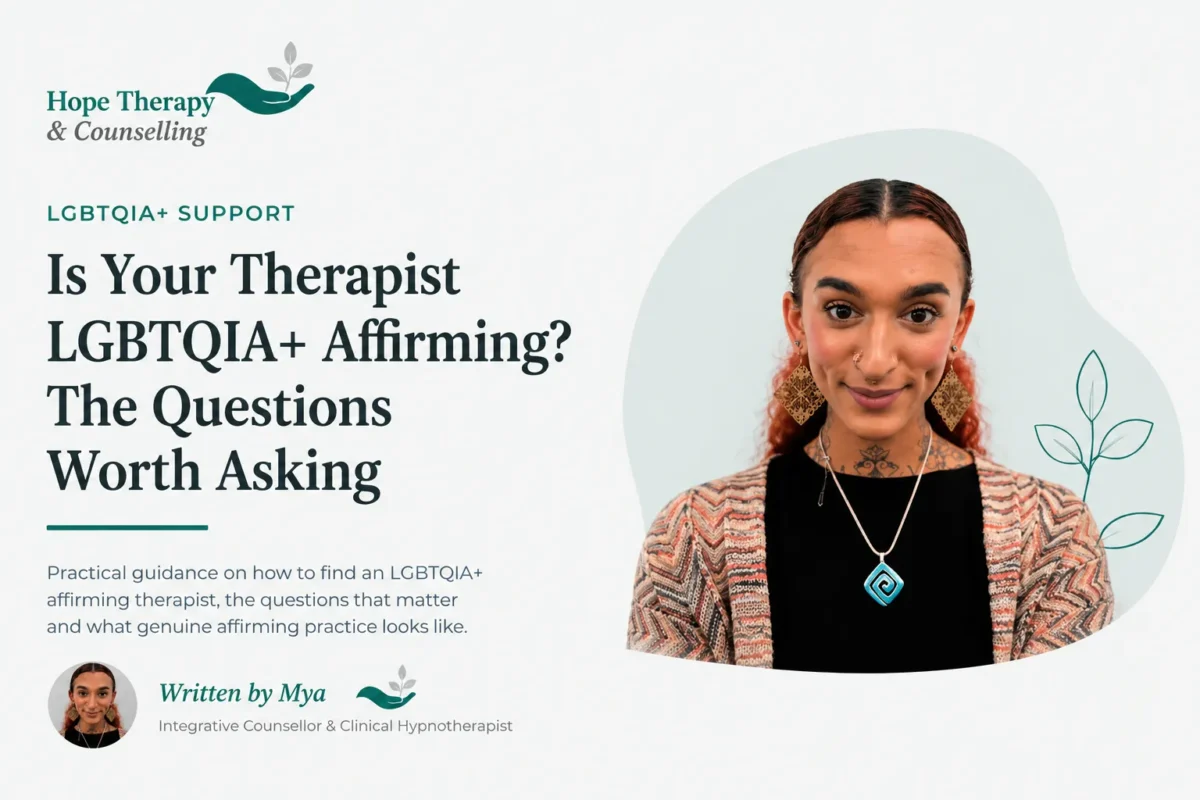
How Do You Know If a Therapist Is Actually LGBTQIA+ Affirming? The Questions Worth Asking
By Mya, MBACPIntegrative Counsellor & Clinical HypnotherapistJune 2026 · 7 min read Most therapists will tell you they…

The Talk Room: Episode 15 – LGBTQIA+ Mental Health – A Compassionate Conversation on Identity and Well-Being
LGBTQIA+ Mental Health podcast: In our exploration of “The Talk Room,” a mental health podcast series dedicated to…

LGBTQIA+ related issues and how Hope Therapy could support these
Although a lot has been achieved in relation to LGBTIQ+ rights, many from the community still face obstacles.…
Meet Our Founder
Built by someone who saw the need from the inside

★
SCoPEd Band C
MBACP & SNCPS Senior Accredited
“Having worked for more than 25 years in senior management, I saw the same thing repeatedly — people struggling with mental health and relationship challenges, and so often struggling to access the right support when it was needed. It was out of this recognition of human need that Hope was born.”
Ian Stockbridge founded Hope Therapy after 25+ years leading large commercial teams – watching colleagues carry stress, anxiety, and personal difficulty with nowhere to turn. He retrained rigorously, now holding Senior Accredited status with both the BACP and NCPS, alongside SCoPEd Band C — the highest independent competence verification in the UK counselling profession.
He remains a practising therapist, clinical supervisor, published author of PMDD Uncovered, and co-presenter of The Talk Room Podcast. Hope Therapy was built on the things he saw were most broken – and designed, from the ground up, to do better.
MBACP (Senior Accredited)
SNCPS (Acc)
SCoPEd Band C
BSc (Hons) CBT
PGCert Supervision L7
Quality Award 2024 — 95%+


You deserve to feel as whole as you already are
A free, no-obligation 15-minute conversation. No pressure, no script — just a chance to be heard, ask questions, and see whether we feel like the right fit.
Get in Touch
Start your enquiry
Not sure where to start? Send us a message and a member of our team will get back to you. All enquiries are treated in the strictest confidence.
★ ★ ★ ★ ★
“From the very first phone call, I felt heard. They didn’t rush me — they helped me work out what I needed.”
Hope Therapy enquiry feedback
NCPS Organisational Member
Est 2014
90+ Qualified Therapists

National Counselling & Psychotherapy Society
British Association for Counselling and Psychotherapy

British Association for Behavioural & Cognitive Psychotherapies
Individual registrations vary per therapist. Last reviewed: May 2026.