LGBTQIA+ Counselling
Coming out is not one conversation — it is a process
Counselling for LGBTQIA+ people at any stage of coming out — to family, at work, later in life, or to yourself. A space to think it through, at your own pace.
NCPS Organisational Member
LGBTQIA+ experienced therapists
Free 15-minute consultation

5,000+
People supported
90+
Qualified therapists
5 ★
Website Testimonials
20+
Counties across England
It is rarely just one moment
Coming out is often talked about as though it were a single event — a conversation, a confession, a before and after. But for most people, it is not like that at all. It is something that happens in stages, over time, with different people, in different contexts, and at different levels of readiness. You may come out to a close friend years before you tell your parents. You may be open in your personal life but not at work. You may still be in the earliest stages — coming out to yourself — and not yet sure what that means or what you want to do about it.
All of that is completely normal. There is no right way to do this and no timeline you should be following. Counselling can offer a space to think it through — somewhere you do not have to manage anyone else’s reaction, explain yourself, or have it all worked out before you speak.
Why people seek support
What coming out can bring up
The decision to come out — or to start thinking about it — can stir up a wide range of feelings. Some of them are welcome: relief, excitement, a sense of finally being honest about who you are. Others are harder: anxiety about how people will respond, fear of losing relationships, grief for the life you thought you would have, confusion about what this means for your future.
Many people find that the hardest part is not the coming out itself, but the period before — the weighing up, the imagining of worst-case scenarios, the exhaustion of carrying something you cannot easily put down. If that is where you are right now, you are not alone in it, and you do not have to sit with it by yourself.
Some of the things our clients bring to counselling around coming out include the anxiety of not knowing how people will react; fear of rejection from family, friends, or a partner; the particular pressure of coming out later in life — when you may have an established relationship, children, or a career built around a version of yourself that no longer feels true; worries about coming out at work and what it might mean for how you are treated; the internal conflict between what you feel and what you were brought up to believe; and the strange, sometimes disorienting mix of grief and liberation that can come with finally saying something out loud.
How counselling can help
Counselling around coming out is not about being told what to do. It is not about being pushed in any direction — towards coming out, or away from it. It is a space where you can say what you are actually thinking, without editing yourself for someone else’s comfort.
Your therapist will not have an agenda for you. They will not assume that coming out is the right thing to do, or the wrong thing, or that it needs to happen on any particular schedule. What they will do is listen — properly — and help you work through what you want, what you are afraid of, and what feels right for you. That might sound simple, but for many people it is the first time they have had that kind of space.
At Hope Therapy, we take care to match you with a therapist who has genuine experience of working with LGBTQIA+ clients. Some of our therapists identify as LGBTQIA+ themselves. Others are experienced allies who have undertaken specific training in this area. What matters is that you do not have to spend the session explaining the basics — you can get straight to what is actually on your mind.
Coming out later in life
When it happens in your 30s, 40s, 50s, or beyond
Coming out later in life brings its own particular complexities. You may have spent decades in a heterosexual relationship. You may have children. You may have built a career, a social life, and an identity around a version of yourself that you now realise does not tell the whole story. Recognising that — and working out what to do about it — can feel overwhelming.
There can be a sense of lost time, or of guilt towards a partner who did not know. There can be fear about how your children will respond, or how your parents will take it at their age. There can be a feeling of not fitting in — too old for the communities you see online, too newly out to feel confident in spaces where other people seem to have it all worked out.
None of that means you are doing it wrong. Coming out at any age takes courage, and the fact that your life is more complex does not make your feelings less valid. Counselling can help you think through the practical and emotional dimensions of this transition — at your own pace, and without anyone telling you how it should go.
Coming out at work
The workplace dimension
For many people, work is one of the last places they come out — and sometimes the place where it feels most difficult. Research from Stonewall found that 39% of LGBTQ+ employees still feel the need to hide their identity at work. More than one in four have experienced verbal abuse from colleagues or clients because of who they are.
The workplace adds layers that personal relationships do not always have: concerns about career progression, the behaviour of colleagues you did not choose, the culture of your industry, the gap between official diversity policies and how things actually feel day to day. You may want to be open but not know how it will be received. You may already be out in other areas of your life and managing the dissonance of being a different version of yourself at work.
Counselling can help you think through what you want from your working life and how — or whether — coming out at work fits into that. It can also help you process the stress of concealment if you are not yet ready, without any pressure to act before you feel prepared.
Our Approach
How we work
We offer a range of therapeutic approaches, tailored to what is most useful for you.
Our booking team and your therapist will discuss which approach — or combination — feels most appropriate for what you are bringing. You do not need to know which is right before you start.
What our clients say
Real experiences
★ ★ ★ ★ ★
Coming out later in life brought up so much I had not expected. My counsellor helped me process it without judgment — and without making my identity the ‘problem’ to solve. Exactly what I needed.
amie who sought support for coming out
★ ★ ★ ★ ★
I had been going back and forth for years about whether to tell my family. Having somewhere to think it through — without being pushed — made all the difference. I finally felt ready on my own terms.
Taylor, who sought support around coming out to family
★ ★ ★ ★ ★
Online sessions meant I could access support discreetly while I was still figuring things out. The matching process found me someone with real LGBTQ+ experience. I could not have asked for better.
Sam, who accessed LGBTQIA+ counselling online
Client experiences are unique. Results vary between individuals.
Getting started
What to expect
Taking the first step can feel daunting — here is how the process works.
1
Free consultation
A brief, relaxed 15-minute conversation with a member of our booking team. We listen to what you are looking for, answer any questions, and explore whether we can help. No pressure, no obligation.
2
Matched with a therapist
We carefully match you with a therapist based on your needs, preferences, and what matters to you — including relevant LGBTQIA+ experience. With 90+ qualified therapists, we take care to find the right fit.
3
Your first session
Your therapist will take time to understand your situation and what you are hoping to work on. There is no rush, no script, and nothing you have to share before you are ready.
Most clients hear back from us the same working day, and typically begin sessions within a week of the free consultation — depending on your preferences and therapist availability.
Standards you can trust
How we match you with the right therapist for coming out support
Choosing a therapist is a personal decision, and we take time to get the match right.
A careful match, not a long list
Therapist availability changes from week to week, so rather than asking you to choose from a directory, we take time during your free 15-minute consultation to understand what you are looking for — and then match you with a therapist suited to your needs.
During the consultation, we will ask about:
- What you would like the work to focus on, and any specific concerns
- Whether you would prefer face-to-face, online, or combination
- Any preferences around therapy approach (counselling, CBT, EMDR, hypnotherapy, mindfulness, ACT, compassion focused therapy and others)
- Day and time availability
- Any specialisms (LGBTQIA+ affirming, neurodiversity-affirming, particular life experiences)
- Practical preferences (therapist gender, age range, shared lived experience)
All therapists we work with are qualified and registered with appropriate UK professional bodies, and we will confirm the most suitable options with you before any sessions begin.
Professional standards across our team
Hope Therapy & Counselling Services has been operating since 2014, and we hold Organisational Membership with the National Counselling & Psychotherapy Society (NCPS). We work in line with the NCPS Code of Ethics and BACP Good Practice, and our wider clinical standards include:
- Qualified, professionally registered therapists across the team — registrations vary per therapist and are confirmed before matching
- Ongoing clinical supervision in line with professional body requirements
- Continuing professional development to maintain and develop practice
- Clear confidentiality standards, with limits explained before sessions begin
- Client-centred, non-judgemental and inclusive practice across all areas of identity and experience
- Founder-led clinical oversight from Ian Stockbridge — MBACP (Senior Accredited) – who continues to lead the practice and oversee its standards
Whether you choose face-to-face counselling near you or online therapy from anywhere in the UK, you can expect to be matched with a therapist who is appropriately qualified and suited to the support you are looking for.
Transparent Pricing
Our fees for coming out counselling
No hidden costs. Your therapist and fees are discussed during your free consultation.
Individual Counselling
From £65
per 50-minute session
- Person-centred, CBT or integrative
- Online via Zoom or telephone
- Face-to-face where available
Couples Counselling
From £85
per 50-minute session
- For all relationship structures
- LGBTQIA+ affirming approach
- Online or face-to-face
EMDR
From £95
per 50-minute session
- Trauma-informed processing
- EMDR Association UK trained
- Online or face-to-face
Looking for a more affordable option? We may be able to offer sessions at a reduced rate — just ask during your free consultation.
London clients: Location-adjusted rates may apply. Please ask during your free consultation and we will confirm the exact fee before you commit to anything.
Common Questions
Frequently asked questions
Do I need to have come out before I start counselling?
Not at all. Many people come to counselling before they have told anyone — sometimes before they have fully acknowledged it to themselves. Counselling can be the first place where you say something out loud, and your therapist will meet you wherever you are in that process.
Will my therapist push me to come out?
No. Coming out is a personal decision and your therapist will not direct you towards it or away from it. The work is about helping you understand what you want and what feels right — not about anyone else’s agenda for your life.
I am coming out later in life — is that common?
More common than many people realise. People come out at every age, and the reasons for doing so later in life are varied and deeply personal. There is no expiry date on self-understanding, and our therapists have experience supporting people through this particular kind of transition.
Can you help if I am worried about how my family will react?
Yes. Fear of family rejection is one of the most common reasons people seek counselling around coming out. Your therapist can help you think through what you want to say, to whom, and when — and support you with whatever the response turns out to be. We also have a dedicated page on family rejection and family dynamics if that is something you are particularly concerned about.
Is everything I say in counselling confidential?
Yes. Sessions are confidential in line with professional ethical standards. There are some limited exceptions — for example, where there is a serious risk of harm to you or someone else — and your therapist will explain these clearly before you begin. If you are not yet out, confidentiality is especially important and we take it seriously.
Can I have sessions online?
Yes. All of our counsellors offer sessions online via Zoom or telephone. Many people going through the coming out process find online counselling particularly helpful — it offers privacy, discretion, and accessibility from anywhere in the UK.
From our Blog
Articles you might find helpful
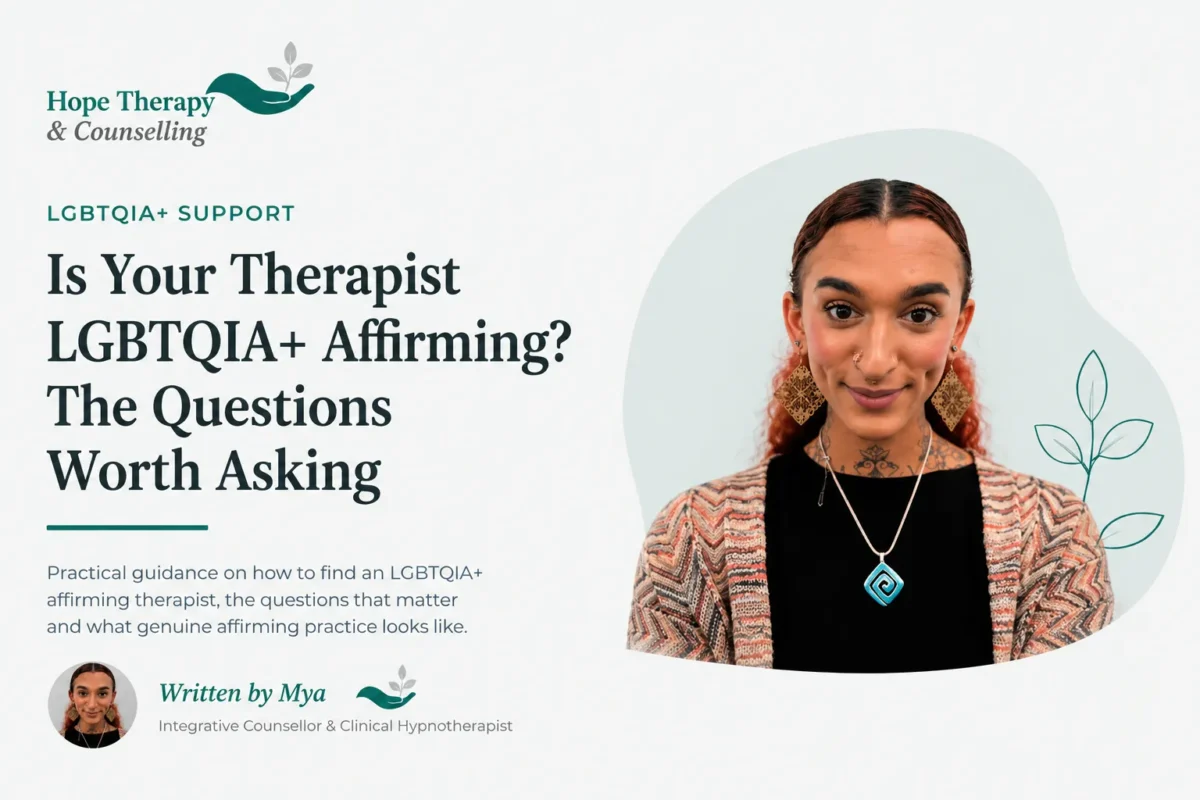
How Do You Know If a Therapist Is Actually LGBTQIA+ Affirming? The Questions Worth Asking
By Mya, MBACPIntegrative Counsellor & Clinical HypnotherapistJune 2026 · 7 min read Most therapists will tell you they…

The Talk Room: Episode 15 – LGBTQIA+ Mental Health – A Compassionate Conversation on Identity and Well-Being
LGBTQIA+ Mental Health podcast: In our exploration of “The Talk Room,” a mental health podcast series dedicated to…

LGBTQIA+ related issues and how Hope Therapy could support these
Although a lot has been achieved in relation to LGBTIQ+ rights, many from the community still face obstacles.…
Meet Our Founder
Built by someone who saw the need from the inside

★
SCoPEd Band C
MBACP & SNCPS Senior Accredited
“Having worked for more than 25 years in senior management, I saw the same thing repeatedly — people struggling with mental health and relationship challenges, and so often struggling to access the right support when it was needed. It was out of this recognition of human need that Hope was born.”
Ian Stockbridge founded Hope Therapy after 25+ years leading large commercial teams – watching colleagues carry stress, anxiety, and personal difficulty with nowhere to turn. He retrained rigorously, now holding Senior Accredited status with both the BACP and NCPS, alongside SCoPEd Band C — the highest independent competence verification in the UK counselling profession.
He remains a practising therapist, clinical supervisor, published author of PMDD Uncovered, and co-presenter of The Talk Room Podcast. Hope Therapy was built on the things he saw were most broken – and designed, from the ground up, to do better.
MBACP (Senior Accredited)
SNCPS (Acc)
SCoPEd Band C
BSc (Hons) CBT
PGCert Supervision L7
Quality Award 2024 — 95%+


You do not have to have it all figured out before you call
A free, no-obligation 15-minute conversation. No pressure, no script — just a chance to be heard, ask questions, and see whether we feel like the right fit.
Get in Touch
Start your enquiry
Not sure where to start? Send us a message and a member of our team will get back to you. All enquiries are treated in the strictest confidence.
★ ★ ★ ★ ★
“From the very first phone call, I felt heard. They didn’t rush me — they helped me work out what I needed.”
Hope Therapy enquiry feedback
NCPS Organisational Member
Est 2014
90+ Qualified Therapists

National Counselling & Psychotherapy Society
British Association for Counselling and Psychotherapy

British Association for Behavioural & Cognitive Psychotherapies
Individual registrations vary per therapist. Last reviewed: May 2026.