LGBTQIA+ Counselling
Your relationship deserves support that understands it
Affirming couples counselling for LGBTQIA+ partnerships of all structures — same-sex, mixed-orientation, polyamorous. Online nationwide and face-to-face across England. From £85 per session.
NCPS Organisational Member
LGBTQIA+ experienced therapists
Free 15-minute consultation

5,000+
People supported
90+
Qualified therapists
5 ★
Website Testimonials
20+
Counties across England
Every relationship has its difficulties — yours deserves support that genuinely understands them
LGBTQIA+ relationships are not inherently more complicated than any other. Research consistently shows that same-sex and gender-diverse couples experience the same levels of relationship satisfaction as their heterosexual counterparts. The love is the same. The commitment is the same. The arguments about whose turn it is to do the washing up are the same.
What is different is the world around you. LGBTQIA+ couples often carry additional pressures that most heterosexual couples never have to think about — the impact of discrimination, the weight of family non-acceptance, the exhaustion of having your relationship questioned or invalidated, the subtle and not-so-subtle ways that society can make even the most ordinary parts of being a couple feel more difficult than they should be. Over time, those pressures can find their way into the relationship itself.
Couples counselling at Hope Therapy is built around understanding those dynamics — not just the universal stuff that affects every relationship, but the particular stressors that come with being LGBTQIA+ in a world that does not always make space for you. Our therapists are affirming, experienced, and genuinely knowledgeable about the realities of LGBTQIA+ partnerships. You will not have to explain why something matters before you can start working on it.
Why couples seek support
What LGBTQIA+ couples bring to counselling
Some of what brings LGBTQIA+ couples to counselling is familiar to any couple — communication difficulties, conflict that keeps repeating, a growing distance that neither of you quite knows how to close. But some of it is shaped by experiences that are particular to LGBTQIA+ relationships.
External pressures can take a real toll. When one or both of you has had a difficult day dealing with a microaggression, a dismissive comment from a family member, or the low-level vigilance of being visibly queer in public, that stress does not stay outside the front door. It comes home with you. Over time, it can make it harder to show up for each other, to communicate clearly, or to feel safe enough to be vulnerable.
Some of the specific issues our therapists work with include managing different levels of outness within a relationship — where one partner is open and the other is not, and the tension that creates; navigating family dynamics when one or both families do not fully accept your relationship; the impact of past experiences of rejection or discrimination on how you relate to your partner; intimacy and connection when external stress is high; mixed-orientation relationships, where one partner’s understanding of their identity has changed; and the particular pressures on LGBTQIA+ couples who are also parents, where questions about family structure, schools, and social acceptance add another layer of complexity.
All partnership structures
No assumptions about what your relationship should look like
We work with LGBTQIA+ couples and partners in all relationship structures. That includes same-sex couples, mixed-orientation partnerships, polyamorous and open relationships, and any other configuration that matters to you. Our therapists will not make assumptions about what your relationship should look like or how it should work. The focus is always on what is important to you and the people you are in relationship with.
If you are in a polyamorous or ethically non-monogamous relationship, you will not have to spend time justifying or explaining that choice. Our affirming approach means your relationship structure is taken seriously from the start, and the work focuses on the issues you are actually there to address — whether that is communication between partners, navigating jealousy or boundaries, managing the logistics of complex arrangements, or something else entirely.
Individual relationship counselling
When one partner comes alone
Not every relationship issue needs both partners in the room. Sometimes one person wants to think through how they are feeling about the relationship before involving their partner. Sometimes a partner is not willing or ready to attend. Sometimes you are processing the end of a relationship and need space to do that on your own terms.
Individual relationship counselling gives you a space to explore what is happening in your relationship — or what has happened — with a therapist who understands the particular dynamics of LGBTQIA+ partnerships. You can work through your own patterns, your responses, and what you want going forward, without needing your partner to be part of that process.
If you later decide that couples work would be helpful, we can arrange that too — either with the same therapist or with a different one, depending on what feels right.
Our Approach
How we work
We offer a range of therapeutic approaches, tailored to what is most useful for you.
Person-Centred Counselling
A non-directive, empathic space to explore your relationship on your own terms. Person-centred counselling can help couples reconnect, improve communication, and understand each other more deeply — without the therapist imposing a particular model of how your relationship should work.
Learn more about counselling →
Our booking team and your therapist will discuss which approach — or combination — feels most appropriate for what you are bringing. You do not need to know which is right before you start.
What our clients say
Real experiences
★ ★ ★ ★ ★
For the first time I did not have to explain my relationship or justify my identity before we could start the actual work. My therapist just got it. That made such a difference to how quickly we were able to open up.
Alex, who sought couples counselling for communication and identity
★ ★ ★ ★ ★
We had been going round in circles with the same argument for months. Our therapist helped us see that most of the tension was coming from outside the relationship — and gave us tools to stop letting it in. We are in a much better place now.
Chris and Jordan, who sought support for recurring conflict
★ ★ ★ ★ ★
Online sessions meant I could access support discreetly while I was still figuring things out. The matching process found me someone with real LGBTQ+ experience. I could not have asked for better.
Sam, who accessed LGBTQIA+ counselling online
Client experiences are unique. Results vary between individuals.
Getting started
What to expect
Taking the first step can feel daunting — here is how the process works.
1
Free consultation
A brief, relaxed 15-minute conversation with a member of our booking team. We listen to what you are looking for, answer any questions, and explore whether we can help. No pressure, no obligation.
2
Matched with a therapist
We carefully match you with a therapist based on your needs, preferences, and what matters to you — including relevant LGBTQIA+ experience. With 90+ qualified therapists, we take care to find the right fit.
3
Your first session
Your therapist will take time to understand your situation and what you are hoping to work on. There is no rush, no script, and nothing you have to share before you are ready.
Most clients hear back from us the same working day, and typically begin sessions within a week of the free consultation — depending on your preferences and therapist availability.
Standards you can trust
How we match you with the right therapist for LGBTQIA+ relationship support
Choosing a therapist is a personal decision, and we take time to get the match right.
A careful match, not a long list
Therapist availability changes from week to week, so rather than asking you to choose from a directory, we take time during your free 15-minute consultation to understand what you are looking for — and then match you with a therapist suited to your needs.
During the consultation, we will ask about:
- What you would like the work to focus on, and any specific concerns
- Whether you would prefer face-to-face, online, or combination
- Any preferences around therapy approach (counselling, CBT, EMDR, hypnotherapy, mindfulness, ACT, compassion focused therapy and others)
- Day and time availability
- Any specialisms (LGBTQIA+ affirming, neurodiversity-affirming, particular life experiences)
- Practical preferences (therapist gender, age range, shared lived experience)
All therapists we work with are qualified and registered with appropriate UK professional bodies, and we will confirm the most suitable options with you before any sessions begin.
Professional standards across our team
Hope Therapy & Counselling Services has been operating since 2014, and we hold Organisational Membership with the National Counselling & Psychotherapy Society (NCPS). We work in line with the NCPS Code of Ethics and BACP Good Practice, and our wider clinical standards include:
- Qualified, professionally registered therapists across the team — registrations vary per therapist and are confirmed before matching
- Ongoing clinical supervision in line with professional body requirements
- Continuing professional development to maintain and develop practice
- Clear confidentiality standards, with limits explained before sessions begin
- Client-centred, non-judgemental and inclusive practice across all areas of identity and experience
- Founder-led clinical oversight from Ian Stockbridge — MBACP (Senior Accredited) – who continues to lead the practice and oversee its standards
Whether you choose face-to-face counselling near you or online therapy from anywhere in the UK, you can expect to be matched with a therapist who is appropriately qualified and suited to the support you are looking for.
Transparent Pricing
Our fees for LGBTQIA+ relationship counselling
No hidden costs. Your therapist and fees are discussed during your free consultation.
Individual Counselling
From £65
per 50-minute session
- Person-centred, CBT or integrative
- Online via Zoom or telephone
- Face-to-face where available
Couples Counselling
From £85
per 50-minute session
- For all relationship structures
- LGBTQIA+ affirming approach
- Online or face-to-face
EMDR
From £95
per 50-minute session
- Trauma-informed processing
- EMDR Association UK trained
- Online or face-to-face
Looking for a more affordable option? We may be able to offer sessions at a reduced rate — just ask during your free consultation.
London clients: Location-adjusted rates may apply. Please ask during your free consultation and we will confirm the exact fee before you commit to anything.
Common Questions
Frequently asked questions
Do we both need to attend couples counselling?
Not necessarily. Couples counselling works best when both partners are willing to engage, but it is also possible for one person to attend alone to work on relationship issues. If your partner is not ready or willing to come, individual relationship counselling can still be helpful. If they later decide to join, that can be arranged.
Do you work with polyamorous and non-traditional relationships?
Yes. Our therapists support people in all relationship structures — including polyamorous, open, and non-traditional partnerships. You will not have to justify or explain your relationship structure before the work can begin. The focus is on what matters to you and what would be most helpful.
Will the therapist take sides?
No. In couples counselling, your therapist is there to support the relationship — not to act as judge or referee. They will help both of you feel heard and understood, and work with you to find ways forward that feel right for both partners.
Can you help if my partner is coming out or questioning their identity?
Yes. This is a situation that many LGBTQIA+ couples face, and it can bring up complex feelings for both partners. Counselling can help you process what this means for your relationship — together or individually — with a therapist who understands the dynamics involved.
Is everything we say in couples counselling confidential?
Yes. Sessions are confidential in line with professional ethical standards. There are some limited exceptions — for example, where there is a serious risk of harm — and your therapist will explain these clearly before you begin. What is discussed in couples sessions stays in that space.
How much does LGBTQIA+ couples counselling cost?
Couples counselling starts from £85 per 50-minute session. Individual counselling starts from £65. If cost is a concern, we may be able to offer sessions at a reduced rate — just ask during your free consultation. Your therapist and exact fees are confirmed before any sessions begin.
From our Blog
Articles you might find helpful
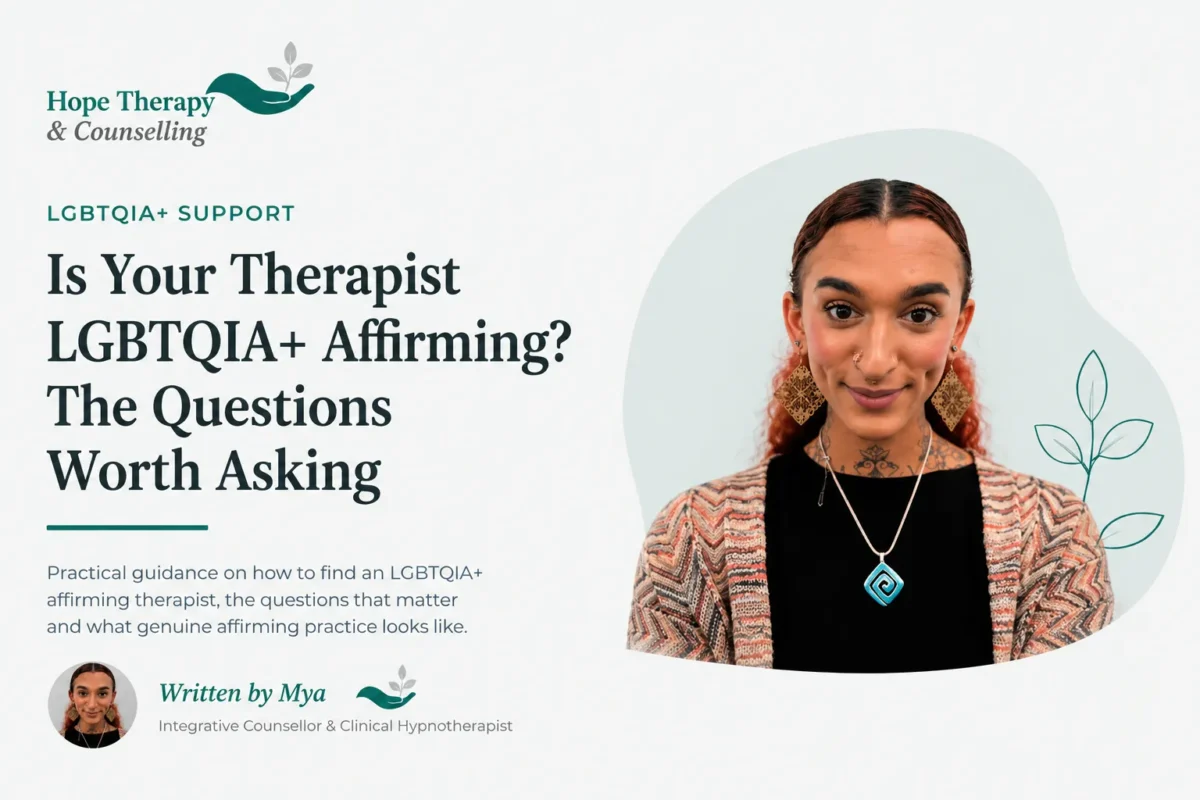
How Do You Know If a Therapist Is Actually LGBTQIA+ Affirming? The Questions Worth Asking
By Mya, MBACPIntegrative Counsellor & Clinical HypnotherapistJune 2026 · 7 min read Most therapists will tell you they…

The Talk Room: Episode 15 – LGBTQIA+ Mental Health – A Compassionate Conversation on Identity and Well-Being
LGBTQIA+ Mental Health podcast: In our exploration of “The Talk Room,” a mental health podcast series dedicated to…

LGBTQIA+ related issues and how Hope Therapy could support these
Although a lot has been achieved in relation to LGBTIQ+ rights, many from the community still face obstacles.…
Meet Our Founder
Built by someone who saw the need from the inside

★
SCoPEd Band C
MBACP & SNCPS Senior Accredited
“Having worked for more than 25 years in senior management, I saw the same thing repeatedly — people struggling with mental health and relationship challenges, and so often struggling to access the right support when it was needed. It was out of this recognition of human need that Hope was born.”
Ian Stockbridge founded Hope Therapy after 25+ years leading large commercial teams – watching colleagues carry stress, anxiety, and personal difficulty with nowhere to turn. He retrained rigorously, now holding Senior Accredited status with both the BACP and NCPS, alongside SCoPEd Band C — the highest independent competence verification in the UK counselling profession.
He remains a practising therapist, clinical supervisor, published author of PMDD Uncovered, and co-presenter of The Talk Room Podcast. Hope Therapy was built on the things he saw were most broken – and designed, from the ground up, to do better.
MBACP (Senior Accredited)
SNCPS (Acc)
SCoPEd Band C
BSc (Hons) CBT
PGCert Supervision L7
Quality Award 2024 — 95%+


Your relationship is worth investing in
A free, no-obligation 15-minute conversation. No pressure, no script — just a chance to be heard, ask questions, and see whether we feel like the right fit.
Get in Touch
Start your enquiry
Not sure where to start? Send us a message and a member of our team will get back to you. All enquiries are treated in the strictest confidence.
★ ★ ★ ★ ★
“From the very first phone call, I felt heard. They didn’t rush me — they helped me work out what I needed.”
Hope Therapy enquiry feedback
NCPS Organisational Member
Est 2014
90+ Qualified Therapists
National Counselling & Psychotherapy Society
British Association for Counselling and Psychotherapy
British Association for Behavioural & Cognitive Psychotherapies
Individual registrations vary per therapist. Last reviewed: May 2026.